Thursday, July 30, 2020

Testing masks for teaching

I had three family members turn away from me while I read two prepared philosophical sentences, using three different masks and no mask, and they ranked each reading for comprehensibility. The scale is:
  1. Incomprehensible
  2. Somewhat comprehensible
  3. Mostly comprehensible
  4. Comprehensible
  5. Completely clear
Here are the results:
  • No mask: 5.0
  • Cheap ebay "KN95": 4.3
  • Sonovia cloth antiviral mask (modified with nose wire): 3.7
  • Surgical mask: 4.7
The ordering between these also matches how I sounded to myself. Since the surgical masks provide very little in the way of protection--I can feel lots of air leaking around the edges--I think I will teach in the "KN95". Maybe I will try to tighten the straps on it for better fit.

For pictures and further descriptions of the masks, see my mask collection.

I would love to hear comments suggesting other options. Those of us who are not in a high risk category are expected to be teaching in person in the fall--with students and faculty all wearing masks, and with social distancing apparently less than 6 feet--and if anyone has ideas that balance comprehensibility with protection, I would love to hear them. Unfortunately, I don't project well normally when I speak.

Reproduction and the holiness of God

  1. Necessarily, every finite person is in the image and likeness of God.

  2. We should not make something in the image and likeness of God except when we have good positive reason to think God gave us permission to do so.

  3. The only case in which we have good positive reason to think God gave us permission to make something in the image and likeness of God is through marital intercourse.

  4. So, we should not engage in either in-vitro fertilization or the production of strong Artificial Intelligence.

The philosophically difficult task here would be to analyze the concept of “image and likeness of God”. The main controversial premise in the argument, however, is (2). I think it somehow follows from the holiness of God.

Wednesday, July 29, 2020

My mask collection

Just as different pairs of shoes are useful for different occasions, different masks are useful for different occasions. Here's my collection.

Category 1: Likely to be significantly protective

1.1. 3M 6300 half-face mask with 2091 P100 filters

Summary: Should be extremely protective for inhalation. The fit of the soft silicone and the adjustable head-straps is excellent. It is easy to breathe through thanks to the large surface area of the filters. And while the original mask has an exhalation valve, and hence doesn't protect others much, I added a 3D printed filter over the exhalation valve, loaded with surgical mask material. As a result, the mask is highly protective of the wearer and probably more protective of others than many other masks, due to the much better fit.

My use cases: Church and shopping.

Down-sides: (1) thanks to the vibrating inhalation and exhalation valves and the thick silicone, I am barely audible through this mask, so I avoid wearing it in situations where I need to communicate with someone; (2) the mask is bulky, which makes it less good for sports; (3) the filters are expensive; (4) can leak around edges on exhalation when breathing extremely hard due to strenuous physical activity.

1.2. Sonovia cloth mask with antiviral and antibacterial coating

Summary: These are the most expensive cloth masks I've seen ($53-69 each, depending on quantity). I learned about these from my mom. My first thought was that they are a scam, but as far as I can tell (but then, this is not my field) they are made by a legitimate Israeli company, backed by serious scientists (including a Nobel prize winner), and their antiviral and antibacterial copper coating apparently really does work, and lasts many cycles of washing. I got a pack of three of these (at the time, they didn't sell them individually) so my daughter could attend her (outdoor, socially distanced) high school graduation.

Unfortunately, out of the box they don't come with a nose wire, which makes the fit poor. However, it was easy to cut a seam, insert a wire and sew it closed, and now the fit is much better. They have better fit for inhalation than exhalation in my experience: if I don't adjust the straps just right, I can feel exhaled air escaping at the cheeks, but they close tight around the nose and mouth for inhalation, providing what feels like a solid seal. A nice bonus of the antiviral coating is that I do not worry about the surface of the mask being contaminated.

My use cases: When I want significant protection but also want to be able to talk, or when the 3M mask is too bulky for convenience.

Disadvantages: More difficult to breathe through than some other options, especially if drenched with sweat. When our climbing facility reopened, I climbed in this mask the first day, but when it got wet while I was climbing laps, I felt like I was drowning for lack of air.

Category 2: Likely to be moderately protective

2.1. Home-made two-layer fitted mask often paired with surgical mask

I made this from one layer of T-shirt cotton and one layer of microfiber cleaning cloth, after looking at the sizes of holes in various fabrics under a microscope. I used this pattern, enhanced with a nose wire. The fit feels superb: I don't feel the tell-tale feel of air rushing past my skin around the edges on either inhalation or exhalation. Back when I didn't have the better masks above, when I went to high risk destinations like the grocery store or church, I would sometimes put a surgical mask under it, thereby increasing the number of layers of filtration while at the same time pressing the surgical mask to my face and hence improving the surgical mask's rather terrible fit.

2.2. Ebay "KN95"

These were so cheap ($10 for ten, and I've since gotten a similar pack of ten for $5) that notwithstanding apparent Chinese certifications, I wouldn't be surprised if they were fake KN95s (and that makes me feel good about not taking protective equipment away from medical staff). However, even if they don't reach the filtration level of a real (K)N95, they fit acceptably, and I suspect--admittedly, without testing--they provide better filtration than home-made cloth options. When breathing very hard--namely, during strenuous physical activity, I can feel air rushing out by the edges of the mask at inhalation, but the mask seems to seal to the face on inhalation. Moreover, I can breathe through it even when very sweaty. I reuse these, following the advice of the N95 inventor to just have multiple masks labeled with days of the week and let them self-disinfect over the period of a week.

My use case: Indoor rock climbing.

Disadvantages:(1) suspiciously low price; (2) poor fit on exhalation

Category 3: Less likely to be moderately protective

3.1. "Surgical" mask

Summary: We have these hanging about in various places and they are convenient to toss on quickly. I can feel they leak around the edges. They are so cheap ($10 for 50 on ebay, if memory serves me) that I doubt they are serious medical protective equipment, so I feel OK about using them.

My use cases: mainly for brief contact with someone (e.g., when picking up a drive-through order in the car)

Disadvantages: Leaks around edges.

3.2. Reebok athletic mask

Summary: These are easy to breathe through, but I have no idea how much protection they provide. They are great for athletic endeavors when one is so far from people outside one's household (e.g., when playing badminton with a family member on an indoor court) that the only reason for a mask is to satisfy the rules rather than protection.

My use cases: Indoor racquet sports when alone on a court with my son. I use a better mask when closer to staff while checking into the facility.

Disadvantages: Leaks at nose bridge causing fogging in sports that require goggles (e.g., racquetball).

Category 4: Not protective

4.1. Home-made single layer T-shirt mask

Summary: I sewed these quickly from an old T-shirt and a piece of wire. Sometimes one needs a mask to satisfy rules but where realistically protection of self or others is not an issue. For instance, an outdoor facility where one can easily distance oneself from others, or while alone on an indoor court with a family member.

Use cases: I toss these in our tennis bag in case I need to go to the bathroom in my department's building after hours when I am unlikely to meet another human in the building, but the university still requires face covering. Also, outdoors at our marina.

Disadvantages: Minimal to non-existent protection of self or others.

4.2. Bandana

Summary: This provides very little protection indeed, since I can feel most of the air coming in and out around the bottom, but it does not leak much around the top and hence works well with racquetball goggles.

Use case: When I play racquetball alone in a court with a family member, the main reason to wear the face covering is to satisfy the facility rules. I am careful to wear a better mask in other areas of the building where there is closer proximity to others, such as when signing in.

Disadvantages: Minimal to non-existent protection of self and others.

Tuesday, July 28, 2020

Independence and probability

Thesis: If we stick to real-numbered probabilities, genuine independence of events A and B cannot be defined in terms of any condition on the conditional probabilities P(X|Y) where X and Y are events can be constructed from A and B by using the boolean operations of union, intersection and complement, even if the conditional probabilities are taken to be primitive rather than defined as ratios.

Argument: Suppose that three genuinely independent darts are thrown uniformly at the interval [0, 1], and consider the events:

  • A: the first dart hits [0, 1/2) or the third hits 1/2

  • B: the second dart hits [0, 1/2) or the third hits 1/2.

The events A and B are not genuinely independent. The third dart’s hitting 1/2 would guarantee that both events A and B happen. But it is easy to check that the conditional probabilities for any boolean combination of A and B are exactly the same as for the corresponding boolean combination of A′ and B′, where:

  • A′: the first dart hits [0, 1/2)

  • B′: the second dart hits [0, 1/2).

So, conditional probabilities can’t distinguish the non-genuinely independent pair A and B from the genuinely independent pair A′ and B′.

Nor should we mind this fact. For genuine independence is a concept about causation or rationality, while probabilities give us a statistical concept.

Monday, July 27, 2020

Loading infinitely many coins

Suppose I have infinitely many coins and I toss them. I then load each of them equally in favor of heads and toss them all again. All the tosses are independent.

Trick question: Was it more likely that they all landed tails on the second toss or on the first?

Although it seems more likely on the first, the correct answer has to be neither. Here’s one way to see it. Let’s imagine for simplicity that the second set of coins is physically distinct from the first, and that all the coins—the loaded and the unloaded—are tossed simultaneously. That shouldn’t make any difference to the comparison. But now let’s suppose that the loaded coins are such that the probability of heads is 3/4 for each coin. Now, line up the coins in such a way that two fair coins are put beside each loaded one. The probability that both of the fair coins land tails is 1/4. The probability that the loaded coin lands tails is 1/4. To get all the fair coins landing tails thus shouldn’t be any more likely than to get all the loaded coins landing tailings, or vice versa. And if the loading is different, we just tweak the arrangement.

So, either the event of all the fair coins landing tails is equal in probability with the event of all the loaded coins landing tails, or the two events cannot be compared in probability.

Wednesday, July 22, 2020

In-vitro fertilization and artificial intelligence

Catholics believe that:

  1. The only permissible method of human reproduction is marital intercourse.

Supposing we accept (1), we are led to this interesting question:

  1. Is it permissible for humans to produce non-human persons by means other than marital intercourse?

It seems to me that a positive answer to (2) would fit poorly with (1). First of all, it would be very strange if we could, say, clone Homo neanderthalensis, or produce them by IVF, but not so for Homo sapiens. But perhaps “human” in (1) and (2) is understood broadly enough to include Neanderthals. It still seems that a positive answer to (2) would be implausible given (1). Imagine that there were a separate evolutionary development starting with some ape and leading to an intelligent hominid definitely different from humans, but rather humanlike in behavior. It would be odd to say that we may clone them but can’t clone us.

This suggests to me that if we accept (1), we should probably answer (2) in the negative. Moreover, the best explanation of (1) leads to a negative answer to (2). For the best explanation of (1) is that human beings are something sacred, and sacred things should not be produced without fairly specific divine permission. It is plausible that we have such permission in the case human marital coital reproduction, but we have no evidence of such permission elsewhere. But all persons are sacred (that’s one of the great lessons of personalism). So, absent evidence of specific divine permission, we should assume that it is wrong for us to produce non-human persons by means other than marital intercourse. Moreover, it is dubious that we have been given permission to produce non-human persons by means of marital intercourse. So, we should just assume that:

  1. It is wrong for us to produce non-human persons.

Moreover, if this is wrong, it’s probably pretty seriously wrong. So we also shouldn’t take significant risks of producing non-human persons. This means that unless we are pretty confident that a computer whose behavior was person-like still wouldn’t be a person, we ought to draw a line in our AI research and stop short of the production of computers with person-like behavior.

Do we have grounds for such confidence? I don’t know that we do. Even if dualism is true and even if the souls of persons are directly created by God, maybe God has a general policy of creating a soul whenever matter is arranged in a way that makes it capable of supporting person-like behavior.

But perhaps is reasonable to think that such a divine policy would only extend to living things?

Tuesday, July 21, 2020

Do Popper functions carry enough information?

Let P be a Popper function on some algebra F of events on Ω. There is a natural way to define a probability comparison given P, namely A ⪅ B iff P(A|A ∪ B)≤P(B|A ∪ B), which I think I’ve used before. Unfortunately, this can violate a common axiom of probability comparisons, namely that A ⪅ B iff Ω − B ⪅ Ω − A.

For instance, consider the Popper function generated by a regular hyperreal probability on [0, 1] whose standard part agrees with Lebesgue measure on intervals. Then [0, 1]⪅[0, 1), since both have conditional probability 1 on [0, 1]∪[0, 1)=[0, 1]. But their complements are ∅ and {1}, respectively, and {1}⪅∅ is false.

This little fact may have some significance. There is a theorem in the literature that shows a correlation between Popper function and hyperreal probabilities: every Popper function with all non-empty sets regular can be generated from a normal hyperreal probability using the conditional probability formula, and given a Popper function with all non-empty sets regular there is a normal hyperreal probability from which the Popper function can be generated. This has led to a debate whether it’s better to work with Popper functions or hyperreal probabilities. One argument for working with Popper functions—an argument I’ve approved of in print—is that the hyperreal probabilities carry more information than reality does. I still think that this problem is there for hyperreal probabilities. But the above argument suggests that going to a Popper function may have discarded too much information. Popper functions allow for fine-grained comparisons of “small” events, such as singletons, but not for the complements of these events.

Monday, July 20, 2020

Complete conditional probabilities, infinitesimal probabilities and two easy Frankenstein facts

Suppose we have a complete finitely-additive conditional probability P(⋅|⋅) on some algebra F of events on a space Ω (i.e., P is a Popper function with all non-empty sets regular), so that P(A|B) is defined for every non-empty B.

Here’s a curious thing: there is a very large disconnect between how P behaves when conditioning on sets of zero measure and when conditioning on sets of non-zero measure.

Here’s one way to see the disconnect. Consider any other complete finitely additive conditional probability Q(⋅|⋅) on the same algebra F, and suppose that Q assigns unconditional measure zero to everything that P does: i.e., if P(A|Ω)=0, then Q(A|Ω)=0.

Then, Frankenstein-fashion, we can sew P and Q into a new conditional probability R where R(A|B)=P(A|B) if P(A|Ω)>0 and R(A|B)=Q(A|B) if P(A|Ω)=0. In other words, R behaves exactly like P when conditioning on non-zero measure sets and exactly like Q when conditioning on zero measure sets.

[To check that R is a conditional probability, the one non-trivial condition to check here is that R(A ∩ B|C)=R(A|C)R(B|A ∩ C). Suppose P(C|Ω)=0. Then the equality follows from the corresponding equality for Q. Suppose P(C|Ω)>0. If P(A ∩ C|Ω)>0 as well, then our equality follows from the corresponding equality for P. Suppose now that P(A ∩ C|Ω)=0. Then the equality to be demonstrated is equivalent to P(A ∩ B|C)=P(A|C)Q(B|A ∩ C). But if P(A ∩ C|Ω)=0, then P(A ∩ B|C)=0 and P(A|C)=0.]

There is an analogous Frankenstein fact for infinitesimal probabilities. Let P and Q be any two finitely-additive probabilities with values in some hyperreal field, and suppose that Q is tiny whenever P is tiny, where a hyperreal is “tiny” provided that it is zero or infinitesimal. Then there is a Frankenstein probability R = Std P + Inf Q, where Std x and Inf x are the standard and infinitesimal parts of a finite hyperreal. (The fact that Q is tiny when P is tiny is used to show that R is non-negative.) This R then has the same large-scale (i.e., standard scale) behavior as P and small-scale behavior as Q.

In other words, as we depart from classical probability, we get a nearly complete disconnect between small-scale and large-scale behavior.

Friday, July 17, 2020

Arbitrariness, regularity and comparative probabilities

In “Underdetermination of infinitesimal probabilities”, following a referee’s suggestion, I allow that qualitative (i.e., comparative) probabilities may escape arbitrariness problems for infinitesimal probabilities. But I now think this may be wrong.

Consider an infinite line of independent fair coins, numbered with the integers ..., −2, −1, 0, 1, 2, .... Let Rn be the hypothesis that coins n, n + 1, ... are all heads. Let Ln be the hypothesis that coins ..., n − 2, n − 1, n are all heads.

Suppose “being less likely or equally likely” is transitive, reflexive and total. Write A < B for A being less likely than B, A ≈ B for A and B being equally likely, and A ⪅ B for A being less likely or equally like than B.

We have strong regularity provided that if event A is a proper subset of event B, then A is strictly less likely than B.

Given strong regularity, the events Ln are strictly decreasing in probability: ... > L−2 > L−1 > L0 > L1 > ... and the events Rn are strictly increasing in probability: ... < R−2 < R1 < R0 < R1 < ....

Theorem: Given strong regularity, exactly one of the following options is true:

  1. For all n and m, Ln < Rm (heads-runs are right-biased)

  2. For all n and m, Rm < Ln (heads-runs are left-biased)

  3. There is a unique n such that for all m ≤ n we have Rm ⪅ Lm and for all m > n we have Lm < Rm (there is a switch-over point at n).

But if (1) or (2) is true, it is difficult to see what objective reality could possibly ground whether heads-runs are right-biased or left-biased in our infinite sequence of coin tosses. And if (3) is true, it is difficult to see what objective reality could possibly make n be a switch-over point. The choice between left- and right-bias seems completely arbitrary, and the choice of a switch-over point is also arbitrary.

The Theorem follows from the following lemma:

Lemma: Let (S, ⪅) be a totally preordered set, and let Ln and Rn be sequences of members of S as n ranges over the integers. Suppose Ln is strictly decreasing and Rn is strictly increasing. Then exactly one of the following is true:

  1. For all n and m, Ln < Rm

  2. For all n and m, Rm < Ln

  3. There is a unique n such that for all m ≤ n we have Rm ≤ Lm and for all m > n we have Lm < Rm.

Proof of Lemma: Suppose that for all n we have Ln < Rn. I claim that (1) is true. For suppose that (1) is false and hence (by totality) we have Rm ⪅ Ln for some m and n. Then m ≠ n, since Ln < Rn. Either m < n or n < m. If m < n, then Rm ⪅ Ln < Lm, and if m > n, then Rn < Rm ⪅ Ln. In either case we have a violation of the fact that Ln < Rn for all n′.

Now suppose that for all n we have Rn < Ln. I now claim that (2) is true. For if (2) is false, we have Ln ⪅ Rm for some m ≠ n. Suppose m < n. Then Ln ⪅ Rm < Rn, a contradiction. And if n < m, then Lm < Ln ⪅ Rm, also a contradiction.

Let A(n) be the statement that for all m ≤ n we have Rm ⪅ Lm and for all m > n we have Lm < Rm. There is at most one n such that A(n). For suppose that we had A(n) and A(n′) and that n < n′. Then by A(n) we have Ln < Rn (since n′>n), and by A(n′) we have Rn ⪅ Ln, resulting in a contradiction.

Assume (1) and (2) are false. By what we have shown earlier and totality, if (2) is not true, there is an n such that Ln ⪅ Rn. Note that if Ln ⪅ Rn, then Lm < Ln ⪅ Rn < Rm for all m > n. Hence, either Ln ⪅ Rn is true for all n or else there is a smallest n for which it’s true. If it’s true for all n, then for all n we have Ln + 1 < Ln ⪅ Rn < Rn + 1, and hence for all n we have Ln < Rn, which we saw would imply (1), which we assumed to be false.

So suppose that n is the smallest integer for which Ln ⪅ Rn. Thus, Rm < Lm whenever m < n. Moreover, since Li is strictly decreasing and Ri is strictly increasing, we have Lm < Rn whenever m > n. There are now two possibilities. Either Ln < Rn or Ln ≈ Rn. If Ln ≈ Rn, then we have A(n) and the proof is complete. Suppose now that Ln < Rn. Then we have A(n − 1) and the proof is also complete.

Symmetry, regularity and qualitative probability

Let ⪅ be a qualitative probability comparison for some collection F of subsets of a space Ω. Say that A ≈ B iff A ⪅ B and B ⪅ A, and that A < B provided that A ⪅ B but not B ⪅ A. Minimally suppose that ⪅ is a partial preorder (i.e., transitive and reflexive). Say it’s total provided that for all A and B either A ⪅ B or B ⪅ A. Suppose that G is a group of symmetries acting on Ω, and that F is G-invariant in the sense that gA ∈ F for all g ∈ G. Then we can define:

  1. ⪅ is strongly G-invariant provided that for all A in G and all g in G we have A ≈ gA, and

  2. ⪅ is weakly G-invariant provided that for all A and B in G and all g in G we have A ⪅ B iff gA ⪅ gB.

There is some reason to be suspicious of strong G-invariance. For in some interesting cases, say where Ω is a circle that G is the set of all rotations, there will be cases where gA is a proper subset of A, and by regularity we would expect to have gA < A rather than gA ≈ A. But weak G-invariance seems harder to question.

Say that g ∈ G is of order n provided that gn = e, where e is identity. However, we also have:

Lemma 1. If ⪅ is total, g is of order 2, and A ⪅ B implies gA ⪅ gB for all A and B, then A ≈ gA for all A.

Proof: Since ⪅ is a total order, either A ⪅ gA or gA ⪅ A. Suppose A ⪅ gA. Then gA ⪅ g2A. But g2A = A. Hence gA ≈ A. Similarly, if gA ⪅ A, then g2A ≈ gA. But g2A = A, so gA ≈ A.

So, we have:

Proposition 1. If ⪅ is total and G is a group generated by elements of order 2, then weak G-invariance entails strong G-invariance.

Say that ⪅ is strongly regular provided that if A is a proper subset of B, then A < B. Weak regularity would say that if B is non-empty then ∅ < B. Weak regularity together with an appropriate additivity condition will imply strong regularity (details left to the reader).

Proposition 2. If G is generated by elements of order 2, and ⪅ is total and weakly G-invariant, then if there exists a g ∈ G and A ∈ F such that gA is a proper subset of A, then G is not strongly regular.

Proof: Strong regularity would require that gA < A, but that would contradict strong G-invariance which we have by Proposition 1.

Corollary 1. If F is a collection of subsets of the unit circle containing all countable sets and invariant under all reflections, and ⪅ is a total qualitative probability comparison weakly invariant under all reflections, then ⪅ is not strongly regular.

Proof: The group generated by all reflections includes all rotations. But there is a subset A of the circle and a rotation g such that gA is a proper subset of A. For instance, let A be the set of points at angles r, 2r, 3r, ... in degrees, where r is irrational, and let g be rotation by r. Then rA is the set of points at angles 2r, 3r, 4r, ... in degrees.

Now, imagine an infinite line on which there are infinitely many evenly spaced people, stretching out in both directions, each of whom flips a fair coin. Let Ω be the probability space describing these flips. Let Hn be the event that all the flips starting with person number n (i.e., n, n + 1, n + 2, ...) land heads. Suppose that F contains all the Hn and is invariant under all reflections of the situation (where we reflect the setup either about the point at which some person stands or at a point half-way between two neighboring people).

Corollary 2. If ⪅ is a total qualitative probability comparison weakly invariant under all reflections, then ⪅ is not strongly regular.

Proof: Let G be the group generated by the reflections. This group contains all translations. A non-trivial translation of Hn will either be a proper subset or a proper superset of Hn, depending on the direction of Hn. So by Proposition 2 we cannot have regularity.

Bibliographic note: Lemma 1 and Corollary 2 are analogous to Lemma 2 and Theorem 4 of this paper.

Thursday, July 16, 2020

The choice between qualitative probabilities and generalized quantitative probabilities is illusory

There are two approaches to generalizing probabilities beyond the classical real-valued numerical approach.

  1. Switch the values of the probability function from real numbers to values in some other ordered algebraic entity (e.g., the hyperreals, the surreals, an arbitrary totally ordered monoid).

  2. Switch to qualitative probabilities, where instead of assigning values to events, one just compares the events probabilistically (this one is at least as likely than that one).

In the literature (including stuff I wrote myself!), the qualitative probability approach is treated as more general. But in fact, it’s not, at least not if we assume that the “at least as likely as” relation is transitive and reflexive, i.e., is a partial preorder. For suppose that we have a collection F of events and a partial preorder ⪅ on them. Say that A ≈ B iff A ⪅ B and B ⪅ A. Let V be the set of equivalence classes of events under the relation ≈, and define the partial order ≤ on V by [A]≤[B] iff A ⪅ B, where [A] is the equivalence class of A. (All this makes sense if ⪅ is a partial preorder.) Define P(A)=[A].

And that’s it! You now have a probability function P on F whose values are a partially ordered set V. So, what you do with qualitative comparisons you can do with values. Now that I’ve said it, it’s obvious to me and I’m kicking myself for not noticing it earlier. Perhaps some people in the field have noticed it and found it so obvious that it’s not worth saying.

And rather than thinking of there being a debate between probability functions with values and qualitative probabilities, we can now just stick to the probability function approach, and say that there is a serious debate as to what kind of a structure the values have: are they a real closed field, a totally ordered field, a totally ordered monoid (and if so, does its operation correspond to addition or to multiplication in the classical case), a mere partially ordered set, etc.?

The point here applies in other contexts, such as qualitative utilities, moral value comparisons, etc. Using the apparatus of set theory, we can replace a comparison relation by a value-assignment, which makes it more convenient to apply all the apparatus of ordered algebraic entities of different sorts.

As an application, in a recent post I said that given two very plausible axioms on probability functions, one cannot have a regular rotationally-invariant probability function on the measurable subsets of the circle. Using the above remarks, that point immediately extends to qualitative probabilities that satisfy the following two axioms:

  1. If A and B are disjoint, A and C are disjoint, and B and C are equally likely, then A ∪ B and A ∪ C are equally likely, and

  2. Ω − A and Ω − B are equally likely iff A and B are equally likely,

with rotational invariance being understood as saying that A is at least as likely as B if and only if ρA is at least as likely as B if and only if A is at least as likely as ρB for every rotation ρ, and with regularity understood as saying that every non-empty event is more likely than the empty event.

Wednesday, July 15, 2020

Gamifying planking

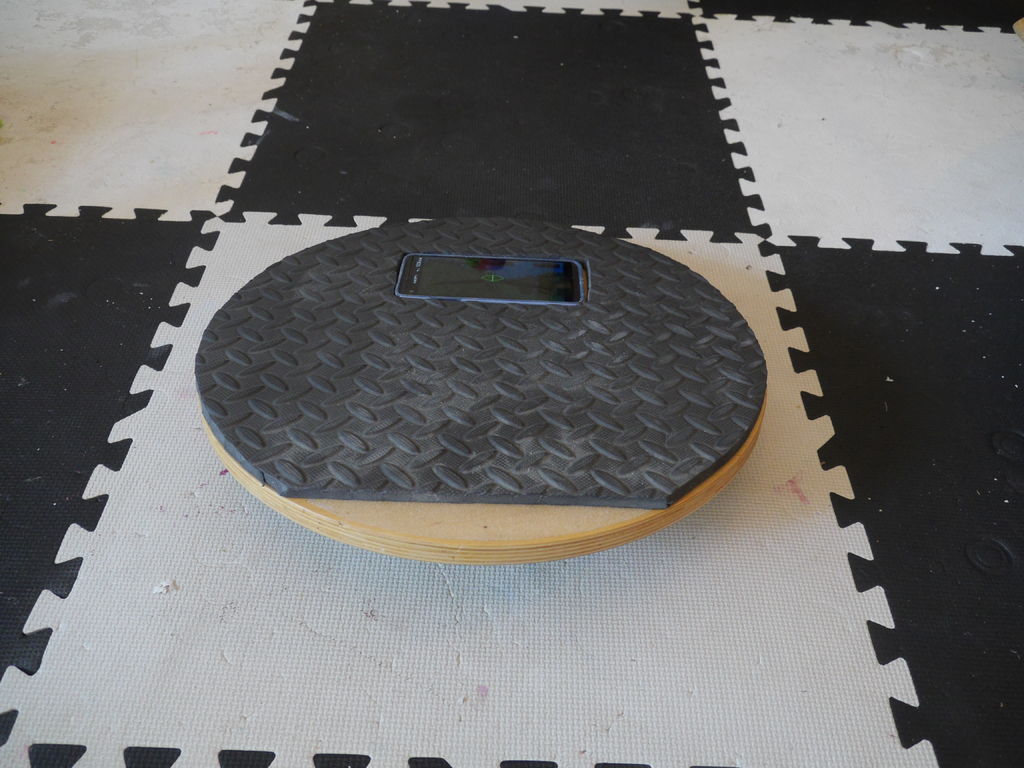
There is research that some video games can relieve pain. And boredom saps endurance. So the Stealth board product which lets you play games on your smartphone while doing core exercise on a specially shaped balance board seems to be a rather fine idea. But it's too expensive for me. So instead I cut a foam overlay with a phone slot and put it on my home-made balance board (with grippy skateboard tape). And the two free games for the Stealth board work great with this (I haven't bought their premium games).


Trivial Instructable here.

Result: I can plank more time on this than I can endure ordinary planking. Admittedly, the fact that the games involve some motion make the exercise less static. But it's still probably good core exercise.

Things God can't cause

It is widely held by Thomists that anything that a creature can cause can be caused directly by God without any creaturely involvement. Now suppose Sam thinks the following thought:

  1. All my thoughts are caused in part by me.

But if God directly causes thought (1) in Sam, then God will directly be causing Sam to think a falsehood (since it will be false that all of Sam’s thoughts are caused in part by Sam). This seems contrary to divine truthfulness.

In an earlier post, I suggest that the Thomist retreat to the principle that for anything a creature can cause, God can directly cause something qualitatively identical to it. But that won't help with this problem, since anything qualitatively identical to (1) but caused directly by God will be false.

I suppose the Thomist can make a similar move here to the one Thomas makes when he says that God can do evil in the sense that he has the power to do it, but not the will. So we would deny that it is possible for God to directly cause anything that a creature can (since God’s goodness rules out God’s causation of some such things), but affirm that he has the power to do so.

Catastrophic decisions

Kirk has come to a planet with two intelligent species in the universe, the Oligons and the Pollakons. There are a million Oligons and a trillion (i.e., million million) Pollakons. They are technologically unsophisticated, live equally happy lives on the same planet, but have no interaction with each other, and the universal translator is currently broken so Kirk can’t communicate with them either. A giant planetoid is about to graze the planet in a way that is certain to wipe out the Pollakons but leave the Oligons, given their different ecological niche, largely unaffected. Kirk can try to redirect the planetoid with his tractor beam. Spock’s accurate calculations give the following probabilities:

  • 1 in 1000 chance that the planetoid will now miss the planet and the Oligons and Pollakons will continue to live their happy lives;

  • 999 in 1000 chance that the planetoid will wipe out both the Oligons and the Pollakons.

If Kirk doesn’t redirect, expected utility is 106 happy lives (the Oligons). If Kirk does redirect, expected utility is (1/1000)(1012 + 106)=109 + 103 happy lives. So, expected utility clearly favors redirecting.

But redirecting just seems wrong. Kirk is nearly certain—99.9%—that redirecting will not help the Pollakons but will wipe out the Oligons.

Perhaps the reason intuition seems to favor not redirecting is that we have a moral bias in favor of non-interference. So let’s turn the story around. Kirk sees the planetoid coming towards the planet. Spock tells him that it has a 1/1000 chance that nothing bad will happen, and a 999/1000 chance that it will wipe out all life on the planet. But Spock also tells him that he can beam the Oligons—but not the Pollakons, who are made of a type of matter incapable of beaming—to the Enterprise. Spock, however, also tells Kirk that beaming the Oligons on board will require the Enterprise to come closer to the planet, which will gravitationally affect the planetoid’s path in such a way that the 1/1000 chance of nothing bad happening will disappear, and the Pollakons will now be certain, and not merely 999/1000 likely, to die.

Things are indeed a bit less clear to me now. I am inclined to think Kirk should rescue the Oligons (this may require Double Effect), but I am worried that I am irrationally neglecting small probabilities. Still, I am inclined to think Kirk should rescue. If that intuition is correct, then even in other-concerning decisions, and even when we have no relevant deontological worries, we should not go with expected utilities.

But now suppose that Kirk over his career will visit a million such planets. Then a policy of non-redirection in the original scenario or of rescue in the modified scenario would be disastrous by the Law of Large Numbers: those 1/1000 events would happen a number of times, and many, many lives will be lost. If we’re talking about long-term policies, then, it seems that Kirk should have a policy of going with expected utilities (barring deontological concerns). But for single-shot decisions, I think it’s different.

This line of thought suggests two things to me:

  • maximization of expected utilities in ordinary circumstances has something to do with limit laws like the Law of Large Numbers, and

  • we need a moral theory on which we can morally bind ourselves to a policy, in a way that lets the policy override genuine moral concerns that would be decisive absent the policy (cf. this post on promises).

Tuesday, July 14, 2020

Regularity and rotational invariance

Suppose that we have some sort of (not merely real-valued) probability assignment P to the Lebesgue measurable subsets of the unit circle Ω.

Theorem: Suppose that the probability values are rotationally invariant (P(A)=P(ρA) for any rotation ρ) and satisfy the two axioms:

  1. If A and B are disjoint, A and C are disjoint, and P(B)=P(C), then P(A ∪ B)=P(A ∪ C)

  2. P(Ω − A)=P(Ω − B) if and only if P(A)=P(B).

Then P(A)=P(∅) for every singleton A.

In other words, we cannot have regularity (non-empty sets having different probability from empty sets) if we have the additivity-type condition (1), the complement condition (2) and rotational invariance.

Proof: Fix an irrational number r and let B be the set of points at angles in degrees r, 2r, 3r, .... Let x0 be the point at angle 0. Then B and C = B ∪ {x0} are rotationally equivalent (you get the former from the latter by rotating by r degrees). So, P(B)=P(C). Let A = Ω − C. Then A and B are disjoint as are A and C. Hence, P(A ∪ B)=P(A ∪ C). But A ∪ C = Ω. So, P(A ∪ B)=P(Ω) by axiom 1. But A ∪ B = Ω − {x0}. So, P({x0}) = P(∅) by axiom 2. But all singletons are rotationally equivalent so they all have the same measure.

This result is a variant of the results here.