Showing posts with label Islam. Show all posts

Wednesday, April 27, 2022

Theism and emotional attitudes to adversity

Here are two three possible emotional attitudes towards great adversity:

  1. Judaeo-Christian: hope

  2. Stoic: calm

  3. Russellian: anger/despair.

Now consider this argument:

  1. The appropriate attitude towards great adversity is Judaeo-Christian or Stoic.

  2. If naturalism is true, the appropriate attitude towards great adversity is Russellian.

  3. So, naturalism is false.

The reason for (1) is the obvious attractiveness of the hopeful-to-calm part of the emotional spectrum as a way of dealing with diversity.

The reason for (2) is that emotions should fit with reality. But as Russell argues, a naturalist reality does not care about us: we came from the nebula and we will go back to the nebula, and the darkness of our life makes Greek tragedy the supreme form of human art. The most we can do shake our fist at the injustice of it all.

Monday, May 11, 2020

Mystery and religion

Given what we have learned from science and philosophy, fundamental aspects of the world are mysterious and verge on contradiction: photons are waves and particles; light from the headlamp on a fast train goes at the same speed relative to the train and relative to the ground; objects persist while changing; we should not murder but we should redirect trolleys; etc. Basically, when we think deeper, things start looking strange, and that’s not a sign of us going right. There are two explanations of this, both of which are likely a part of the truth: reality is strange and our minds are weak.

It seems not unreasonable to expect that if there were a definitive revelation of God, that revelation would also be mysterious and verge on contradiction. Of the three great monotheistic religions, Christianity with the mystery of the Trinity is the one that fits best with this expectation. At the same time, I doubt that this provides much of an argument for Christianity. For while it is not unreasonable to expect that God’s revelation would be paradoxical, it is a priori a serious possibility that God’s revelation might be so limited that what was revealed would not be paradoxical. And it would also be a priori a serious possibility that while creation is paradoxical, God is not, though this last option is a posteriori unlikely given what we learn from the mystical experience traditions found in all the three monotheistic religions.

So, I am not convinced that there is a strong argument for Christianity and against the other two great monotheistic religions on the grounds that Christianity is more mysterious. But at least there is no argument against Christianity on the basis of its embodying mysteries.

Thursday, October 5, 2017

The argument from highly intelligent saints who are Christians

  1. There have been many highly intelligent saints who were Christians.

  2. If there have been may highly intelligent saints who were Christians, then probably (insofar as the above evidence goes) the central doctrines of Christianity are true.

  3. So, probably (insofar as the above evidence goes), the central doctrines of Christianity are true.

(An interesting variant is to replace “are true” in (2) and (3) with “are approximately true”, and then to combine the conclusion with my previous post.)

I do not plan to defend 1. That’s too easy. Note, though, that while easy, it’s not trivial. I am not claiming that there were many highly intelligent people who were canonized “Saints” by the Catholic or Orthodox Church, though that’s true. Nor am I claiming that there were many highly intelligent people who were Christian saints. I am claiming that there are may highly intelligent people who were saints simpliciter, as well as being Christian.

What is a saint like? Saints are deeply morally good people who, insofar as it depends on them, lead a deeply flourishing human life. Their lives are meaningful and when seen closely—which may be difficult, as many saints are very unostentatious—these lives are deeply compelling to others. Saints tightly integrate the important components of their lives. In particular, those saints who are highly intelligent—and not all saints are intelligent, though all are wise—integrate their intellectual life and their moral life. Highly intelligent saints are reflective. They have an active and humble conscience that is on the lookout for correction, and this requires integration between the intellectual life and the moral life.

An intelligent saint who is a Christian is also a Christian saint. For Christianity is not the sort of doctrine that can be held on the peripheries of a well-lived life. Someone who is a Christian but to whose life Christianity is not central is neither a saint simpliciter nor a Christian saint. For a central part of being Christian is believing that Christianity should be central to one’s life, and an intelligent saint—in either sense—will see this and thus either conscientiously act on such a belief, making Christianity be central to her life, or else conclude that Christianity is false.

Now, the existence of a highly intelligent saint who is a Christian is evidence for coherence between central moral truths and the truth of Christianity. For if they were not coherent, the reflectiveness of the highly intelligent saint would likely have seen the incoherence, and her commitment to morality would have led to the rejection of Christianity. But it’s not just that the moral truths and the truth of Christianity cohere: the truths of Christianity support and motivate the moral life. For the saint who is a Christian is, as I just argued, also a Christian saint. And a Christian saint is motivated in the moral life by considerations central to Christianity—the love of God as shown in creation and in the incarnate Son’s sacrificial death on the cross.

It is difficult to have a coherent theory that includes in a highly integrated way deeply metaphysical beliefs and correct moral views in a way where the metaphysical beliefs support the moral ones. That a theory is such is significant evidence for the theory’s truth. More generally and loosely, I think that a person whose life is deeply compelling is likely to be right in those central beliefs of her that are tightly interwoven with what makes her life compelling. But the saint’s moral life is compelling, and if she is a Christian, then her central Christian beliefs are tightly interwoven with her moral life.

Hence, 2 is true.

Of course, the above is not all the evidence there is. What about highly intelligent saints who are not Christians? The existence of such may well weaken the argument. But at least, I think, the argument makes Christianity an intellectually serious option.

And there may be something we can say more specifically on a case by case basis about saints outside of Christianity. Crucial to my argument was that one cannot be a saint and a Christian and have the Christianity be peripheral to one’s moral life. But one can be a saint and an atheist and have the atheism be peripheral to one’s moral life. Atheism is a negative doctrine, after all. If one turns it into a positive motivational doctrine, one gets something like Russell’s “A Free Man’s Worship”. But that is too proud, too haughty, too cold, too dark to be the central motivational doctrine of a saint. A saint who is an atheist is, I suspect, not as likely to be an atheist saint as a saint who is a Christian is to be a Christian saint.

Eastern religions have their saints, but there is an obvious tension between the irrealism to which Eastern religions tend and moral truths about the importance of love of others, of corporal care for the needs of others. One can adhere to an irrealist philosophy and despite this live a life of service to others, but it is unlikely that the service to others be central to one’s life in the way that moral sainthood requires.

What about Jewish and Muslim saints? Well, it may be that many of the motivationally central parts of Judaism and Islam are shared by Christianity—though the converse is not true, given the motivational centrality of the Incarnation to Christianity. One might object that the transcendence and simplicitly of God as taught in Judaism and Islam is motivationally central. But classical Christian theism embraces the transcendence and simplicity of God—and the Incarnation and Trinity, too.

Monday, March 13, 2017

Life

Accounts of biological life characterize it by lists of features such as “reproduction, metabolism, functional organization, growth, responsiveness to the environment, movement, and short- and long-term adaptations” (SEP s.v. life). But Jewish, Christian and Muslim theists have reason to worry about such accounts of life in the light of the fact that our scriptures present God as the paradigm of a living being.

Here are some options:

Option 1: Modify one’s theology to make God fit with something pretty close to one of the biological accounts of life. Mormonism is a fairly radical example of this. A more moderate version might be some version of process theology, though one may need to jettison some features, like metabolism and growth.

Option 2: Trinitarians have this option available: The Son proceeds from the Father and the Spirit from the Father and/through the Son and these processions could count as reproduction. Moreover, because Trinitarian processions multiply persons but the resulting persons are one God, Trinitarian reproduction has an internality that might count as a kind of growth—not that the divine essence grows, but that the number of persons of the one God grows. This solution would have the important consequence that the Old Testament texts that present God as living are proto-Trinitarian. Obviously, this solution is unlikely to be attractive to Jews and Muslims, though there may be some Kabbalistic analogue that might appeal to some Jews. Moreover, unless one adopts some version of process theology, this solution still requires one to drop a number of the features in traditional accounts of biological life, such as metabolism, movement and adaptation.

Option 3: Replace the biological accounts of life with something radically different which makes God a paradigm instance of life. Here are three such possibilities for characterizing life:

A. Living things are ones that have some mental property like consciousness or purposefulness.

B. Living things have teleology.

C. Living things are ones that have a well-being, that are capable of being well.

Suboption A is pretty radical: it requires either saying that plants have a mental life or that plants aren’t alive. I think it’s not that crazy to say that plants have something like mental life. Maybe they are aware of their environment in a way that goes robustly beyond the mere data processing of a digital thermometer. And it seems plausible that one can ascribe a certain kind of purposefulness to plant processes.

Suboption B is pretty close to the purposefulness variant of suboption A, but teleology is a more general concept than mental purposefulness. For me, the main difficulty with suboption B is that I think all substances have teleology. And I don’t want to extend life to elementary particles. But those who do not think that teleology extends to all substances might like Suboption B.

Suboption C is, of course, related to Suboption B. I have the same worry about C as about B: I think all substances that have teleology have a well-being. Elementary particles have well-being—the only difference between them and organic substances is that as far as we can tell, elementary particles are always well. This is of course very controversial, and those who do not accept it may like C.

There are, no doubt, other options and suboptions. I am attracted to Options 2 and 3A.

Monday, July 6, 2009

Pascal's wager and infinity

(Cross-posted to prosblogion).

Some people, I think, are still under the impression that the infinities in Pascal's wager create trouble. Thus, there is the argument that even if you don't believe now, you might come to believe later, and hence the expected payoff for not believing now is also infinite (discounting hell), just as the payoff for believing now. Or there is the argument that you might believe now and end up in hell, so the payoff for believing now is undefined: infinity minus infinity.

But there are mathematically rigorous ways of modeling these infinities, such as Non-Standard Analysis (NSA) or Conway's surreal numbers. The basic idea is that we extend the field of real numbers to a larger ordered field with all of the same arithmetical operations, where the larger field contains numbers that are bigger than any standard real number (positive infinity), numbers that are bigger than zero and smaller than any positive standard real number (positive infinitesimals), etc. One works with the larger field by exactly the same rules as one works with reals. This is all perfectly rigorous.

Let's do an example of how it works. Suppose I am choosing between Christianity, Islam and Atheism. Let C, I and A be the claims that the respective view is true. Let's simplify by supposing I have three options: BC (believe and practice Christianity), BI (believe and practice Islam) and NR (no religious belief or practice).

Now I think about the payoff matrix. It's going to be something like this, where the columns depend on what is true and the rows on what I do:

CIA
BC0.9X-0.1Y0.7X-0.3Y-a
BI0.6X-0.4Y0.9X-0.1Y-b
NR0.4X-0.6Y0.4X-0.6Yc
Here, X is the payoff of heaven and -Y is the payoff of hell, and X and Y are positive infinities. I assume that the Christian and Islamic heavens are equally nice, and that the Christian and Islamic hells are equally unpleasant. The lowercase letters a, b and c indicate finite positive numbers. How did I come up with the table? Well, I made it up. But not completely arbitrarily. For instance, BC/C (I will use that symbolism to indicate the value in the C column of the BC row) is 0.9X-0.1Y. I was thinking: if Christianity is true, and you believe and practice it, there is a 90% chance you'll go to heaven and a 10% chance you'll go to hell. On the other hand, BC/I is 0.7X-0.3Y, because Islam expressly accepts the possibility of salvation for Christians (at least as long as they're not ex-Muslims, I think), but presumably the likelihood is lower than for a Muslim. BI/C is 0.6X-0.4Y, because while there are well developed Christian theological views on which a Muslim can be saved, these views are probably not an integral part of the tradition, so the BI/C expected payoff is lower than the BC/I one. The C and I columns of the tables should also include some finite numbers summands, but those aren't going to matter. A lot of the numbers can be tweaked in various ways, and I've taken somewhat more "liberal" (in the etymological sense) numbers--thus, some might say that the payoff of NR/C is 0.1X-0.9Y, etc.

What should one do, now? Well, it all depends on the epistemic probabilities of C, I and A. Let's suppose that they are: 0.1, 0.1 and 0.8, and calculate the payoffs of the three actions.

The expected payoff of BC is EBC = 0.1 (0.9X - 0.1Y) + 0.1 (0.7X - 0.3Y) + 0.8 (-a) = 0.16X - 0.04Y - 0.8a.

The expected payoff of BI is EBI = 0.15X - 0.05Y - 0.8b.

The expected payoff of NR is ENR = 0.08X - 0.12Y + 0.8c.

Now, let's compare these. EBC - EBI = 0.01X + 0.01Y + 0.8(b-a). Since X and Y are positive infinities, and b and a are finite, EBC - EBI > 0. So, EBC > EBI. EBI - ENR = 0.07X + 0.07Y - 0.8(b+c). Again, then EBI - ENR > 0 and so EBI > ENR. Just to be sure, we can also check EBC - ENR = 0.08X + 0.08Y - 0.8(a+c) > 0 so EBC > ENR.

Therefore, our rank ordering is: EBC > EBI > ENR. It's most prudent to become Christian, less prudent to become a Muslim and less prudent yet to have no religion. There are infinities all over the place in the calculations, but we can rigorously compare them.

Crucial to Christianity being favored over Islam was the fact that BC/I was bigger than BI/C: that Islam is more accepting of salvation for Christians than Christianity is of salvation for Muslims. If BC/I and BI/C were the same, then we'd have a tie between the infinities in EBC and EBI, and we'd have to decide based on comparisons between finite numbers like a, b and c (and finite summands in the other columns that I omitted for simplicity)--how much trouble it is to be a Christian versus being a Muslim, etc. However, in real life, I think the probabilities of Christianity and Islam aren't going to be the same (recall that above I assumed both were 0.1), because there are better apologetic arguments for Christianity and against Islam, and so even if BC/I and BI/C are the same, one will get the result that one should become Christian.

It is an interesting result that Pascal's wager considerations favor more exclusivist religions over more inclusivist ones--the inclusivist ones lower the risk of believing something else, while the exclusivist ones increase it.

It's easy to extend the table to include deities who send everybody to hell unless they are atheists, etc. But the probabilities of such deities are very low. There is significant evidence of the truth of Christianity and some evidence of the truth of Islam in the apologetic arguments for the two religions, but the evidence for such deities is very, very low. We can add another column to the table, but as long as the probability of it is small (e.g., 0.001), it won't matter much.

Tuesday, April 8, 2008

Art as argument

I once ran a panel discussion between an Islamic theologian and a philosopher of art. The Islamic theologian was defending what she claimed was traditional Islamic jurisprudence, that for the sake of freedom of inquiry it is legally permitted to write anything in the context of intellectual verbal argument (even really nasty things about the founder of Islam, as long as long as they were supported by argumentation), but that there are restrictions on, say, what is permitted in art. The idea was that in intellectual inquiry, verbal expressions have a privileged status.

It seems to me that this account of inquiry is somewhat impoverished. While argument can be made in words, it can also be made in other ways. In their fun Handbook of Christian Apologetics Kreeft and Tacelli give this argument for the existence of God:

There is the music of Johann Sebastian Bach.
Therefore there must be a God.
You either see this one or you don't.
I may not see it, because my own appreciation of music is most deficient[note 1], but I see the kind of argument that is made here, and it is not an argument in words—simply asserting that there is the music of J. S. Bach doesn't do the job. The music is an essential part of the argument itself.

Or consider the following argument:

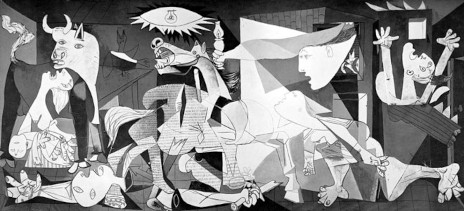
  1. Guernica
  2. Therefore, war is wrong.

Does it make sense to simply incorporate a work of art as a premise to an argument. One problem—and this may be the reason for the apparent Islamic privileging of verbal arguments—is that arguments that incorporate a work of art as a premise are hard to criticize. I am not a pacifist. So I accept that the above argument is unsound. But it is really hard to see what I deny. Do I deny premise (1), i.e., deny Guernica? That seems to be a category mistake. Or do I deny that (2) follows from (1)? So there is something unfair about the use of art in argument—one is putting oneself beyond criticism, except maybe by a competing work of art.

Difficulties with this notwithstanding, I do think the idea that a work of art can express an otherwise ineffable proposition is defensible. Perhaps Guernica expresses the proposition that war is like this (isn't it fun to use hyperlinks to indicate referrents of demonstratives?). If so, then while denying Guernica is a category mistake, denying the proposition expressed by Guernica is no category mistake.

If so, then poems, songs, novels, etc. can express propositions that have truth value. This might be relevant to an account of Biblical inerrancy that includes the full range of genres found in Scripture.

Final note: I think the Bach and Guernica arguments may have different logical forms. It may not be that the music of Bach itself expresses something that implies the existence of God, so that the music is not a premise, but only a part of a premise—the premise that there is this [mp3 download is from here].