Showing posts with label seeing. Show all posts

Monday, December 9, 2024

Hachette v. Internet Archive

I am not a lawyer, but I love constructing counterexamples. I’ve been thinking about the Hachette v. Internet Archive. The Archive scanned a bunch of books they owned, and then lent the scans to users on the Internet, making sure that for each physical book, only one scan was lent at a time. The courts ruled that this was copyright infringement.

I imagine a sequence of cases for a library (the Internet Archive is officially a library in California):

  1. A user comes to the library and reads a book in the ordinary way.

  2. The book is delicate and valuable, so the library puts the book in a metal box with a window, with delicate robotically controlled page flippers controlled by buttons outside the box. The user reads the book through the window while flipping pages with the buttons.

  3. Same as 2, but the user wears glasses.

  4. Same as 2, but the user lives across the street from the library, and the librarian has placed the box in the library window so pointed that the user, and the user alone, can read the book via an ordinary refracting telescope, with the user having buttons connected to the page flippers via long wires.

  5. Same as 4, but the telescope is digital: it has an optical sensor connected electronically to a screen (basically, a CCTV system).

  6. Same as 5, but the optical sensor is inside the library while the digital telescope’s screen is in the user’s home.

  7. Same as 6, but the user can be arbitrarily far away, because wires are very long.

  8. Same as 7, but instead of custom wiring for the connection between the sensor and the screen and the user’s button’s and the page flippers, a TCP/IP protocol over the Internet is employed.

  9. Same as 8, but to reduce wear and tear on the book, the sensor caches the images, so that if the user chooses to jump to a page that has already been viewed, the flippers do not need to operate. The cache is deleted at the end of the session.

  10. Same as 9, but the cache is not deleted at the end of the session, but is kept for the next session with the same user.

  11. Same as 10, but the cache is kept for the next user. Only one user can access the book at once.

  12. Same as 10, but a full cache is generated for all the pages once and for all users. Only one user can operate the system at once.

  13. Same as 11, but the whole cache is copied to the user’s device and removed once the loan period expires.

Here, 12 is pretty much what the Archive was doing when it was letting users download books for a period, and 11 was what they were doing when it was letting users view the books via a browser.

If 11 and 12 are not allowed, at what point do things become impermissible?

If the worry is about there being copying, then there is already copying at 5: the electrical data from the sensor is copied to the screen. If the user flips through the book, the copying is of the book as a whole, though the copies are constantly deleted. But it seems to me (who am not a lawyer) that we shouldn’t make a significant distinction between a digital and an analogue telescope. Moreover, even viewing by eye involves copying. As soon as a page of a book is exposed to light, a large stream of copies of the data in the book appear in the air as patterns of light. Whether these copies are in the air or in glass (as in the case where glasses or an analogue telescope is used) does not seem significant. Is it significant if the data is in electrons rather than photons, as in 5?

Perhaps the worry is about non-evanescent copies. That sounds reasonable. When a book is exposed to light, the copies that are immediately made are evanescent (though very large in quantity), and likewise if a sensor and a screen arrangement (e.g., CCTV) is used. Thus, 1-8 might be distinguished from 9-12, and maybe the caching introduced at 9 is the problem.

However, the Internet and other electronic devices already have caching built in at various levels, so there is already some “hidden” caching introduced at 9, so the existence of caching doesn’t seem that significant. It seems like caching is just an efficiency improvement that does not significantly affect the normative issues.

Monday, July 19, 2010

Seeing dark nebulae and silhouettes

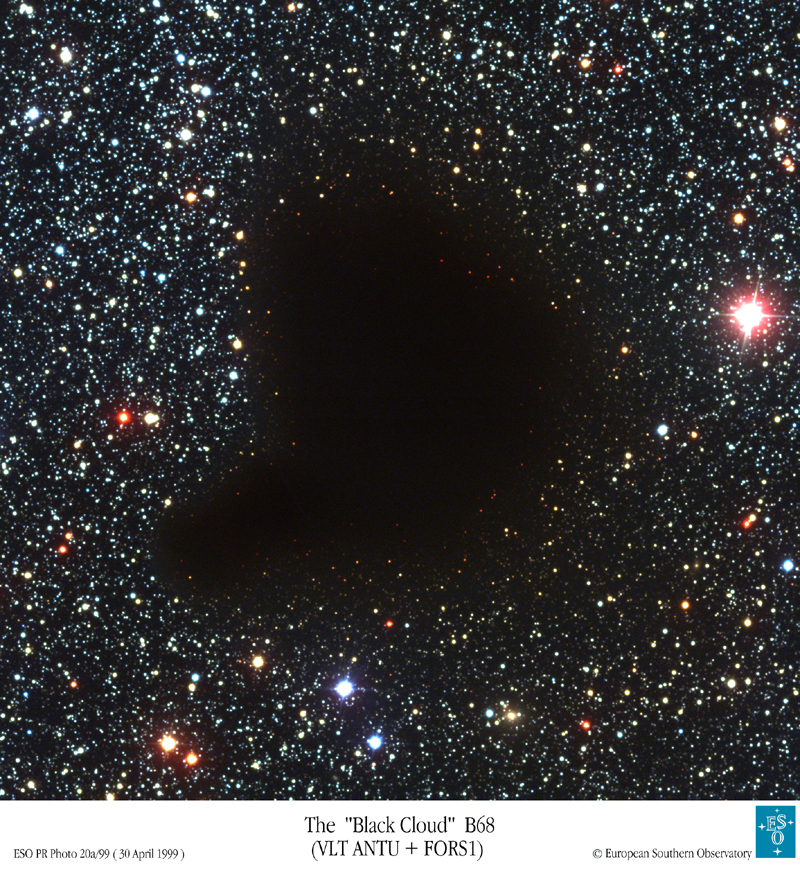
B68We can see shadows, even though surely shadows don't exist—there is nothing to them, but lack. Dark nebulae can also be seen, as the photo shows. However, a dark nebula isn't a complete nonentity like a shadow. It is a molecular cloud of particles that obscure the stars behind it. Those who believe in unrestricted compositionality will even think that they are really existing objects. But seeing a dark nebula is rather different from seeing a shadow. The shadow's shadowy being is constituted by the absence of light. The absence of light in the case of the dark nebula does nothing to constitute the nebula—it is simply that the dark nebula has absorbed the light from the stars and other objects behind it.
Here is an argument that we see dark nebulae. Two nights ago, I tried to see Barnard 91. I thought I saw it, but I was looking at the wrong thing. So, I tried to see it, and failed. But this suggests that there is a distinction between seeing and not seeing it.
There may seem to be something paradoxical here. Isn't seeing supposed to be a causal process, where patterns of light are seen and caused by the object seen? But in the case of the dark nebula—or a human silhouette in the dark, outlined against a light—it is precisely a matter of the absence of light caused by the object seen. However, patterns can be constituted by absence as well as presence. When I look at a sheet of transparent red plastic, the redness of the plastic comes from the plastic's selective transmission characteristics: it lets red light through, and holds back much of the rest of the visible spectrum. The case of the dark nebula and silhouette are just limiting cases of this.
But what the above helps show is that the "in the right way" causal condition for seeing is going to be very complicated. Does this matter? Maybe: it does make life harder for reductionist accounts of perception.

Friday, June 26, 2009

Dark nebulae

Last night, I was observing a portion of the Pipe Nebula, which is a dark lane of dust obscuring the Milky Way. It was kind of cool: I could see stars to the left of it through the telescope, and then as I moved the telescope to the right, the field of view went almost completely dark, except for some stars on the fringes and some quite faint stars in the middle. But did I see the Pipe Nebula? It seems that what constituted "seeing" the Pipe Nebula was my not seeing the stars behind it. After all, intuitively seeing seems to be a causal process whereby the seen object causes light to reach the eyes. But the Pipe Nebula did not cause any light to reach the eyes. Of course, the same issue comes up when one "sees" a matte-black cube, a shadow, etc.

Maybe, then, we need to relax the intuitive concept of seeing as a process whereby the seen object causes light to reach the eyes. One might say that seeing is a process whereby the seen object causes light to reach or not reach the eyes (or, maybe better, causes a particular profile of wavelengths of light to reach the eyes, which profile might be empty). But if that were right, then we should say that a blindfolded person sees the blindfold (and that a person with eyes closed sees the inside of the eyelids). However, I do not think we say that—we say, rather, that a blindfolded person does not see anything.

Here is an alternative that accounts for shadows, ultra flat black cubes and dark nebulae: in seeing, the seen object causes a non-empty shaped pattern of light. There are two ways of causing a shaped pattern of light: one way is by causing the light (by reflection, emission or refraction) and the other way is by causing the shape. Here, "shape" must be understood in such a way that a field of view filled with uniform light counts as a shape (so that if one is right up against a uniform blue wall, one still sees the wall) while an empty field of view, as in the blindfold case, does not count as a shape.

A problem with this account is that if one's face is up against a red, or green, or blue wall, one counts as seeing the wall, but if the wall is painted with ultra flat black paint, then one isn't seeing the wall. I do not know how to give an account on which one counts as seeing the ultra flat black wall, but one doesn't count as seeing the blindfold.

Monday, July 21, 2008

Amateur astronomy and the joy of seeing

A couple of days ago, I got an 8-inch Newtonian telescope (an old Coulter Odyssey 8). I've been wanting to have a decent telescope since I was a kid. Earlier this year I had got some giant 15x70 binoculars, which gave some very nice views at dark locations, but the telescope will open new vistas. I'm still trying to find a good observing site close to home. At home there are too many trees and streetlights are very close.

Oddly enough, I don't have much of anything philosophical to say about amateur astronomy yet. Here is one remark, oddly making a connection with things I am writing in my book on love and sex—tomorrow's post will draw out the connection. Another will follow in two days.

Aristotle begins the Metaphysics with the remark that all humans desire to know, and gives as evidence the love which we have for the sense of sight, sight being the most informative of the senses. Yet the experience of amateur astronomers suggests that Aristotle is wrong. There is a joy in seeing that seems to go beyond mere knowing. After all, the average amateur astronomer, is unlikely to see anything that she couldn't find out much more about by reading astronomy textbooks or at least research articles. Yet, while the amateur astronomer may read astronomy textbooks and maybe even research articles, her paradigmatic activity as amateur astronomer, an activity into which many resources are put, is seeing.

One answer to the puzzle of why there is such an activity as amateur astronomy would be to bring in a distinction between knowing propositions and knowing what things appear like. If one has been born deaf, one may know all the scientific facts about a middle C, but have no idea what one sounds like. I don't think, however, that this is the best explanation of the existence of the amateur astronomer (or the tourist or bird-watcher[note 1]). One reason it's not, is that I am not sure I buy the distinction between knowing that and knowing what it is like. I think that a visual image can express proposition, a proposition that is distinct from those expressed in spoken words. One reason I say this is because I have a wide view of language, that includes gestures, sketches, and other things. So in seeing an object, one knows a proposition that cannot be put into words.

However, in fact, neither the story distinguishing between two kinds of knowledge, nor my liberality with propositions and language, does justice to the amateur astronomer. Two days ago I saw, I think, the Ring Nebula. That gave me some joy. But what did I see? It was not the magnificent photograph that can be seen here. It was a tiny and very faint greyish spot, which looked slightly less bright in the middle if one looked enough. (I was viewing only at 30X magnification—I need to get more eyepieces—in a light-polluted driveway, on a full-moon night, with a poorly collimated scope, a terrible combination.) Still, it was a delight to have found it. Yet if I was after information, even of the "what it is like" variety, I could have just used Google image search.

There is, then, a joy in seeing first hand, a joy that seems goes beyond the informational content. Seeing first hand, even through an instrument, has something more to it than seeing photographs. Part of it is, I think, is the activity in seeing that goes beyond contemplating. There is the taking up of a point of view. Think of people in an art gallery, looking at a picture from one distance, then stepping back or forward. There is the choosing of the right way of seeing it (glasses, microscopes, telescopes, with their various settings), the right time, the right location. And, especially for a beginner like me, there is the finding. There is a natural good in the activity of seeing, but this activity is more than just contemplating, where I use the term "contemplating" for the visual perceiving part of the activity. Contemplating is the completion of this activity, but the activity goes beyond the contemplation that results from it.

Now here is something that I think is interesting. While Aristotle is, I think, right that the value of seeing comes from the fact that seeing gives us more information than any other sense, we should not take this on at the level of individual instances or tokens. It is false that my seeing the Ring Nebula got all of its value from its informational content. Rather, it is that the activity of seeing (including here the taking up of a point of view, the screwing up of one's eyes, the finding of the object, the manipulating whether in reality or through changing filters, etc.—I am thinking here of Ian Hacking kinds of ideas) gets its value from the fact that it is an activity that has a directedness at a genuine good, the good of contemplating. But the activity then has a value even when it does not achieve the telos. This is a way in which Natural Law differs from consequentialism—instances or tokens of an activity directed at a good have a value over and beyond the relevant instance of the good. In fact, the activity is valuable even when the good that the activity is aimed at is not achieved. Thus, when I failed to find the Whirlpool Galaxy last night and the night before last, while that activity failed to achieve the contemplation that was its telos, it was valuable.

On this view, a particular engagement in an activity can gets its value from the fact that the type of activity has a value, and the type of activity can get its value from the activity's telos. The value of an activity can go beyond the value of the activity's point, even if the activity derives its value from that point. Notice that while amateur astronomy is a skilled activity, it would not have the same kind of meaning if it were not aimed in some way at truth—if, for instance, amateur astronomers put on filters that completely distorted the sky into prettier patterns.