Showing posts with label expected utility. Show all posts

Sunday, November 3, 2024

Does one's vote make a difference?

Suppose that there is a simple majority election, with two candidates, and there is a large odd number of voters. Suppose polling data makes the election too close to call. How likely is it that you can decide which candidate wins?

I could look up this stuff, but it’s more fun to figure it out.

A quick and dirty model is this. We have N people other than you voting, each choosing between candidates A and B with probabilities p and 1 − p respectively. You don’t know what p and 1 − p are, but polling data tells you that p is between 1/2 − a and 1/2 + b for some positive numbers a and b. Your vote decides the election provided that exactly N/2 people vote for candidate A. This requires that N be even (if N is odd, at best you can decide between a candidate winning and the election being undecided, so you can’t decide which candidate wins), which has probability 1/2. Given that N = 2n is even, the probability that the other votes are exactly balanced is (a+b)−1 C(2n,n)∫1/2−a1/2+bpn(1−p)n − 1dp, where C(m,n) is the binomial coefficient. Assuming n is large as compared to a and b, the integral can be approximated by replacing its bounds by 0 and 1 respectively, and some work with Mathematica shows that for large n the probability is approximately 1/(N(a+b)).

So what? Well, suppose you think that candidate A will on average make a person in the jurisdiction be u units of flourishing better off than candidate B will, and there are K persons, where K ≥ N + 1 (there are at least as many persons as candidates). So, the expected amount of difference that your voting for A will make is at least Ku/(2N(a+b)). This is at least u/(a+b). Thus, if the polling data gives you a range between 0.48 and 0.52 for the probability of a person’s preferring candidate A, and half of the people in the jurisdiction vote, the expected amount of difference that your vote makes is 25u. This is quite a lot if you think that which candidate wins makes a significant difference u per governed person.

Interestingly, some numerical work with Mathematica also shows that as number of people increases, then the expected amount of difference your vote makes also increases asymptotically, up to the limit of Ku/(2N(a+b)). So for larger jurisdictions, even though the probability of your vote making a difference is smaller, the expected difference from your vote is a bit bigger.

My quick and dirty model is not quite right. Of course, people don’t come to the polls and randomly choose whom to vote for. A more likely source of randomness has to do with who actually makes it to the polls (who gets sick, who has something come up, who decides it’s pointless to vote, etc.). A better model might be this. We have M people eligible to vote, of whom pM want to vote for A and (1−p)M want to vote for B. Some random subset of the M people then votes. My probabilist intuitions say that this is not that different from my model if the number of actual voters is, say, half of the eligible voters. If I had an election that I was eligible to vote in coming, I might try to figure our the more complex model, but I don’t.

Wednesday, October 26, 2022

The Law of Large Numbers and infinite run payoffs

In discussions of maximization of expected value, the Law of Large Numbers is sometimes invoked, at times—especially by me—off-handedly. According to the Strong Law of Large Numbers (SLLN), if you have an infinite sequence of independent random variables X1, X2, ... satisfying some conditions (e.g., in the Kolmogorov version ∑n(σn2/n2) < ∞, where σn2 is the variance of Xn), then with probability one, the average of the random variables converges to the average of the mathematical expectations of the random variables. The thought is that in that case, if the expectation of each Xn is positive, it is rationally required to accept the bet represented by Xn.

In a recent post, showed how in some cases where the Strong Law of Large Numbers is not met, in an infinite run it can be disastrous to bet in each case according to expected value.

Here I want to make a minor observation. The fact that the SLLN applies to some sequence of independent random variables is itself not sufficient to make it rational to bet in each case according to the expectations in an infinite run. Let Xn be 2n/n with probability 1/2n and  − 1/(2n) with probability 1 − 1/2n. Then

  • EXn = (1/2n)(2n/n) − 1/(2n)(1−1/2n) = (1/n)(1−(1/2)(1−1/2n)).

Clearly EXn > 0. So in individual decisions based on expected value, each Xn will be a required bet.

Now, just as in my previous post, almost surely (i.e., with probability one) only finitely many of the bets Xn will have the positive payoff. Thus, with a finite number of exceptions, our sequence of payoffs will be the sequence  − 1/2,  − 1/4,  − 1/6,  − 1/8, .... Therefore, almost surely, the average of the first n payoffs converges to zero. Moreover, the average of the first n mathematical expectations converges to zero. Hence the variables X1, X2, ... satisfy the Strong Law of Large Numbers. But what is the infinite run payoff of accepting all the bets? Well, given that almost surely there are only a finite number of n such that the payoff of bet n is not of the form  − 1/(2n), it follows that almost surely the infinite run payoff differs by a finite amount from  − 1/2 − 1/4 − 1/6 − 1/8 =  − ∞. Thus the infinite run payoff is negative infinity, a disaster.

Hence even when the SLLN applies, we can have cases where almost surely there are only finitely many positive payments, infinitely many negative ones, and the negative ones add up to  − ∞.

In the above example, while the variables satisfy the SLLN, they do not satisfy the conditions for the Kolmogorov version of the SLLN: the variances grows exponentially. It is somewhat interesting to ask if the variance condition in the Kolmogorov Law is enough to prevent this pathology. It’s not. Generalize my example by supposing that a1, a2, ... is a sequence of numbers strictly between 0 and 1 with finite sum. Let Xn be 1/(nan) with probability an and  − 1/(2n) with probability 1 − an. As before, the expected value is positive, and by Borel-Cantelli (given that the sum of the an is finite) almost surely the payoffs are  − 1/(2n) with finitely many exceptions, and hence the there is a finite positive payoff and an infinite negative one in the infinite run.

But the variance σn2 is less than an/(nan)2 + 1 = (1/(n2an)) + 1. If we let an = 1/n2 (the sum of these is finite), then each variance is at most 2, and so the conditions of the Kolmogorov version of the SLLN are satisfied.

In an earlier post, I suggested that perhaps the Central Limit Theorem (CLT) rather than the Law of Large Numbers is what one should use to justify betting according to expected utilities. If the variables X1, X2, ... satisfy the conditions of the CLT, and have non-negative expectations, then P(X1+...+Xn≥0) will eventually exceed any number less than 1/2. In particular, we won’t have the kind of disastrous situation where the overall payoffs almost surely go negative, and so no example like my above one can satisfy the conditions of the CLT.

Tuesday, October 18, 2022

Expected utility maximization

Suppose every day for eternity you will be offered a gamble, where on day n ≥ 1 you can choose to pay half a unit of utility to get a chance of 2−n at winning 2n units of utility.

At each step, the expected winnings are 2n ⋅ 2−n = 1 unit of utility, and at the price of half a unit, it looks a good deal.

Here’s what will happen if you always go for this gamble. It is almost sure (i.e., it has probability one) that you will only win a finite number of times. This follows from the Borel-Cantelli lemma and the fact that ∑2−n < ∞. So you will pay the price of half a unit of utility every day for eternity, and win only a finite amount. That’s a bad deal.

Granted, this assumes you will in fact play an infinite number of times. But it is enough to show that expected utility maximization in individual choices is not always the best policy (and suggests a limitation in the argument here).

Objection: All this has to do with aggregating an infinite number of payments, or traversing an infinite future, and hence is just another paradox of infinity.

Response: Actually the crucial point can be made without aggregating infinitely many payments. Suppose you adopt the policy of accepting the gamble. Then, with probability one, there will come a day M after which you never win again. By day M, you may well have won some (maybe very large) finite amount. But after that day, you will keep on paying to play and never win again. After some further finite number of days, your losses will overtake your winnings, and after that you will just fall further and further behind every day. This unhappy fate is almost sure if you always accept the gamble, and hence if you adopt expected utility maximization in individual decisions as your policy. And the unhappiness of this fate does not depend on aggregation of infinitely many utilities.

Question: What if the game ends after a fixed large finite number of steps?

Response: In any finite number of steps, of course the expected winnings are higher than the price you pay. But nonetheless as the number of steps gets large, the chance at those expected winnings shrinks. Imagine that the game goes on for 200 days, the game on day 100 has finished, and you’re now choosing your policy for the next 100 days. The expected utility of playing for the next 100 days is 50 units. However, assuming you accept this policy, the probability that you will win anything over the next 100 days is less than 2−100, and if you don’t win anything, you lose 50 units of utility. So it doesn’t seem crazy to think that the no-playing policy is better, even though it has worse expected utility. In fact, it seems like quite a reasonable thing to neglect that tiny probability of winning, less than 2−100, and refuse to play. And knowing that the expected utility reasoning when extended for infinite time leads to disaster (infinite loss!) should make one feel better about the decision to violate expected utility maximization.

Final remark: It is worth considering what happens in interpersonal cases, too. Suppose infinitely many people numbered 1, 2, 3, ... are given the opportunity to play the game, with person n being given the opportunity of winning 2n units with probability 2−n. If everyone goes for the game, then almost surely a finite number of people will win a finite amount while an infinite number pay the half-unit price. That’s disastrous: an infinite price is being paid for a finite benefit.

Wednesday, April 6, 2022

Consequentialism and probability

Classic utilitarianism holds that the right thing to do is what actually maximizes utility. But:

  1. If the best science says that drug A is better for the patient than drug B, then a doctor does the right thing by prescribing drug A, even if due to unknowable idiosyncracies of the patient, drug B is actually better for the patient.

  2. Unless generalized Molinism is true, in indeterministic situations there is often no fact of the matter of what would really have happened had you acted otherwise than you did.

  3. In typical cases what maximizes utility is saying what is true, but the right thing to do is to say what one actually thinks, even if that is not the truth.

These suggest that perhaps the right thing to do is the one that is more likely to maximize utility. But that’s mistaken, too. In the following case getting coffee from the machine is more likely to maximize utility.

  1. You know that one of the three coffee machines in the breakroom has been wired to a bomb by a terrorist, but don’t know which one, and you get your morning coffee fix by using one of the three machines at random.

Clearly that is the wrong thing to do, even though there is a 2/3 probability that this coffee machine is just fine and utility is maximized (we suppose) by your drinking coffee.

This, in turn, suggests that the right thing to do is what has the highest expected utility.

But this, too, has a counterexample:

  1. The inquisitor tortures heretics while confident that this maximizes their and others’ chance of getting into heaven.

Whatever we may wish to say about the inquisitor’s culpability, it is clear that he is not doing the right thing.

Perhaps, though, we can say that the inquisitor’s credences are irrational given his evidence, and the expected utilities in determining what is right and wrong need to be calculated according to the credences of the ideal agent who has the same evidence.

This also doesn’t work. First, it could be that a particular inquisitor’s evidence does yield the credences that they actually have—perhaps they have formed their relevant beliefs on the basis of the most reliable testimony they could find, and they were just really epistemically unlucky. Second, suppose that you know that all the coffee machines with serial numbers whose last digit is the same as the quadrilionth digit of π have been rigged to explode. You’ve looked at the coffee machine’s serial number’s last digit, but of course you have no idea what the quadrilionth digit of π is. In fact, the two digits are different. You did the wrong thing by using the coffee machine, even though the ideal agent’s expected utilities given your evidence would say that you did the right thing—for the ideal agent would know a priori what the quadrilionth digit of π is.

So it seems that there really isn’t a good thing for the consequentialist to say about this stuff.

The classic consequentialist might try to dig in their heels and distinguish the right from the praiseworthy, and the wrong from the blameworthy. Perhaps maximizing expected utility is praiseworthy, but is right if and only if it actually maximizes utility. This this still has problems with (2), and it still gets the inquisitor wrong, because it implies that the inquisitor is praiseworthy, which is also absurd.

The more I think about it, the more I think that if I were a consequentialist I might want to bite the bullet on the inquisitor cases and say that either the inquisitor is acting rightly or is praiseworthy. But as the non-consequentialist that I am, I think this is a horrible conclusion.

Tuesday, March 1, 2022

The probability of success condition for a just war

Traditional just war theory holds that a necessary condition for a just war is not just the proportionality condition that the expected benefits exceed the expected harms, but that success is likely.

In typical cases, where the success condition fails, the proportionality condition fails as well. However, there are some hightly hypothetical cases where the success condition fails but the proportionality condition is satisfied. And in those cases I think war is justified. Thus, we should drop the success condition, and simply insist on proportionality, while being clear that proportionality includes a probabilistic assessment.

Case one. Kneebonia has exactly one missile and no weapons other than that missile. They declare war and shoot that missile at a gorgeous cathedral in the Elbonian capital that took centuries to build. They offer the Elbonia the following terms of surrender: Elbonia will become a province of Kneebonia and all books in the Elbonian language will be burned and permanently banned. Elbonia has one soldier. They parachute her onto the roof of the Kneebonian missile control building, and task her with penetrating to the computer room in order to redirect the missile into the sea. However, they know that the chance of success in this mission is 1%, because she is likely to be captured. At the same time, because the Kneebonian soldiers have no weapon other than the missile, one can be pretty confident that even if the mission fails, the Elbonian soldier will survive.

The Elbonians reciprocate the declaration of war and send their one soldier in. Proportionality may well be met: the danger of one soldier being non-lethally captured is proportionate to a 1% chance of saving a precious cultural artifact that took centuries to build. But the chance of success in this war is 1%. But if there is no success, there will be likely very little harm (one soldier captured alive).

Granted, this is a defensive case. But there are offensive cases that can be imagined as well.

Case two. A regional branch of the Elbonian army is perpetrating genocide on local Kneebonian minorities. Kneebonia has only one missile, and it can shoot it at the headquarters of that branch. Intelligence data shows that if the missile strike is successful, Elbonia will surrender and agree to end the genocide. However, the missile is wonky. There is a 99% chance that instead of hitting the headquarters, it will veer off-course and explode unseen in Elbonian coastal waters, and there is a 1% chance of success. Intelligence data shows that in case of a miss Elbonia can simply withdraw its declaration of war and the war will end, with the Kneebonians slightly puzzled as to why no hostile action apparently occurred.

Again, the probability of success is 1%. Yet it seems that war is justified. Again, if there is no success, there will be no harm.

All that said, the probability of success condition is a useful heuristic. For in typical wars, where there is insufficient probability of success, the expected harms will outweigh the expected benefits.

Monday, April 5, 2021

Best estimates and credences

Some people think that expected utilities determine credences and some thing that credences determine expected utilities. I think neither is the case, and want to sketch a bit of a third view.

Let’s say that I observe people playing a slot machine. After each game, I make a tickmark on a piece of paper, and if they win, I add the amount of the win to a subtotal on a calculator. After a couple of hours—oddly not having been tossed out by the casino—I divide the subtotal by the number of tickmarks and get the average payout. If I now get an offer to play the slot machine for a certain price, I will use the average payout as an expected utility and see if that expected utility exceeds the price (in a normal casino, it won’t). So, I have an expected utility or prevision. But I don’t have enough credences to determine that expected utility: for every possible payout, I would need a credence in getting that payout, but I simply haven’t kept track of any data other than the sum total of payouts and the number of games. So, here the expected utility is not determined by the credences.

The opposite is also not true: expected utilities do not determine credences.

Now consider another phenomenon. Suppose I step on an analog scale, and it returns a number w1 for my weight. If that’s all the data I have, then w1 is my best estimate for the weight. What does that mean? It certainly does not mean that I believe that my weight is exactly w1. It also does not mean that I believe that my weight is close to w1—for although I do believe that my weight is close to w1, I also believe it is close to w1 + 0.1 lb. If I were an ideal epistemic agent, then for every one of the infinitely many possible intervals of weight, I would have a credence that my weight lies in that interval, and my best estimate would be an integral of the weight function over the probability space with respect to my credence measure. But I am not an ideal epistemic agent. I don’t actually have much of a credence for the hypothesis that my weight lies between w1 − 0.2 lb and w1 + 0.1 lb, say. But I do have a best estimate.

This is very much what happened in the slot machine case. So expected values are not the only probabilistic entity not determined by our credences. Rather, they are a special case of best estimates. The expected utility of the slot machine game is simply my best estimate at the actual utility of the slot machine game.

We form and use lots of such best estimates.

Note that the best estimate need not even be a possible value for the thing we are estimating. My best estimate payoff for the slot-machine given my data might be $0.94, even though I might know that in fact all actual payouts are multiples of a dollar.

With this in mind, we can take credences to be nothing else than best estimates at the truth value, where we think of truth value as either 0 (false) or 1 (true). (Here, I think of the fact that the standard Polish word for probability is “prawdopodobieństwo”—truthlikeness, verisimilitude.) Just as in the case above, when my best estimate for the truth is 0.75, I do not think the actual truth value is 0.75: I like classical logic, and think the only two possible values are 0 and 1.

Here, then, is a picture of what one might call our probabilistic representation of the world. We have lots of best estimates. Some of these are best estimates of utilities. Some are best estimates of other quantities, such as weights, lengths, cardinalities, etc. Some are best estimates of truth values. A consistent agent is one such that there exists a probability function such that all of the agent’s best estimates are mathematical expetations of the corresponding values with respect to the probability function. In particular, this probability function would extend the agent’s credences, i.e., the agent’s best estimates for truth values.

On this picture, there is no privileging between expected utilities, credences or other best estimates. It’s just estimates all around.

Thursday, April 1, 2021

Going against currently expected utilities

Today I am making an important decision between A and B. The expected utilities of A and B depend on a large collection of empirical propositions p1, ..., pn. Yesterday, I spent a long time investigating the truth values of these empirical propositions and I calculated the expected utility of A to be much higher than that of B. However, today I have forgotten the results of my investigations into p1, ..., pn, though I still remember that A had a higher expected utility given these investigations.

Having forgotten the results of my investigations into p1, ..., pn, my credences for them have gone back to some sort of default priors. Relative to these defaults, I know that B has higher expected utility than A.

Clearly, I should still choose A over B: I should go with the results of my careful investigations rather than the default priors. Yet it seems that I also know that relative to my current credences, the expected utility of B is higher than that of A.

This seems very strange: it seems I should go for the option with the smaller expected utility here.

Here is one possible move: deny that expected utilities are grounded in our credences. Thus, it could be that I still hold a higher expected utility for A even though a calculation based on my current credences would make B have the higher expected utility. I like this move, but it has a bit of a problem: I may well have forgotten what the expected utilities of A and B were, and only remember that A’s was higher than B’s.

Here is a second move: this is a case where I now have inconsistent credences. For if I keep my credences in p1, ..., pn at their default levels, I have a piece of evidence I have not updated my credences on, namely this: the expected utility of A is higher than that of B relative to the posterior credences obtained by gathering the now-forgotten evidence. What I should do is update my credences in p1, ..., pn on this piece of evidence, and calculate the expected utilities. If all goes well—but right now I don’t know if there is any mathematical guarantee that it will—then I will get a new set of credences relative to which A has a higher expected utility than B.

Thursday, March 18, 2021

Valuations and credences

One picture of credences is that they are derived from agents’ valuations of wagers (i.e., previsions) as follows: the agent’s credence in a proposition p is equal to the agent’s valuation of a gamble that pays one unit if p is true and 0 units if p false.

While this may give the right answer for a rational agent, it does not work for an irrational agent. Here are two closely related problems. First, note that the above definition of credences is dependent on the unit system in which the gambles are denominated. A rational agent who values a gamble that pays one dollars on heads and zero dollars otherwise at half a dollar will also value a gamble that pays one yen on heads and zero yen otherwise at half a yen, and we can attribute a credence of 1/2 in heads to the agent. In general, the rational agent’s valuations will be invariant under affine transformations and so we do not have a problem. But Bob, an irrational agent, might value the first gamble at $0.60 and the second at 0.30 yen. What, then, is that agent’s credence in heads?

If there were a privileged unit system for utilities, we could use that, and equate an agent’s credence in p with their valuation of a wager that pays one privileged unit on p and zero on not-p. But there are many units of utility, none of them privileged: dollars, yen, hours of rock climbing, glazed donuts, etc.

And even if there were a privileged unit system, there is a second problem. Suppose Alice is an irrational agent. Suppose Alice has two different probability functions, P and Q. When Alice needs to calculate the value of a gamble that pays exactly one unit on some proposition and exactly zero units on the negation of that proposition, she uses classical mathematical expectation based on P. When Alice needs to calculate the value of any other gamble—i.e., a gamble that has fewer than or more than two possible payoffs or a gamble that has two payoffs but at values other than exactly one or zero—she uses classical mathematical expectation based on Q.

Then the proposed procedure attributes to Alice the credence function P. But it is in fact Q that is predictive of Alice’s behavior. For we are never in practice offered gambles that have exactly two payoffs. Coin-toss games are rare in real life, and even they have more than two payoffs. For instance, suppose I tell you that I will give you a dollar on heads and zero otherwise. Well, a dollar is worth a different amount depending on when exactly I give it to you: a dollar given earlier is typically more valuable, since you can invest it for longer. And it’s random when exactly I will pay you. So on heads, there are actually infinitely many possible payoffs, some slightly larger than others. Moreover, there is a slight chance of the coin landing on the edge. While that eventuality is extremely unlikely, it has a payoff that’s likely to be more than a dollar: if you ever see a coin landing on edge, you will get pleasure out of telling your friends about it afterwards. Moreover, even if we were offered a gamble that had exactly two payoffs, it is extremely unlikely that these payoffs would be exactly one and zero in the privileged unit system.

The above cases do not undercut a more sophisticated story about the relationship between credences and valuations, a story on which one counts as having the credence that would best fit one’s practical valuations of gambles with two-values, and where there is a tie, one’s credences are underdetermined or interval-valued. In Alice’s case, for instance, it is easy to say that Q best fits the credences, while in Bob’s case, the credence for heads might be a range from 0.3 to 0.6.

But we can imagine a variant of Alice where she uses P whenever she has a gamble that has only two payoffs, and she uses Q at all other times. Since in practice two-payoff gambles don’t occur, she always uses Q. But if we use two-payoff gambles to define credences, then Alice will get P attributed to her as her credences, despite her never using P.

Can we have a more sophisticated story that allows credences to be defined in terms of valuations of gambles with more payoffs than two? I doubt it. For there are multiple ways of relating a prevision to a credence when we are dealing with an inconsistent agent, and none of them seem privileged. Even my favorite way, the Level Set Integral, comes in two versions: the Split and Shifted versions.

Thursday, February 18, 2021

Moral risk

Say that an action is deontologically doubtful (DD) provided that the probability of the action being forbidden by the correct deontology is significant but less than 1/2.

There are cases where we clearly should not risk performing a DD action. A clear example is when you’re hunting and you see a shape that has a 40% chance of being human: you should not shoot. But notice that in this case, deontology need play no role: expected-utility reasoning tells you that you shouldn’t shoot.

There are, on the other hand, cases where you should take a significant risk of performing a DD action.

Beast Case: The shape in the distance has a 30% chance of being human and a 70% chance of being a beast that is going to devour a dozen people in your village if not shot by you right now. In that case, it seems it might well be permissible to shoot.

This suggests this principle:

  1. If a DD action has significantly higher expected utility than refraining from the action, it is permissible to perform it.

But this is false. I will assume here the standard deontological claim that it is wrong to shoot one innocent to save two.

Villain Case: You are hunting and you see a dark shape in the woods. The shape has a 40% chance of being an innocent human and a 60% chance of being a log. A villain who is with you has just instructed a minion to go and check in a minute on the identity of the shape. If the shape turns out to be a human, the minion is to murder two innocents. You can’t kill the villain or the minion, as they have bulletproof jackets.

The expected utility of shooting is significantly higher than of refraining from the action. If you shoot, the expected lives lost are (0.4)(1)=0.4, and if you don’t shoot the expected lives lost are (0.4)(2)=0.8. So shooting has an expected utility that’s 0.4 lives better than not shooting. But it is also clear, assuming the deontological claim that it is wrong to kill one to save two, that it is wrong to shoot in this case.

What is different from the villain case and the dangerous beast case is that in the Villain Case, the difference in expected utilities comes precisely from the scenario where the shape is human. Intuition suggests we should tweak (1) to evaluate expected utilities in a way that ignores the good effects of deontologically forbidden things. This tweak does not affect the Beast Case, but it does affect the Villain Case, where the difference in utilities came precisely from counting the life-saving benefits of killing the human.

I don’t know how to precisely formulate the tweaked version of (1), and I don’t know if it is sufficiently strong to covere all cases.

Wednesday, July 15, 2020

Catastrophic decisions

Kirk has come to a planet with two intelligent species in the universe, the Oligons and the Pollakons. There are a million Oligons and a trillion (i.e., million million) Pollakons. They are technologically unsophisticated, live equally happy lives on the same planet, but have no interaction with each other, and the universal translator is currently broken so Kirk can’t communicate with them either. A giant planetoid is about to graze the planet in a way that is certain to wipe out the Pollakons but leave the Oligons, given their different ecological niche, largely unaffected. Kirk can try to redirect the planetoid with his tractor beam. Spock’s accurate calculations give the following probabilities:

  • 1 in 1000 chance that the planetoid will now miss the planet and the Oligons and Pollakons will continue to live their happy lives;

  • 999 in 1000 chance that the planetoid will wipe out both the Oligons and the Pollakons.

If Kirk doesn’t redirect, expected utility is 106 happy lives (the Oligons). If Kirk does redirect, expected utility is (1/1000)(1012 + 106)=109 + 103 happy lives. So, expected utility clearly favors redirecting.

But redirecting just seems wrong. Kirk is nearly certain—99.9%—that redirecting will not help the Pollakons but will wipe out the Oligons.

Perhaps the reason intuition seems to favor not redirecting is that we have a moral bias in favor of non-interference. So let’s turn the story around. Kirk sees the planetoid coming towards the planet. Spock tells him that it has a 1/1000 chance that nothing bad will happen, and a 999/1000 chance that it will wipe out all life on the planet. But Spock also tells him that he can beam the Oligons—but not the Pollakons, who are made of a type of matter incapable of beaming—to the Enterprise. Spock, however, also tells Kirk that beaming the Oligons on board will require the Enterprise to come closer to the planet, which will gravitationally affect the planetoid’s path in such a way that the 1/1000 chance of nothing bad happening will disappear, and the Pollakons will now be certain, and not merely 999/1000 likely, to die.

Things are indeed a bit less clear to me now. I am inclined to think Kirk should rescue the Oligons (this may require Double Effect), but I am worried that I am irrationally neglecting small probabilities. Still, I am inclined to think Kirk should rescue. If that intuition is correct, then even in other-concerning decisions, and even when we have no relevant deontological worries, we should not go with expected utilities.

But now suppose that Kirk over his career will visit a million such planets. Then a policy of non-redirection in the original scenario or of rescue in the modified scenario would be disastrous by the Law of Large Numbers: those 1/1000 events would happen a number of times, and many, many lives will be lost. If we’re talking about long-term policies, then, it seems that Kirk should have a policy of going with expected utilities (barring deontological concerns). But for single-shot decisions, I think it’s different.

This line of thought suggests two things to me:

  • maximization of expected utilities in ordinary circumstances has something to do with limit laws like the Law of Large Numbers, and

  • we need a moral theory on which we can morally bind ourselves to a policy, in a way that lets the policy override genuine moral concerns that would be decisive absent the policy (cf. this post on promises).

Tuesday, June 2, 2020

Is it too risky to do philosophy if there is no God?

If we are created by a loving God, there is good reason to expect that what is good for us to believe—maybe even good for us as moral agents—and what is true tend to go together in the case of the most important beliefs. But if we’re not created by a loving God, then I wouldn’t expect the true and the beneficial to go together, except in the case of straightforward empirical beliefs about the external world, such as that apples are nutritious and that lions eat us. If there is no loving God, it would seem pretty likely to me that—as some non-theist philosophers indeed worry—it is good for us to have various philosophical illusions (say, that God exists).

This means that if one is sure there is no loving God, there is a pretty decent argument against doing philosophy. For either philosophy leads to truth or not. If it doesn’t lead to truth, there is little point to doing it: for then philosophy fails to promote the non-instrumental value of truth and we have no reason to think that it would be any more beneficial instrumentally than our pre-philosophical views. But even if it leads to truth, then unless we think there is a correlation between truth and utility, we are still risking endangering beliefs—such as in moral responsibility—that are crucial for human society’s functioning. Given how much is at stake here, it seems not to be worth the risk. One might hope, of course, that philosophy would lead to beliefs—true or false—that would let society function much better than it has done in the past, and that the hope of this benefit at least cancels out the fear of harm. But I think this is unrealistically optimistic: it seems far easier to undermine society than to build it up. (Think of the sweeping tragedies arising from Marxist and fascist philosophies in the 20th century.)

That said, one doesn’t need to be confident that there is a God to justify doing philosophy. One just needs a sufficiently high probability that once one takes into account the possibility that God exists and hence that truth and utility are correlated, the expected value of doing philosophy is positive.

And the above line of thought doesn’t apply to the kind of abstruse philosophy which is unlikely to connect with everyday life.

Wednesday, January 22, 2020

Lebesgue sums previsions don't always lead to Dutch Books for inconsistent credences

Suppose E is the Lebesgue-sum prevision. Namely, if W is a wager on a finite space Ω with a credence (perhaps inconsistent P) and UW is the utility function corresponding to W, then EW = ∑yP({ω : UW(ω)=y}).

Suppose your decision procedure for repeated wagers is to accept a wager if and only if the wager’s value is non-negative (independently of whatever other wagers you might have accepted). Suppose, further, that Ω has exactly two points and the credence of each point is non-negative and of at least one it is positive.

Proposition: Then, no finite sequence of wagers forms a Dutch Book.

Proof: Consider the sequence of utility functions U1, ..., Un that corresponds to a Dutch Book sequence of wagers W1, ..., Wn. Then U1 + ... + Un < 0 everywhere on Ω and yet EWi ≥ 0 for all i. Let a and b be the two points of Ω. Reordering the wagers if necessary (the order doesn’t matter on this decision procedure), we can assume that the wagers W1, ..., Wm are such that Ui(a)≠Ui(b) for i ≤ m, and that Wm + 1, ..., Wn are such that Ui(a)=Ui(b) for i > m. Then EWi = Ui(a)=Ui(b) for i > m. Hence, Ui is positive everywhere on Ω for i > m. So, if W1, ..., Wn form a Dutch Book, so do W1, ..., Wm. Now, EWi = αUi(a)+βUi(b) where α and β are the probabilities of a and b respectively. It follows that EW1 + ... + EWn = α(U1(a)+...+Um(a)) + β(U1(b)+...+Um(b)). Since this is a Dutch Book, it follows that the two sums on the right hand side are both negative. Since α and β are non-negative and at least one is positive, it follows that EW1 + ... + EWn < 0, and hence this isn’t a Dutch Book.

Tuesday, November 12, 2019

More complications for Dutch Book results

Think of a wager as a sequence of event-payoff pairs:

  • W = ((e1, u1),...,(en, un)).

There are then two different ways to calculate the expected value of the wager. First, directly:

  1. ED(W)=u1P(e1)+...+unP(en).

Second, indirectly by letting UW be the utility function defined by W, i.e., UW = u1 ⋅ 1e1 + ... + un ⋅ 1en (where 1e is the function that is 1 if e happens and 0 otherwise) and then calculating the expected utility of the function UW:

  1. EI(W)=E(UW).

If the credence function P is additive, then the two ways are equivalent. But without additivity, they come apart. Moreover, there is more than one way of calculating E(U) if the credences are inconsistent, but for now I will assume the standard Lebesgue sum way where, assuming U has only finitely many values, E(U)=∑yyP(U = y).

The most common de Finetti Dutch Book Theorem, which says that inconsistent probabilities give rise to a Dutch Book, makes use of the direct way of calculating the values of wagers. Specifically, it considers wagers where you pay an amount x for a chance to win amount y if event E eventuates, and it calculates the value of such a wager as yP(E)−x. However, if instead one uses the indirect method of calculation, the value of such a wager becomes (y − x)P(E)−xP(Ec), where Ec is the complement of E.

This actually makes a real difference to Dutch Book theorems. Consider this inconsistent credence for a coin toss:

  • P(H)=1/4

  • P(T)=1/4

  • P(H&T)=0

  • P(H ∨ T)=1.

Then for any credence function U, it turns out that EI(U)>0 if and only if the expected value of U is positive given the standard consistent fair-toss measure. The reason is this. Either U has the same value at heads and tails or it does not. If it has the same value at heads and tails, then EI(U) has the same value as the expectation using the fair measure, since P agrees with the fair measure regarding H ∨ T. On the other hand, if U has different values at heads and tails, then EI(U)=(1/4)U(H)+(1/4)U(T) which is exactly half of the fair measure’s expectation for U, and hence, again, EI(U)>0 if and only if the fair measure says the expectation is positive. It seems to follow that EI recommends exactly the same wagers as the standard consistent fair-toss measure.

Except that this isn’t quite true, either. For in addition to two ways of calculating expected values, there are two ways of making decisions on their basis in the case where a sequence of wagers is offered:

  1. Accept a wager whose individual expected utility is positive.

  2. Accept a wager when the expected utility of the already-accepted wagers combined with the currently offered wager exceeds the expected value of the combination of the already-accepted wagers.

Here, the combination of two wagers is concatenation. For instance ((e1, u1),(e2, u2)) combiness with ((e3, u3)) to form the wager ((e1, u1),(e2, u2),(e3, u3)). Given consistent credences, we have, E(W1 + W2)=E(W1)+E(W2), and (3) and (4) are equivalent. But, again, for inconsistent credences this additivity property can fail, and so a choice needs to be made between (3) and (4).

Note that (4) is itself an oversimplification. For theoretically, what wagers one accepts earlier on may depend on one’s best estimate as to what wagers will be offered later.

All in all, I know of five utility maximization decision procedures for sequences of wagers, generated by the answers to these questions:

  • Direct or indirect utility calculation for a wager? (D or I)

  • If indirect, Lebesgue sum or level set integral for calculating expectations? (LSum or LSet)

  • If indirect, is the presently offered wager combined with previously accepted wagers in calculating expectations? (Indiv or Combo)

For consistent probabilities, these are all equivalent.

Moreover, there are two kinds of Dutch Books. There are Simple Dutch Books, where from the original position the agent accepts a Dutch Book, and Incremental Dutch Books, where after accepting some wagers, the agent goes on to accept a Dutch Book.

What happens with Dutch Books varies between the different procedures, and I am still working out the details. Say that a credence P is monotonic provided that P(∅)=0, P(Ω)=1 and P(A)≤P(B) whenever A ⊆ B. Here is what I have:

  • D: Simple Dutch Books whenever probabilities are inconsistent.

  • I+LSum+Indiv: I conjecture Incremental Dutch Books for some but not all inconsistent monotonic credences.

  • I+LSum+Combo: I conjecture Incremental Dutch Books for all non-additive credences.

  • I+LSet+Indiv: I don’t know.

  • I+LSet+Combo: No Dutch Books of either sort for any monotonic credences.

Thursday, November 7, 2019

Expected utility and inconsistent credences

Suppose that we have a utility function U and an inconsistent credence function P, and for simplicity let’s suppose that our utility function takes on only finitely many values. The standard way of calculating the expected utility of U with respect to P is to look at all the values U can take, multiply each by the credence that it takes that value, and add:

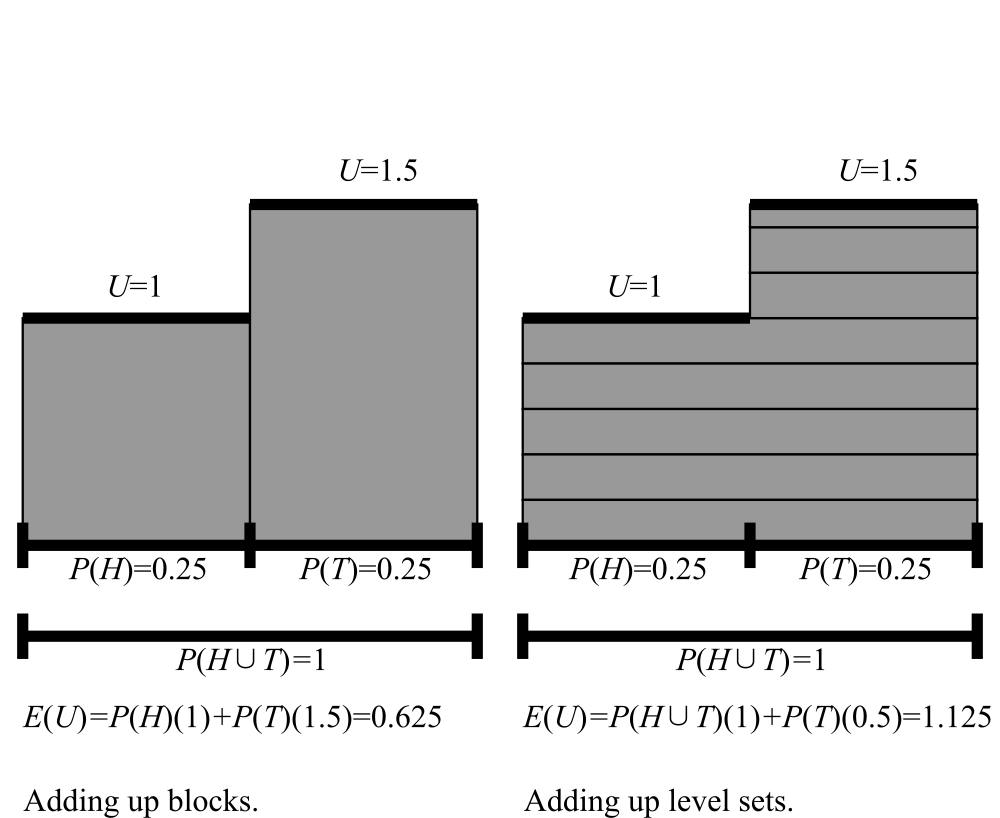
  1. E(U)=∑yyP(U = y).

Call this the Block Way or Lebesgue Sums.

Famously, doing this leads to Dutch Books if the credence function fails additivity. But there is another way to calculate the expected utility:

  1. E(U)=∫0∞P(U > y)dy − ∫−∞0P(U < y)dy.

Call this the Level Set Way, because sets of points in a space where some function like U is bigger or smaller than some value are known as level sets.

Here is a picture of the two ways:

Blocks vs. Level Sets

On the Block Way, we broke up the sample space into chunks where the utility function is constant and calculated the contribution of each chunk using the inconsistent credence function, and then added. On the Level Set Way, we broke it up into narrow strips, and calculated the contribution of each strip, and then added.

It turns out that if the credence function P is at least monotone, so that P(A)≤P(B) if A ⊆ B, a condition strictly weaker than additivity, then an agent who maximizes utilities calculated the Level Set Way will not be Dutch Booked.

Here is another fact about the Level Set Way. Suppose two credence functions U1 and U2 are certain to be close to each other: |U1 − U2|≤ϵ everywhere. Then on the Block Way, their expected utilities may be quite far apart, even assuming monotonicity. On the other hand, on the Level Set Way, their expected utilities are guaranteed to be within ϵ, too. The difference between the two Ways can be quite radical. Suppose a coin is tossed, and the monotone inconsistent credences are:

  • heads: 0.01

  • tails: 0.01

  • heads-or-tails: 1

  • neither: 0

Suppose that U1 says that you are paid a constant $100 no matter what happens. Both the Block Way and the Level Set Way agree that the expected utility is $100.
But now suppose that U2 says you get paid $99 on heads and $101 on tails. Then the Block Way yields:

  • E(U2)=0.01 ⋅ 99 + 0.01 ⋅ 101 = 1

while the Level Set Way yields:

  • E(U2)=1 ⋅ 99 + 0.01 ⋅ 2 = 99.02

Thus, the Block Way makes the expected value of U2 ridiculously small, and far from that of U1, while the Level Set Way is still wrong—after all, the credences are stupid—but is much closer.

So, it makes sense to think of the Level Set Way as harm reduction for those agents whose credences are inconsistent but still monotone.

That said, many irrational agents will fail monotonicity.

Friday, April 28, 2017

Fun with St Petersburg

Consider any game, like St Petersburg where the expected payoff is infinite but the prizes are guaranteed to be finite. For instance, a number x is picked uniformly at random in the interval from 0 to 1 not inclusive, and your prize is 1/x.

Suppose you and I independently play this game, and we find our winnings. Now I go up to you and say: “Hey, I’ve got a deal for you: you give me your winnings plus a million dollars, and then you’ll toss a hundred coins, and if they’re all heads, you’ll get one percent of what I won.” That’s a deal you can’t rationally refuse (assuming I’m dead-set against your negotiating a better one). For the payoff for refusing is the finite winnings you have. The payoff for accepting is −1000000 + 2−100⋅0.01⋅(+∞) = +∞.

Wow!

Now let’s play doubles! There are two teams: (i) I and Garibaldi, and (ii) you and Delenn. The members of each team don’t get to talk to each other during the game, but after the game each team evenly splits its winnings. This is what happens. The house calculates two payoffs using independent runs of our St Petersburg style game, w1 and w2. I am in a room with you; Garibaldi is in a room with Delenn. I and Delenn are each given w1; you and Garibaldi are each given w2. Now, by pre-arrangement with Garibaldi, I offer you the deal above: You give me a million, and then toss a hundred coins, and then you get one percent of my winnings if they’re all heads. You certainly accept. And Garibaldi offers exactly the same deal to Delenn, and she accepts. What’s the result? Well, the vast majority of the time, the Pruss and Garibaldi team ends up with all the winnings (w1 + w2 + w1 + w2 = 2w1 + 2w2), plus two million, and the you and Delenn team end up out two million. But about once in 2100 runs, the Pruss and Garibaldi team ends up with 1.99w1 + 1.99w2, plus two million, while you and Delenn end up with 0.01w1 + 0.01w2 − 2000000.

And, alas, I don’t see a way to use Causal Finitism to solve this paradox.

Wednesday, February 18, 2015

A fallacy of probabilistic reasoning with an application to sceptical theism

Consider this line of reasoning:

  1. Given my evidence, I should do A rather than B.
  2. So, given my evidence, it is likely that A will be better than B.
This line of reasoning is simply fallacious. Decisions in many contexts where deontological-like concerns are not relevant are appropriately made on the basis of expected utilities. But the following inference is fallacious:
  1. The expected utility of A is higher than that of B.
  2. So, probably, A has higher utility than B.
In fact it may not even be possible to make sense of (4). For instance, suppose I am choosing between playing one of two indeterministic games that won't be played without me. I must play exactly one of the two. Game A pays a million dollars if I win, and the chance of winning is 1/1000. Game B pays a hundred, and the chance of winning is still 1/1000. Obviously, I should play game A, since the expected utility is much higher. But unless something like Molinism is true, if I choose A, there is no fact of the matter as to how B would have gone, and if I choose B, there is no fact of the matter as to how A would have gone. So there is no fact of matter as to whether A or B would have higher utility.

But even when there is a fact of the matter, the inference from (3) to (4) is fallacious, due to simple cases. Suppose that a die has been rolled but I haven't seen the result. I can choose to play game A which pays $1000 if the die shows 1 and nothing otherwise, or I have option B which is just to get a dollar no matter what. Then the expected utility of A is about $167 (think 1000/6) and the expected utility of B is exactly $1. However, there is a 5/6 chance that B has higher utility.

The lesson here is that our decisions are made on the basis of expected utilities rather than on the basis of the probabilities of the better outcome.

Now the application. One objection to some resolutions to the problem of evil, notably sceptical theism, is this line of thought:

  1. We are obligated to prevent evil E.
  2. So, probably, evil E is not outweighed by goods.
But this is just a version of the expectation-probability fallacy above. Bracketing deontological concerns, what is relevant to evaluating claim (5) is not so much the probability that evil E is or is not outweighed by goods, but the expected utility of E or, more precisely, the expected utilities of respectively preventing or not preventing E. On the other hand, what is relevant to (6) is precisely the probability that E is outweighed.

One might worry that the case of responses to the problem of evil isn't going to look anything like the cases that provide counterexamples to the expectation-probability fallacy. In other words, even though the expectation-probability fallacy is a fallacy in most cases, it isn't fallacious in the case of (5) and (6). But it's possible to provide a counterexample to the fallacy that is quite close to the sceptical theism case.

At this point the post turns a little more technical, and I won't be offended if you stop reading. Imagine that a quarter has been tossed a thousand times and so has a dime. There is now a game. You choose which coin counts—the quarter or the time—and then sequentially over the next thousand days you get a dollar for each heads toss and pay a dollar for each tails toss. Moreover, it is revealed to you that the first time the quarter was tossed it landed heads, while the first time the dime was tossed it landed tails.

It is clear that you should choose to base the game on the tosses of the quarter. For the expected utility of the first toss in this game is $1, and the expected utility of each subsequent toss is $0, for a total expected utility of one dollar, whereas the expected utility of the first toss in the dime-based game is $(-1), and the subsequent tosses have zero expected utility, so the expected utility is negative one dollar.

On the other hand, the probability that the quarter game is better than the dime game is insignificantly higher than 1/2. (We could use the binomial distribution to say just how much higher than 1/2 it is.) The reason for that is that the 999 subsequent tosses are very likely to swamp the result from the first toss.

Suppose now that you observe Godot choosing to play the dime game. Do you have significant evidence against the hypothesis that Godot is an omniscient self-interested agent? No. For if Godot is an omniscient self-interested agent, he will know how all the 1000 tosses of each coin went, and there is probability that's insignificantly short of 1/2 that they went in such a way that the dime game pays better.