Showing posts with label amateur astronomy. Show all posts
Showing posts with label amateur astronomy. Show all posts
Monday, May 25, 2020
Manual Star Tracker
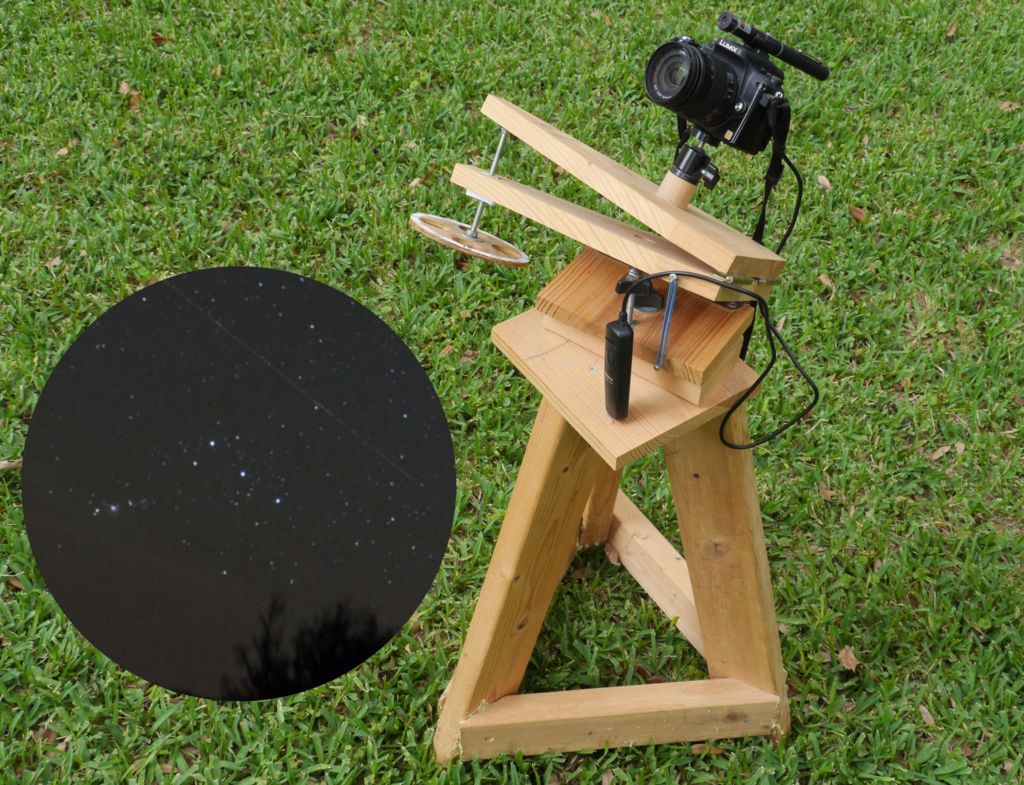
My Instructable for a simple manual star tracker for astrophotography is now up. The idea is that you manually rotate a knob together in sync with a stopwatch to compensate for the earth's rotation. There is little that is innovative, except for the fact that I accidentally found that a carriage bolt head compensates for tangent error very nicely.


Friday, November 4, 2016
My new toy
I've acquired a 3D printer (a used DaVinci 1.0a, hacked by the previous user to have custom firmware), and I've been having fun with it. I still don't have the ideal printing parameters figured out (ABS works OK, but PLA is dodgy, because the printer wasn't designed for it--I had to add a heat sink to help it), but I'm learning how to design 3D solid objects.
 I've been finding graphical 3D design tools like Sketchup and Fusion 360 highly unintuitive--maybe with more practice I can improve--but I've also come across OpenSCAD where one uses a simple programming language to code shapes, and that is much more intuitive to me. Last night I designed and printed a super-simple collimator box for the laser collimator for my telescope. Rotating, drawing and dragging faces would have been a big nuisance, but it was a simple bit of code, and it's easily customizable for other dimensions of laser.

Monday, May 9, 2016
Transit of Mercury
I'm taking a break from grading. See small dot right and up of center. Larger and more diffuse dot left of center is a sunspot.


Monday, March 31, 2014

Tuesday, June 5, 2012
Transit of Venus
Here are some photos over the first 45 minutes or so. They are in sequence, but not evenly spaced in time.
This is from my 8" F/4.5 scope, stopped down to about 3", with photo taken hand-held with my Canon G7 camera off the projection funnel.

Here is the last photo in a larger size. The sunspots were very nicely visible in the funnel (I counted about 15), and I could even see two without a telescope in the #14 welder's glass. The photo doesn't do justice to the sunspots, especially the nice bright area that was just barely visible at the bottom of the disc.

This is from my 8" F/4.5 scope, stopped down to about 3", with photo taken hand-held with my Canon G7 camera off the projection funnel.

Here is the last photo in a larger size. The sunspots were very nicely visible in the funnel (I counted about 15), and I could even see two without a telescope in the #14 welder's glass. The photo doesn't do justice to the sunspots, especially the nice bright area that was just barely visible at the bottom of the disc.

Sunday, May 20, 2012
Eclipse
Here in central Texas, the sun set before the eclipse hit maximum. But we had some lovely views of the moon gobbling up sunspots as the sun was setting over the lake. Photos are taken by a Canon G7 camera, using a modified version of the sun funnel for projection. The scope is an 8" F/4.5. For the first photo it was stopped down to about 3". The second photo I think used the full aperture.


And for reference, here's the sun in the afternoon, before the eclipse:


And for reference, here's the sun in the afternoon, before the eclipse:

Sunday, August 28, 2011
Micrometeorite candidates


From what I've read, rounded things that look like they were partly melted are good candidates. Here is a less rounded one that ended up on the slide of the four that I saved. I don't know how it got there, as I only intentionally transferred three to it, if memory saves. Maybe it accidentally got carried there. It looks too rough-edged to be a micrometeorite. However, I've also read that they can avoid atmospheric melting by being small, so maybe rough-edged things count as candidates, too. It, too, has a nice shine to it, though the photo doesn't show it.
If you try to view these with bright-field microscopy, of course you just get black silhouettes. What I did is I taped a bright LED flashlight to the microscope, pointing at the sample, and then I took timed exposures, holding the camera to the eyepiece (sometimes with some sort of adapter to keep the camera in place). For the second two photos, I found a way of adding more light. I took the microscope outdoors, and then reflected sunlight onto the slide with a mirror (actually, a hard drive platter--they make lovely mirrors). The photos were taken with point and shoot cameras hand-held to microscope eyepieces, with some loose-fitting adapters to make it easier. The first photo was with a Sony P100 through the 10X Huygens eyepiece that the microscope came with. The second and third photos were with a Canon G7 through a Rini 30mm telescope eyepiece, using my home-made telescope-to-microscope eyepiece adapter. Update: I wish I knew how to better identify micrometeorites. The very round one may not be one--see this article.
Tuesday, August 2, 2011
Telescope making instructable
My instructable for making a small (6") Dobsonian telescope got posted on the front page of Instructables. Yay! I built the scope with one of my colleagues at Baylor--we've got quite a nice little group of amateur astronomers in the Philosophy Department. (I also entered this project in their space-related contest.)
Friday, March 25, 2011
Hunting for micrometeorites
Inspired by stuff on the web (e.g., here), I went hunting for micrometeorites. I wrapped a magnet with plastic wrap, and ran it through the dirt under one of our house's downspouts. Apparently meteorites have high iron content so magnets capture them. There was some magnetic dust. I then transfered a couple of pieces of it to a microscope slide and had a look. I saw black chunks of stuff with transmitted light, unsurprisingly, but they became pretty and shiny when I shone a flashlight on them. The two largest ones had rough edges. Micrometeorites are supposed to be smoother due to their hot passage through the atmosphere. But moving the slide around, I cam on a smaller piece with smoother edges and interesting texture that matched what one would expect a meteorite to look like. There was some shiny bumpiness, some small pit-like spots and some interesting rod/wave like areas.
I tried to save the tiny piece for future observations. I tried to stick it to some sticky tape, but the goo made it very hard to observe under the microscope. So I ended up dissolving the goo with acetone to recover the piece. As a side-effect, the piece became cleaner and was brightly metallic under the microscope. Unfortunately, I eventually lost it. It was very small, about four or five times longer than wide, and the width was about that of a hair or maybe a touch more. I lost it when I tried to transfer it with the tip of a needle from a dirtier cover glass to a cleaner one, but somehow it just disappeared--I used a powerful loupe to try to find it, but couldn't. Oh well.
At least the kids got to see it. I don't know it was a meteorite, of course. Too bad I lost it before taking a picture.
Monday, December 27, 2010
Science fun for kids and adults
This isn't philosophy, but I've been having fun with sciencey (sciency?) things.
I just did this little demonstration for my five-year-old: I took a 12ml syringe with no needle attached, and filled it about 15% with hot tap water, turned it tip up, and used the plunger to push out the air. I then plugged the tip of the syringe with my finger, and pulled the plunger back, creating a partial vacuum (obviously, some air leaks back in). The water immediately started to boil, thereby demonstrating that the boiling point of water goes down as air pressure goes down.
Another step one can add (I didn't) is to touch the water that had just been boiling and observe that it's not boiling hot (I guess if one does that with a five-year-old, one accompanies it with warnings that normally water that had just been boiling is hot). A more sophisticated experiment would involve measuring the temperature of the water before and after the boiling, comparing with a control sample in another syringe that hadn't been made to boil, and seeing if the boiling removes thermal energy (as I expect it does).
 The other fun sciencey thing I got to do was that last night I went to our astronomy club's observatory and got to operate the 24" scope. Here's a quick photo I took of a small portion of the Andromeda Galaxy, showing a large star cloud (big circle) in it, an open cluster (small circle) in it, and a bunch of dark lanes, presumably due to Andromedan dust blocking out the light. The photo is about 17 arcmin on each side.
 I also took a quick photo of Comet Hartley, which I had previously seen in the fall. The comet is down and left of center, with coma going up and to the right.
I just did this little demonstration for my five-year-old: I took a 12ml syringe with no needle attached, and filled it about 15% with hot tap water, turned it tip up, and used the plunger to push out the air. I then plugged the tip of the syringe with my finger, and pulled the plunger back, creating a partial vacuum (obviously, some air leaks back in). The water immediately started to boil, thereby demonstrating that the boiling point of water goes down as air pressure goes down.
Another step one can add (I didn't) is to touch the water that had just been boiling and observe that it's not boiling hot (I guess if one does that with a five-year-old, one accompanies it with warnings that normally water that had just been boiling is hot). A more sophisticated experiment would involve measuring the temperature of the water before and after the boiling, comparing with a control sample in another syringe that hadn't been made to boil, and seeing if the boiling removes thermal energy (as I expect it does).


Tuesday, December 21, 2010
Lunar eclipse
I stayed up to watch the lunar eclipse. It was quite nice. I took the kids out for the grand finale.
I also took a whole bunch of photos. I'll be editing them a bit more and trying to write some script to align the frames better (and maybe even de-rotating?), but for now, here is the set. The animation jumpy because I wasn't taking pictures all the time--some of the time I was indoors watching Starship Exeter. I used a perl script and ImageMagick to animate the photos, using the exif time stamps and speeding up by a factor of 400. Some of the shadows are odd--I've had trouble with shadows of clouds, branches and internal telescope structures. I'll eventually try to clean up the photos and remove the bad ones.

I suppose one of the remarkable things about an eclipse is that one is used to astronomical views changing much more slowly. The video covers a period of about an hour.
Wednesday, June 2, 2010
Feeling at home in the universe
When I was a kid, and early in my amateur astronomy hobby, I found the night sky spooky. But now I feel relaxed and at home in the starry dark, with a telescope and (electronic) charts. There is a pleasant familiarity (though I still don't know the constellations by name very well; I often just see the shape on the chart and think of them as "the one that has such-and-such a squiggle"). I wonder if the feeling of at-homeness in the universe isn't some evidence that the universe is created for humans. On the other hand, we are made for heavenly life and exiles here. So maybe the feeling is pernicious. But the "here" where we are exiles, maybe that is not a spatial here. Perhaps the new earth and the new heavens will include--as in the last Narnia book--all the best features of the present earth and the present heavens. (For the report of the observing session that led to this reflection, see here.)
Thursday, May 6, 2010
My amateur astronomy blog
Somebody asked me for photos of my travel scope, so I started off an amateur astronomy blog with them. I expected I'll be mostly posting observing lists there and my DIY projects.
Friday, June 26, 2009
Dark nebulae
Last night, I was observing a portion of the Pipe Nebula, which is a dark lane of dust obscuring the Milky Way. It was kind of cool: I could see stars to the left of it through the telescope, and then as I moved the telescope to the right, the field of view went almost completely dark, except for some stars on the fringes and some quite faint stars in the middle. But did I see the Pipe Nebula? It seems that what constituted "seeing" the Pipe Nebula was my not seeing the stars behind it. After all, intuitively seeing seems to be a causal process whereby the seen object causes light to reach the eyes. But the Pipe Nebula did not cause any light to reach the eyes. Of course, the same issue comes up when one "sees" a matte-black cube, a shadow, etc.
Maybe, then, we need to relax the intuitive concept of seeing as a process whereby the seen object causes light to reach the eyes. One might say that seeing is a process whereby the seen object causes light to reach or not reach the eyes (or, maybe better, causes a particular profile of wavelengths of light to reach the eyes, which profile might be empty). But if that were right, then we should say that a blindfolded person sees the blindfold (and that a person with eyes closed sees the inside of the eyelids). However, I do not think we say that—we say, rather, that a blindfolded person does not see anything.
Here is an alternative that accounts for shadows, ultra flat black cubes and dark nebulae: in seeing, the seen object causes a non-empty shaped pattern of light. There are two ways of causing a shaped pattern of light: one way is by causing the light (by reflection, emission or refraction) and the other way is by causing the shape. Here, "shape" must be understood in such a way that a field of view filled with uniform light counts as a shape (so that if one is right up against a uniform blue wall, one still sees the wall) while an empty field of view, as in the blindfold case, does not count as a shape.
A problem with this account is that if one's face is up against a red, or green, or blue wall, one counts as seeing the wall, but if the wall is painted with ultra flat black paint, then one isn't seeing the wall. I do not know how to give an account on which one counts as seeing the ultra flat black wall, but one doesn't count as seeing the blindfold.
Saturday, September 20, 2008
Astronomy log
I had a really good time last night (i.e., the night of 9/19/2008) observing with a colleague: M25, M18, M8, M22, M28, C16, Omega Nebula, Ring Nebula, Jupiter with Great Red Spot, and maybe barely NGC6717 with averted vision. And a small asterism or open cluster at or near 18 38 11 +40 11 07 not listed in any of the catalogs I have.
[Edited: Initially, I logged the Omega Nebula twice, once as Omega and once as Horseshoe, because I found it twice, using different catalogs, not noticing it was the same object. I also saw the International Space Station, and an unidentified satellite.]
Friday, July 25, 2008
Amateur astronomy update
Last night, I found an OK observing site a five minute drive from home. There are some sodium lights 100-200 yards away, but they are bearable. I also found the tube of my Odyssey 8 sits nicely on the front seat of the car, secured with a seatbelt, as if it were a person. Log for last night: M28, M25, M22, M21, M8, M54, NGC6652, M69, NGC6997. And, of course, Jupiter, but that goes without saying.
Wednesday, July 23, 2008
Naming and taming
After having jumped into amateur astronomy, the sky has lost some of its aweful majesty to me. It's beautiful, but not aweful. I think this has something to do with the way that by having names to attach to objects and having ways of classifying them, there is a way in which we have tamed them. That beautiful glow over there—that's "just" the Lagoon Nebula. There is a way in which this is deceptive. We encompass a whole galaxy in a word, completely ignorant of the billions of fascinating lives that, for all we know, are unfolding there. But there is also a way in which the galaxy itself, leaving aside any life in it (I think it would be strange to talk of a dog, much less a human, as "part of the Milky Way Galaxy"), really is not aweful. It is a creature of God, and in itself not as wondrous as a human being with reason and volition.
I think the above gives me reason to be even more sympathetic to the Thomistic doctrine that God is not a member of any of the genera, and the early Christian insistence on God not having a name.
I think the above gives me reason to be even more sympathetic to the Thomistic doctrine that God is not a member of any of the genera, and the early Christian insistence on God not having a name.
Tuesday, July 22, 2008
Sex and reproduction
In my previous post I suggested, using amateur astronomy as an example, that an engagement in an activity can have a value over and beyond the value of the activity's goal, even though the value of the activity derives from the value of that goal.
An interesting instance of this is the following view of sex. Sex gets its value from being an activity naturally directed at offspring, offspring having great value. But the activity naturally directed at offspring has a value over and beyond that of offspring. Thus, even sex that does not result in reproduction, say because the couple is infertile (temporarily or permanently) has value. This value does not derive from the value of offspring in the particular case—there are none in the particular case—but from the fact that it is an instance of a type of activity that is directed at a good.
We can also see that there is something at least problematic in contraception. Contracepted sex is an engagement in a sexual activity while one is trying to ensure that that goal from which the activity derives its value is not attained. Imagine an amateur astronomer who, while engaging in the skilled activity of amateur astronomy (collimating telescope, choosing eyepieces, pointing telescope, etc.), just before looking in the eyepiece at the chosen object puts the lens cap back on. There, one's deliberate choices are contradicting that from which the activity derives its meaning.
Monday, July 21, 2008
Amateur astronomy and the joy of seeing
A couple of days ago, I got an 8-inch Newtonian telescope (an old Coulter Odyssey 8). I've been wanting to have a decent telescope since I was a kid. Earlier this year I had got some giant 15x70 binoculars, which gave some very nice views at dark locations, but the telescope will open new vistas. I'm still trying to find a good observing site close to home. At home there are too many trees and streetlights are very close.
Oddly enough, I don't have much of anything philosophical to say about amateur astronomy yet. Here is one remark, oddly making a connection with things I am writing in my book on love and sex—tomorrow's post will draw out the connection. Another will follow in two days.
Aristotle begins the Metaphysics with the remark that all humans desire to know, and gives as evidence the love which we have for the sense of sight, sight being the most informative of the senses. Yet the experience of amateur astronomers suggests that Aristotle is wrong. There is a joy in seeing that seems to go beyond mere knowing. After all, the average amateur astronomer, is unlikely to see anything that she couldn't find out much more about by reading astronomy textbooks or at least research articles. Yet, while the amateur astronomer may read astronomy textbooks and maybe even research articles, her paradigmatic activity as amateur astronomer, an activity into which many resources are put, is seeing.
One answer to the puzzle of why there is such an activity as amateur astronomy would be to bring in a distinction between knowing propositions and knowing what things appear like. If one has been born deaf, one may know all the scientific facts about a middle C, but have no idea what one sounds like. I don't think, however, that this is the best explanation of the existence of the amateur astronomer (or the tourist or bird-watcher[note 1]). One reason it's not, is that I am not sure I buy the distinction between knowing that and knowing what it is like. I think that a visual image can express proposition, a proposition that is distinct from those expressed in spoken words. One reason I say this is because I have a wide view of language, that includes gestures, sketches, and other things. So in seeing an object, one knows a proposition that cannot be put into words.
However, in fact, neither the story distinguishing between two kinds of knowledge, nor my liberality with propositions and language, does justice to the amateur astronomer. Two days ago I saw, I think, the Ring Nebula. That gave me some joy. But what did I see? It was not the magnificent photograph that can be seen here. It was a tiny and very faint greyish spot, which looked slightly less bright in the middle if one looked enough. (I was viewing only at 30X magnification—I need to get more eyepieces—in a light-polluted driveway, on a full-moon night, with a poorly collimated scope, a terrible combination.) Still, it was a delight to have found it. Yet if I was after information, even of the "what it is like" variety, I could have just used Google image search.

There is, then, a joy in seeing first hand, a joy that seems goes beyond the informational content. Seeing first hand, even through an instrument, has something more to it than seeing photographs. Part of it is, I think, is the activity in seeing that goes beyond contemplating. There is the taking up of a point of view. Think of people in an art gallery, looking at a picture from one distance, then stepping back or forward. There is the choosing of the right way of seeing it (glasses, microscopes, telescopes, with their various settings), the right time, the right location. And, especially for a beginner like me, there is the finding. There is a natural good in the activity of seeing, but this activity is more than just contemplating, where I use the term "contemplating" for the visual perceiving part of the activity. Contemplating is the completion of this activity, but the activity goes beyond the contemplation that results from it.
Now here is something that I think is interesting. While Aristotle is, I think, right that the value of seeing comes from the fact that seeing gives us more information than any other sense, we should not take this on at the level of individual instances or tokens. It is false that my seeing the Ring Nebula got all of its value from its informational content. Rather, it is that the activity of seeing (including here the taking up of a point of view, the screwing up of one's eyes, the finding of the object, the manipulating whether in reality or through changing filters, etc.—I am thinking here of Ian Hacking kinds of ideas) gets its value from the fact that it is an activity that has a directedness at a genuine good, the good of contemplating. But the activity then has a value even when it does not achieve the telos. This is a way in which Natural Law differs from consequentialism—instances or tokens of an activity directed at a good have a value over and beyond the relevant instance of the good. In fact, the activity is valuable even when the good that the activity is aimed at is not achieved. Thus, when I failed to find the Whirlpool Galaxy last night and the night before last, while that activity failed to achieve the contemplation that was its telos, it was valuable.
On this view, a particular engagement in an activity can gets its value from the fact that the type of activity has a value, and the type of activity can get its value from the activity's telos. The value of an activity can go beyond the value of the activity's point, even if the activity derives its value from that point. Notice that while amateur astronomy is a skilled activity, it would not have the same kind of meaning if it were not aimed in some way at truth—if, for instance, amateur astronomers put on filters that completely distorted the sky into prettier patterns.
Subscribe to:
Posts (Atom)