Showing posts with label music. Show all posts

Wednesday, April 24, 2024

A small disability

On the mere difference view of disability, one isn’t worse off for being disabled as such, though one is worse off due to ableist arrangements in society. A standard observation is that the mere difference view doesn’t work for really big disabilities.

In this post, I want to argue that it doesn’t work for some really tiny disabilities. For instance, about 3-5% of the population without any other brain damage exhibits “musical anhedonia”, an inability to find pleasure in music. I haven’t been diagnosed, but I seem to have something like this condition. With the occasional exception, music is something I either screen out or a minor annoyance. Occasionally I find myself with an emotional response, but I also don’t like having my emotions pulled on by something I don’t understand. When I play a video game, one of the first things I do is turn off all music. If I could easily run TV through a filter that removed music, I would (at least if watching alone). (Maybe movies as well, though I might feel bad about disturbing the artistic integrity of the director.)

On the basis of testimony, however, I know that music can embody immense aesthetic goods which cannot be found in any other medium. I am missing out on these goods. My missing out on them is not a function of ableist assumptions. After all, if the world were structured in accordance with musical anhedonia, there would be no music in it, and I would still miss out on the aesthetic goods of music—it’s just that everybody else would miss out on them as well, which is no benefit to me. I suppose in a world like that more effort would be put into other art forms. The money spent on music in movies might be spent on better editing, say. In church, perhaps, better poetic recitations would be created in place of hymns. However, more poetry and better editing wouldn’t compensate for the loss of music, since having music in addition to other art forms makes for a much greater diversity of art.

Furthermore, presumably, parallel to music anhedonia there are other anhedonias. If to compensate for musical anhedonia we replace music with poetic recitations, then those who have poetic anhedonia (I don’t know if that is a real or a hypothetical condition; I would be surprised, though, if no one suffered from it; I myself don’t appreciate sound-based poetry much, though I do appreciate meaning-based poetry, like Biblical Hebrew poetry or Solzhenitsyn’s “prose poems”) but don’t have musical anhedonia are worse off.

In general, the lack of an ability to appreciate a major artistic modality is surely a loss in one’s life. It need not be a major loss: one can compensate by enjoying other modalities. But it is a loss.

In the case of a more major disability, there can be personal compensations from the intrinsic challenges arising from the disability. But really tiny disabilities need not generate much in the way of such meaningful compensations.

Here’s another argument that musical anhedonia isn’t a mere difference. Suppose that Alice is a normal human being who would be fully able to get pleasure from music. But Alice belongs to a group unjustly discriminated against, and a part of this discrimination is that whenever Alice is in earshot, all music is turned off. As a result, Alice has never enjoyed music. It is clear that Alice was harmed by this. And the bulk of the harm was that she did not have the aesthetic experience of enjoying music—which is precisely the harm that the person with music anhedonia has.

Objection 1: Granted, musical anhedonia is not a mere difference. But it is also not a disability because it does not significantly impact life.

Response 1.1: But music is one of the great cultural accomplishments of the human species.

Response 1.2: Moreover, transpose my argument to a hypothetical society where it is difficult to get by without enjoying music, a society where, for instance, most social interactions involve explicit sharing in the pleasure of music. In that society, musical anhedonia may make one an outcast. It would be a disability. But it would still make one lose out on one of the great forms of art, and hence would still be a really bad thing, rather than a mere difference.

Objection 2: There is a philosophical and a spiritual benefit to me from my musical anhedonia, and it’s not minor. The spiritual benefit is that I look forward to being able to really enjoy music in heaven in a way in which I probably wouldn’t if I already enjoyed it significantly. The philosophical benefit is that music provides me with a nice model of an aesthetic modality that is beyond one’s grasp. Normally, “things beyond one’s grasp” are hard to talk about! But in the case of music, I can lean on the testimony of others, and thus talk about this art form that is beyond my grasp. And this, in turn, provides me with a reason to think that there are likely other goods beyond our current ken, perhaps even goods that we will enjoy in heaven (back to the spiritual). Furthermore, music provides me with a conclusive argument against emotivist theories of beauty. For I think music is beautiful, but I do not have the relevant aesthetic emotional reaction to it. My belief that music is beautiful is largely based on testimony.

Response 2: These kinds of compensating benefits help the mere difference view. Even if one were able to get tenure on the strength of a book on the philosophy of disease inspired by getting a bad case of Covid, the bad case of Covid would be bad and not a mere difference. The mere difference view is about something more intrinsic to the condition.

Thursday, May 30, 2019

Taste and cross-cultural encounters

After visiting the British Museum yesterday, I find it rather hard to take seriously the argument for the relativity of beauty from the diversity of taste. It seems clear that just as C. S. Lewis has argued for a moral core cutting across cultures, one can argue that there is an aesthetic core across cultures.

There is, however, an interesting apparent difference between the diversity of taste and the diversity of morals. I think a cross-cultural encounter involving a difference of taste regarding the best cultural artifacts—by each culture’s own standards—should typically lead to a broadening of taste. But a cross-cultural moral encounter should not typically lead to a broadening of morals. Very often, it should lead to a narrowing of morals: for instance, one culture learning from the other that slavery sex is wrong.

Why this difference? I think it may come from a difference in quantifiers.

As Aquinas already noted (in a somewhat different way), to be morally good, an action has to be good or neutral with respect to every relevant dimension of moral evaluation. If it is good with respect to courage and kindness and generosity, but it is bad with respect to justice (Robin Hood?), then the action is plain wrong. Thus as new dimensions of moral evaluation are discovered, as can happen in cross-cultural encounter, we get a narrowing of the actions that we classify as morally good.

On the other hand, for an item to be beautiful, it only needs to be beautiful with respect to some relevant dimensions of beauty. A musical performance is still beautiful on the whole even if the orchestra is dressed in dirty rags, and a painting can be beautiful even if it reeks of oil. Thus as we discover new dimensions of beauty, we get a broadening of the pieces that we classify as beautiful.

Wednesday, February 20, 2019

Fundamental bearers of aesthetic properties

I am finding myself frustrated trying to figure out whether the fundamental bearers of aesthetic properties are mental states or things out in the world. When I think about the fact that there does not seem to be any significant difference between the beauty of music that one actually listens to with one’s ears versus “music” that is directly piped to the auditory center of the brain, that makes me think that the fundamental bearers of aesthetic properties are mental states.

But on the other hand, when I think about the beauty of character exhibited by a Mother Teresa, I find it hard to think that it is my mental states—say, my thoughts about Mother Teresa—that bear the fundamental aesthetic properties. If I thought that it was my mental states that are the bearers of aesthetic properties, then I would think that a fictional Mother Teresa is just as beautiful as a real one. But it seems to me that a part of the beauty of the real Mother Teresa is that she is real.

Perhaps the fundamental bearers of aesthetic properties vary. For music and film, perhaps, the fundamental bearers are mental states: the experiences one paradigmatically has when listening and viewing (but which one could also have by direct brain input). For the characters of real people, perhaps, the fundamental bearers are the people themselves or their characters. For the characters of fictional people, perhaps, the fundamental bearers are mentally constituted (in the mind of the author or that of the audience or both).

Maybe the beauty of a real person is a different thing from the beauty of a fictional character. This kind of makes sense. For we might imagine an author who creates a beautiful work of literature portraying a nasty person: the nasty person qua fictional character is beautiful, but would have been ugly in real life, perhaps.

But I hate views on which we have such a pluralism of fundamental bearers of a property.

Monday, February 18, 2019

Musical beauty and virtual music

We have beautiful music at home on a hard drive. But wait: the arrangement of magnetic dipoles on a disc is not musically beautiful! So it seems inaccurate to say that there is music on the hard drive. Rather, the computer, hard drive, speakers and the orientations of magnetic dipoles jointly form a device that can produce the sound of beautiful music on demand.

One day, however, I expect many people will have direct brain-computer interfaces. When they “listen to music”, no sounds will be emitted (other than the quiet hum of computer cooling fans, say). Yet I do not think this will significantly change anything of aesthetic significance. Thus, the production of musical sounds seems accidental to the enjoyment of music. Indeed, we can imagine a world where neither composers nor performers nor audiences produce or consume any relevant sounds.

Perhaps, then, we should say that what is of aesthetic significance about my computer, with its arrangements of magnetic dipoles, is that it is a device that can produce musical experiences.

But where does the musical beauty lie? Is it that the computer (or the arrangement of magnetic dipoles on its drive) is musically beautiful? That seems wrong: it seems to be the wrong kind of thing to be musically beautiful. Is it the musical experiences that are musically beautiful? But that seems wrong, too. After all, a musical performance—of the ordinary, audible sort—can be musically beautiful, and yet it too gives rise to a musical experience, and surely we don’t want to say that there are two things that are musically beautiful there.

Perhaps a Platonic answer works well here: Maybe it is some Platonic entities that are trulymusically musically beautiful, and sometimes their beauty is experienced in and through an audible performance and sometimes directly in the brain?

Another possibility I am drawn to is that there is a property that isn’t exactly beauty, call it beauty*, which is had by the musical experiences in the mind. And it is this property that is the aesthetically valuable one.

And of course what goes for musical beauty goes for visual beauty, etc.

Monday, September 17, 2018

Non-propositional conveyance

One sometimes hears claims like:

  1. There are things that can be conveyed through X (poetry, novels, film, art, music, etc.) that cannot be conveyed propositionally.

But what kind of a thing are those things? Facts? Not quite. For while some of the “things that can be conveyed … that cannot be conveyed propositionally” are in fact real and true, some are not. Leni Riefenstahl’s Triumph of the Will and Fritz Lang’s M are both good candidates for conveying “things … that cannot be conveyed propositionally”. But Triumph in doing so conveys falsehoods about the Nazi Party while M conveys truths about the human condition. But facts just are. So, the “things” are not just facts.

What I said about Triumph and M is very natural. But if we take it literally, the “things” must then be the sorts of things that can be true or false. But the primary bearers of truth are propositions. So when we dig deeper, (1) is undermined. For surely we don’t want to say that Triumph and M convey propositions that cannot be conveyed propositionally.

Perhaps, though, this was too quick. While I did talk of truth and falsehood initially, perhaps I could have talked of obtaining and not obtaining. If I did that, then maybe the “things” would have turned out to be states of affairs (technically, of the abstract Plantinga sort, not of the Armstrong sort). But I think there is good reason to prefer propositions to states of affairs here. First, it is dubious whether there are impossible states of affairs. But not only can X convey things that aren’t so, it can also convey things that couldn’t be so. A novel or film might convey ethical stuff that not only is wrong, but couldn’t be right. Second, what is conveyed is very fine-grained, and it seems unlikely to me that states of affairs are fine-grained enough. The right candidate seems to be not only propositions, but Fregean propositions.

But (1) still seems to be getting at something true. I think (1) is confusing “propositionally” with “by means of literalistic fact-stating affirmative sentences”. Indeed:

  1. There are things that can be conveyed through X (poetry, novels, film, art, music, etc.) that cannot be conveyed by means of literalistic fact-stating affirmative sentences.

(Note the importance of the word “conveyed”. If we had “expressed”, that might be false, because for any of the “things”, we could stipulate a zero-place predicate, say “xyzzies”, and then express it with “It xyzzies.” But while that sentence manages to express the proposition, it doesn’t convey it.)

Wednesday, October 11, 2017

MIDI fruit piano

My daughters and I saw a Makey-Makey banana piano at a local fair, and they thought it was cool. So I made an Arduino(clone) fruit piano, using capacitive sensing, and a Python program on a computer that plays polyphonic music. It's super-simple, as it uses the ADCTouch library which doesn't need any electronic components besides the Arduino(clone), and it's better than the banana piano as it doesn't require the user to be grounded.

While tweaking the project, I learned that MIDI format is really simple, so now the fruit-piano sends notes to the computer via MIDI-over-serial-over-USB, and so one can presumably use the fruit-piano as a keyboard for various kinds of desktop music software.

Instructions are here. Code is here.

If you look at the picture carefully, you'll see that I cheated. We didn't have the eight oranges for the C major scale that my eldest daughter thought we should have, so two of the keys are soda cans.


Wednesday, June 29, 2016

Emotivism about art

Being largely tone-deaf, I don't appreciate music much at all. In fact, the older I get, the more music tends to annoy me, particularly when I meet it in the background of daily activities. I would much prefer listening to 4'33'' than to Mozart or Beethoven.

Yet I know that Mozart and Beethoven are much more beautiful music. Hence I embody a counterexample to emotivism about art. It is fun to be a counterexample (but I realize that it would be more fun to appreciate music, and I hope to do so in heaven).

Friday, April 29, 2016

Is music a sound?

It seems that music is a sound, and sound is constituted by vibrations of a surrounding medium, i.e., typically air. But you can listen to a musical piece through a bone conduction headset. In that case, you're not listening to vibrations of a surrounding medium. Moreover, we could suppose that the performer is producing electronic music live, which is directly piped to the audience's bone conduction headsets without any speakers anywhere, so it's never in the air (except accidentally). Assuming that the bone conduction headsets produce the same experienced quality as listening to the music the normal way, it seems that the audience wouldn't be losing out on anything musically relevant. Yet, if music is a kind of sound, and sound is vibrations of a surrounding medium, then we have a paradox:

  1. There is no music there.
  2. But the audience isn't missing out on anything musically relevant.
  3. So, music need not be musically relevant!

Perhaps, though, music doesn't require vibrations of a surrounding medium. The vibrations of bones might be sufficient to qualify as music. I am not sure, however, whether in the concert that I have imagined the audience counts as hearing vibrations of their bones. Yes, their bones vibrate, but the content of the experience isn't the vibration of bones. Rather, it sounds like sound coming from outside them, so the content is external sound, but in my story that's absent, replaced by a mere illusion of sound.

In any case, we can modify the story. Suppose the piece is performed electronically, and never generates the relevant vibrations. Instead, it is directly piped to the performer's and audience's brains' auditory centers. It seems that musically nothing is lost, even though now there is definitely no sound at all.

The conclusion that music needn't be musically relevant is absurd. So we have to deny the claim that music is a sound. What is it then? A sequence of experiences? Then there is no music when the performer and audience are deaf. Maybe that's a bullet we should bite?

Maybe music--both the music composed by a composer and the music performed by a performer (who may be in part or whole a composer, as in cases of improvisation)--should be seen as an abstract sound type. The composer and performer discover music but don't create it. In order to grasp an abstract sound type, it is not needed that one hear an instance of it, but only that one have an experience as of hearing an instance of it. The performer, thus, causes the audience to have experiences as of hearing instances of it. Those experiences are neither sound nor music. We can then, by extension, call an instance of the abstract sound type--i.e., a concrete sound--"music". But music in this sense is not musically relevant except as a vehicle for music in the Platonic sense.

(In case it's relevant, I should note that I'm largely tone deaf, and I do not speak from experience.)

(One can mount another argument against the thesis that music is a sound on the basis of Cage's 4'33". But if 4'33" is music, we could still say it normally involves sound, in that one could have a more nuanced theory on which sound isn't the vibrations, but a token pattern of vibrations. And no-vibrations counts a pattern of vibrations.)

Tuesday, July 22, 2014

Meaning

  1. Every meaning derives from components to which intelligent beings have assigned a meaning.
  2. Some things that have a meaning that does not derive from components to which earthly beings have assigned a meaning.
  3. Therefore, there is a non-earthly intelligent being.

I suggest two examples for premise (2).

Life: Life has a meaning. But a meaning of life that derives from our assignments is not a meaning that matters to us. What we have assigned meaning to, we could reassign meaning to. If the meaning of life were merely a matter of human assignment, then humanity's search for meaning would be a mere matter of curiosity, of figuring out how our ancestors have assigned meaning and how those meanings combine. It would be either like searching for the meaning of an ancient inscription (a case where we don't know the meanings of the components) or like parsing a complex sentence in first order logic (a case where we know the meanings of the components but don't know how they go together). There would be no deep existential relevance in such a meaning, since we could just as well assign a meaning ourselves. It would be just a meaning assigned by peers.

This example shows that the meaning of life needs not just to be a meaning assigned by a non-earthly intelligent being, but by a being whose meaning-assignments have deep existential relevance to us. A being with a deep kind of authority. So not just some space alien that seeded life on earth, say.

The sublime: Any case of the sublime—say, the Orion Nebula or Beethoven's 9th—has a meaning that escapes us, all of us. Cases of the sublime can be natural or human-made, but in both cases they have a meaning beyond us. And that meaning-beyond-us isn't just a matter of being better at figuring out how components combine, in the way that the meaning of a sentence of First Order Logic is. In a piece of the sublime we don't know very well, but can only vaguely sense, what the meaningful components are, and we are not responsible for the mysterious meaningfulness of these components. Even in the human-made cases, the creator is a servant to that mysterious meaning of the components.

Moreover, the meaning of the sublime piece is one that we resonate with, one we have a kind of grasp of—or maybe that has a grasp on us—that ever eludes us. We have a resonance to the meaning of the sublime. So whatever story we give about that meaning, we also need to give a story about how it's a meaning we resonate to. There could be aliens that have assigned deep mythological interpretations to various components of the Orion Nebula. But that isn't the meaning we resonate to. So, once again, the argument not only yields a non-earthly intelligence, but one who can make us resonate to his designs.

Wednesday, November 28, 2012

Music, religion and appreciation

I typically do not appreciate music at all. While there are rare exceptions, music typically leaves me aesthetically cold or annoys me (though there may be a non-aesthetic emotional impact, say of creepy music during a scary part of a movie). This inability to appreciate music is a kind of disability, one that I hope will be gone in heaven (plus the music there will be better), since music seems an important part of the human good of aesthetic appreciation.

I suspect that how I typically feel about music is how many (though not all) non-religious people feel about religion: while it may be good for others, it's just not something one finds oneself getting anything out of. But I think there is a crucial disanalogy. For it is uncontroversial that to be properly benefited by receptive aesthetic goods, like those proper to listening to music or contemplating a painting, one needs to experience them with appreciation. One gets nothing from musical goods without listening to the music, and mere listening gets one nothing of the aesthetic good if one doesn't appreciate. (Though experiencing the art without appreciation can lead to later development of appreciation, and an analogous claim can be true of religious practice.) But according to many of the great religions, many of the goods of participation—say, innate transformations of the soul, the intrinsic value of praising God, etc.—can occur in the absence of experiential appreciation.

There is also another disanalogy. Participating in religious goods isn't exactly analogous to experiencing works of art. Rather, it is analogous both to experiencing and to creating them. And creating works of art is an aesthetic good that perhaps does not require appreciation of the works of art that one is creating. One could have a sculptor who manages to express her artistic vision in incredible ways, but who incorrectly experiences herself as producing junk. The artist need not understand her work.

Friday, January 27, 2012

Copper pipe glockenspiel

My 6-year-old son and I built this copper pipe glockenspiel. Full build instructions with more photos are here.

Monday, January 9, 2012

Creative suggestion to improve my Leibniz and Spinoza seminar

I looked at my teaching evaluations from the fall.  There were some useful suggestions.  And one that was particularly amusing: background mood music.

Monday, October 3, 2011

On a relativism about beauty

Consider a naive relativist theory on which, necessarily,
  • y is beautiful to x if and only if x takes y to be beautiful.
This cannot be a complete theory about beauty.  After all, exactly the same theory can be given for ugliness:
  • y is ugly to x if and only if x takes y to be ugly.
Since nothing has been said that distinguishes beauty from ugliness, the theory cannot be complete.  

Moreover, there is a further oddness about the theory as I've given it.  According to the theory, the fundamental concepts are relational: being beautiful (or ugly) to.  But on the right hand side of the biconditionals we have the monadic beautiful (or ugly).  If someone fully accepts the theory, she won't take anything to be beautiful simpliciter, but only beautiful to her.  So, perhaps the relativist should say:
  • y is beautiful to x if and only if x takes y to be beautiful to her.
One serious problem with this is that then nothing is beautiful to the self-conscious objectivist, since the self-conscious objectivist takes nothing to be beautiful to her--she does not have any relational "is beautiful to" predicate.

And consider another problem.  Suppose I am essentially logically omniscient, so that if p and q are logically equivalent, then it is an essential property of me that I believe p if and only if I believe q.  Applying this to the biconditional, I get:
  • It is an essential property of me that: I believe that y is beautiful to me if and only if I believe that I take y to be beautiful to me.
But to take something to be beautiful to me is just to believe it is beautiful to me.  So:
  • It is an essential property of me that: I believe that y is beautiful to me if and only if I believe that I believe that y is beautiful to me.
But that is surely wrong: logical omniscience should not imply omniscience about my internal states.

Maybe, though, I am being too cognitivist about "takes y to be beautiful to her".  Maybe to take y to be beautiful isn't to believe anything about y but to have a certain appreciative attitude to y.  That takes care of the problem of the objectivist and the logically omniscient individuals.  

But we still have another problem.  Imagine that I love Mozart.  I go to a Mozart violin concert, and then during the intermission I get a message about a family emergency and I need to go home.  The first part of the concert was beautiful to me.  Tomorrow I hear that the second half of the concert was even better in the respects I appreciate.  I conclude that I missed some beautiful performances.  But on the appreciative attitude version of "takes", that's false.  For the second half of the concert wasn't beautiful to me, since I didn't take it to be beautiful in the appreciative sense.  

A familiar response is to amend the right-hand-side of the biconditional to replace "I take y to be beautiful (to me)" with "I would take y to be beautiful (to me) if I experienced y."  But probably not.  After all, had I stayed for the second half of the concert, worries about the family emergency and guilt that I am enjoying someone's fiddling while my home burns (literally or figuratively) would have spoiled my enjoyment of the concert.  Of course this is just a special case of the problems that go under the head of "the conditional fallacy."  

So we would have to idealize: I would take y to be beautiful if I experienced y in ideal observing circumstances.  But as the above example shows, the ideal observing circumstances need to include being in the right mental state.  We better not define the right mental state as the one in which one's appreciation is correct, since then our theory isn't subjectivist any more.  And given that what one appreciates can be so heavily dependent on one's emotional state, it seems that at this point matters are hopeless.  

And all the same goes for similar theories about morality.

Tuesday, April 8, 2008

Art as argument

I once ran a panel discussion between an Islamic theologian and a philosopher of art. The Islamic theologian was defending what she claimed was traditional Islamic jurisprudence, that for the sake of freedom of inquiry it is legally permitted to write anything in the context of intellectual verbal argument (even really nasty things about the founder of Islam, as long as long as they were supported by argumentation), but that there are restrictions on, say, what is permitted in art. The idea was that in intellectual inquiry, verbal expressions have a privileged status.

It seems to me that this account of inquiry is somewhat impoverished. While argument can be made in words, it can also be made in other ways. In their fun Handbook of Christian Apologetics Kreeft and Tacelli give this argument for the existence of God:

There is the music of Johann Sebastian Bach.
Therefore there must be a God.
You either see this one or you don't.
I may not see it, because my own appreciation of music is most deficient[note 1], but I see the kind of argument that is made here, and it is not an argument in words—simply asserting that there is the music of J. S. Bach doesn't do the job. The music is an essential part of the argument itself.

Or consider the following argument:

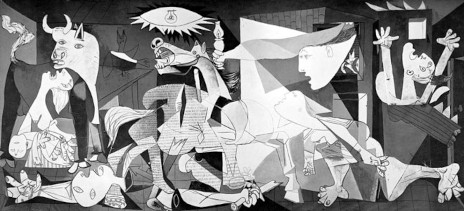
  1. Guernica
  2. Therefore, war is wrong.

Does it make sense to simply incorporate a work of art as a premise to an argument. One problem—and this may be the reason for the apparent Islamic privileging of verbal arguments—is that arguments that incorporate a work of art as a premise are hard to criticize. I am not a pacifist. So I accept that the above argument is unsound. But it is really hard to see what I deny. Do I deny premise (1), i.e., deny Guernica? That seems to be a category mistake. Or do I deny that (2) follows from (1)? So there is something unfair about the use of art in argument—one is putting oneself beyond criticism, except maybe by a competing work of art.

Difficulties with this notwithstanding, I do think the idea that a work of art can express an otherwise ineffable proposition is defensible. Perhaps Guernica expresses the proposition that war is like this (isn't it fun to use hyperlinks to indicate referrents of demonstratives?). If so, then while denying Guernica is a category mistake, denying the proposition expressed by Guernica is no category mistake.

If so, then poems, songs, novels, etc. can express propositions that have truth value. This might be relevant to an account of Biblical inerrancy that includes the full range of genres found in Scripture.

Final note: I think the Bach and Guernica arguments may have different logical forms. It may not be that the music of Bach itself expresses something that implies the existence of God, so that the music is not a premise, but only a part of a premise—the premise that there is this [mp3 download is from here].

Saturday, December 29, 2007

Music and the problem of evil

Suppose I have superhuman hearing. While you are listening to Beethoven's Ninth, I hear, with great precision, every single sound wave impacting each of my eardrums. But I do not actually assemble them into a coherent piece of music.[note 1] As far as aesthetic appreciation goes, I might as well be looking at a CD under a scanning electron microscope.

It is quite easy to see all the physical details of a work of art without seeing the work as a whole, which work gives meaning to the parts. The details may look nothing like the whole. And suppose now that we did not even see all the details, first, because our perceptual processes already processed the data in some lossy way, perhaps a way irrelevant to the aesthetic qualities (think of someone who, whenever a piece of music came into his ears, received instead a visual representation of a Fourier transform of a distorted version of the sound), and, second, because we did not perceive the whole. Then our judgment as to the aesthetic qualities of the whole, as to the fittingness of parts, would be of very dubious value.

Now it is plausible that a universe created by God is very much like a work of art. A work of art we see only a portion of and in a way that involves perceptual pre-processing of a sort that may lose many significant aspects of the axiological properties of the work.

If that is how we saw things, then we would find a portion of the "sceptical theism" position quite plausible: we would find it quite plausible that various local evils we see fit into global patterns that give them a very different significance from what we thought. I am not saying the local evils disappear, that they are not evil. But the meaning is very different. We see this in music, in literature, in painting.

[A]ll people are under control in their own spheres; but to everyone it seems as if there is no control over them. As for you, you only have to bother about what you want to be, because whatever and however you want to be, the craftsman knows where to put you. Consider a painter. Various colors are set before him, and he knows where to put each color. The sinner, of course, wanted to be the color black; does that mean the craftsman is not in control, and doesn't know where to put him? How many things he can do, in full control, with the color black! How many detailed embellishments the painter can make! He paints the hair with it, paints the eyebrows. To paint the forehead he only uses white. - St. Augustine, Sermon 125

And just as there may be aesthetic values we are unaware of, there may be moral values we are unaware of.

All this points towards a version of sceptical theism. But I think we should not go too far in that direction. For unlike a piece of music, the work of art that the universe is is executed not out of soundwaves that have little individual worth, the universe is a work that incorporates persons--beings in the image and likeness of God. This makes the divine work much more gloriously impressive especially if God doesn't determine our free actions, but it also means that there is real, intrinsic meaning in the local situations we find, in the pains, joys, sufferings and ecstasies of life. While the meaning of these can be transformed, evils will still be evils. The problem of evil is not solved in this way, but it is, I think, mitigated significantly.

Moreover, thinking in this way solves a problem that plagues standard sceptical theist solutions, namely that they undercut design arguments for the existence of God. For although we might be unable to perceive the significance of the whole, we might perceive significance in the part, and the beauty of a figure in a painting, a chapter in a novel or musical movement can be sufficient to establish something about the talent of the artist.

I explore some of these themes in this piece I once presented at a conference, but the online version is sadly bereft of its illustrations in part for copyright reasons.