Showing posts with label COVID-19. Show all posts

Thursday, September 7, 2023

Reverse valve masking

I was exposed to Covid recently, so by University rules I need to mask for a while. I don't particularly love masking at the gym, but I found a nice solution. My go-to mask for physical activity during the pandemic was the Trend Air Stealth N100 respirator, with the valve replaced by a 3D-printed blocker. But now I don't need to protect myself, just others. So I simply put the valve back in, but in reverse, so I get clear air intake but my exhalations go through the N100 filters. The respirator was already pretty breathable, but now it's even better, though it still looks super-weird and I need to remember not to use the respirator with this modification when I actually need protection, e.g., when doing woodworking.


Friday, May 7, 2021

Personal escape?

I'm now fully vaccinated, so through the wonders of modern medicine I'm deeming myself to have likely escaped COVID-19, while sadly aware that so much of the world is still struggling (I pray that vaccine patent waivers will go through and help).

I've been so very fortunate, unlike so many. Starting with August, the pandemic had little negative personal impact. On the contrary, being masked and distanced made me feel more comfortable around other people, and having conference and lecture travel be replaced with online events was wonderful. It would be great, for convenience, cost and environmental reasons, if conferences continued online indefinitely, hopefully with technical progress on getting informal interactions working better. (My experience is that the formal discussions at conferences are intellectually every bit as good when online, at least when the same people are in attendance.)

Since April 2020, I had exactly four occasions where I was within two meters of someone not from my household for 15 minutes or more in a 24-hour period. Two of them were dental visits. And two were Uber rides between home and the car repair shop. For the two Uber rides, I wore my "industrial-looking" elastomeric 3M P100 respirator (with an added exhalation filter), so I was quite safe--alas, it wasn't practical to do that for the dental visits.

For church and grocery stores, I usually used the 3M respirator. For the gym, I have a Trend woodworking N100 respirator (eventually modified to remove valves and block the exhale port). In both cases, I was quite safe and so were others around me.

Apart from one lecture moved online due to snow and one online due to a false COVID alarm (on the basis of two negative tests, I eventually concluded it was just a bad cold), I taught in person in both fall and spring. For teaching, I used cheap but heavily modified five-layer KN95 masks, because I was much more audible through them than through cloth, not to mention elastomeric respirators. Of course, I usually had some students Zooming in, often for COVID-related reasons but sometimes probably for more minor reasons.

I am not quite sure how I will modify my protocols now that I am fully vaccinated. My 3M and Trend elastomeric masks are very breathable, and keep the filter material away from my sweaty face, so I may end up still using the Trend mask for the gym. I may replace its N100 filters with 3D printed filters based on surgical mask material, though. I have considered continuing social distancing for the rest of my life in order to reduce the transmission of all respiratory diseases. Neither the flu nor even the common cold are enjoyable, and my personal utilities are such that if social distancing were to prevent the flu, it would be worth it, since given my white collar occupation and given that I live in a smallish town, it's only a slight inconvenience to distance myself under most circumstances, and it's intrinsically pleasant to have more personal space. However, since other people in my household aren't going to distance themselves from strangers once the pandemic is over, I suspect that my personal distancing would not do much to keep me from getting respiratory diseases at that point. I may make an effort to try for at least a meter of distance in most circumstances when interacting with people outside the household--but that is anyway within the range of North American proxemic zones.

Sunday, August 30, 2020

Another KN95 mask mod

As an experiment, I cut the ear loops of one of my KN95 masks, and then made them join very snugly behind the head with rubber bands. I found that both comfort and fit improved greatly: I tested this while rock climbing. I expect this might work for surgical-style masks as well.

Important note: If you do this, strengthen the ear loop joints with Shoe Goo or some other goopy adhesive first, or they will likely not withstand the added pressure.

An optional improvement I made later is to add a clasp to the lower strap to make it easier to put on despite the loop being tight. Here are my 3D printing files. If you don't have a 3D printer, you could probably make a clasp out of a paperclip.

This is a lot of work for a disposable mask. But I reuse them.

Friday, August 28, 2020

Making KN95 masks better

I have found (using a small single blind test) that disposable masks have better audio quality for teaching: cloth muffles the voice, especially I think an already somewhat muddy male voice like mine. Surgical-style masks have a lot of leaks around the edges, so I went with cheap ebay KN95 masks.

I reuse them, "disinfected" by airing for seven days (as recommended for N95 masks by the N95's inventor), leaving them hanging on a little wooden rack with nails in it. (I had some fun with my CNC router on it as you can see.)
The cheap KN95s have some air leaking around the edges and top, and occasionally I've had an earloop break off. So, here are three mods I've made. You can do the first two without special equipment, but the third requires a 3D printer. (But if you're someone in my social circle at Baylor, I could 3D print some for you.)

First: add a bit of Shoe Goo under, around and over where the earloops meet the mask. This seems to greatly increase the strength of the connection. No broken off earloops since.

Second: I added some rubber bands joining the earloops. The main point was to make the fit more snug, reducing air leaking. Sadly, it puts more pressure on the ears. (There is probably a sweet spot in rubber band length where it reduces pressure on the ears, but I'm putting safety over comfort.)

Third: I replaced the flimsy metal nosepiece with a hefty 3D printed one. It took me five prototypes until I got the size and shape right, but then it worked great in teaching. It's 2mm thick, printed in PLA, and glued on with Shoe Goo. (The metal strips came off very easily from at least one of the brands of cheap KN95s.) No more fiddling with fitting the nosepiece, and no more feeling of air going up and out along the nose bridge, so I expect it increased the protection for others from exhalation. I don't normally need to wear glasses with a mask, but I tested with my sunglasses while walking home from class and found no fogging. I still fiddle with and adjust the mask, but a nice bonus is that I mainly need to touch the plastic strip, which is probably cleaner than the filtering surface.

I don't know that the strip increased the protection for me as significantly, because the KN95s already would seal around the face when breathing in. (There have been a lot of claims made that masks protect others more than they protect the wearer. I am somewhat skeptical of this in the case of KN95s and well-fitted cloth masks, because my experience is that when you breathe in, fitted masks pull to the face and seal much more tightly than when breathing out.)

My 3D printing files are here. Unless I have an identical twin I don't know about, you'll need to edit the OpenSCAD files and tweak the Bezier parameters to make them work for you. Mine I did mainly by trial and error with five prototypes, but when I made one for my son, I had him press a wire around the bridge of his nose, and then scanned the wire along with a ruler for size, and traced Beziers over the wire (if you're in my Baylor social circle, I can do this for you, on the basis of a good photo of a bent wire and a ruler or other calibrating object).

Saturday, August 15, 2020

Fighting the flu

Some people, perhaps more towards the beginning of our pandemic than now, have said that we wouldn’t have a shutdown for seasonal influenza, and COVID-19 is not much worse. Our best mortality data shows that this argument is unsound: COVID-19 is much worse. But still I wonder if there isn’t something to do the idea of turning the argument around to conclude that we should be doing more about the flu—and the common cold, while we’re at it—than we are.

The flu isn’t nearly as deadly as COVID-19, but it does kill many. It causes significant suffering to a much greater number than it kills, and it is very disruptive to the economy. The kinds of public health measures taken against COVID-19 have apparently been extremely effective against the flu, apparently leading to a seven-fold decrease in flu-like symptoms in Australia around April of this year as compared to last year. Of course, for economic reasons, it would not be prudent to shut down businesses and schools to prevent the flu, especially since economic impact is one of the reasons for fighting the flu. And, in my sample of one, I continue to delight in the fact that since spring break, I haven’t had any flu or cold—five months without coughing is completely new to me, and wonderful!

But some of the measures taken against COVID-19 carry little economic costs, and yet might significantly decrease flu transmission. Specifically: voluntary individual social distancing and masks. Prior to the pandemic, comfortable personal space in the U.S. was said to be at least 1.5 feet for good non-romantic friends, four feet for strangers and three for co-workers and casual acquaintances. We could modify our etiquette to increase all these distances to six in those circumstances where it is not seriously inconvenient to do so. And we could also make it a part of our social etiquette that we wear good quality masks (which we could presumably make in large numbers at relatively low cost if we put more resources into it in the long term) when we are with those who aren’t very close to us, again when this is not seriously inconvenient.

Of course, there would be many circumstances where distancing and masking would be seriously inconvenient, and our etiquette could take those into account, just as it already allows for exceptions to personal space requirements on public transit and on crowded streets. And in cases where facial expressions are important, or when communicating with members of the Deaf community, one would need to take off one’s mask or use a mask with a window.

And there might well be some bonuses:

  • covering up a significant portion of the face could result in greater social equality for two reasons: (a) decreased lookism because of covering up of much of the face (one of my teens mentioned acne in this connection!) and (b) decreased barriers to social participation by those with serious social anxiety (for instance, I have noticed that I feel more comfortable in social interactions when covered up)
  • potential for avoidance of being the victim of street crime, in that non-accidental violation of one’s personal space would provide an earlier warning of bad intentions (with lots of false positives, of course) and allow earlier evasive and protective action.

It would require research whether such partial measures would have sufficient effectiveness against the flu (and the common cold, which is still pretty unpleasant) to outweigh their inconvenience, at least when any bonuses are added.

Nonetheless, I am kind of thinking of unilaterally implementing some variant of these measures once the pandemic is over. The idea of being on an airplane or in a car with strangers and not wearing a mask—even if flu and common cold are all that one has to worry about—now seems rather weird or even repugnant to me. And I’ve wanted more personal space for a while—I can see myself continuing to step back from people not in my household when having conversations to ensure six feet of separation.

(And of course getting vaccinated for the flu goes without saying. I didn't even bother to write it because it's so obvious until my wife reminded me of how many people don't do it.)

Monday, August 3, 2020

Should we vaccinate for COVID-19 ahead of Phase III trial results?

Warning: This is speculative back-of-the-envelope discussion of public policy outside of my fields of expertise.

For some time I’ve been thinking that perhaps, now that the Phase II safety trials of some coronavirus vaccines have been completed, we should just start vaccinating prior to completion of the Phase III trials. But of course, it’s not my field! Yesterday, however, I was pleased to note an article in Forbes by a biostatistician advocating the same thing.

While it’s not my field, I am a decision theorist, so here is a back-of-the-envelope utility calculation. The Oxford vaccine has had Phase I/II safety testing on 543 participants. Of course, there is about a 37% chance that, if there were an adverse effect that afflicts one in 543 participants, it would be missed by that sample. So, let’s suppose that there is a 40% chance of a 1 in 600 users lethal effect. So, counting vaccine-related death, the disutility of giving the vaccine to someone is (0.4)(1/600)=0.0007 deaths.

Given that Phase I/II does reveal some evidence of effectiveness, albeit evidence not sufficient for knowledge, we might say that we now have about 70% probability that the vaccine works, and let’s say that if it works, it works for 90% of the users (of course, these numbers are made-up). Moreover, by the best CDC estimate, each COVID-19 infection has a 0.0065 chance of resulting in death. So, counting death alone, the utility of giving the vaccine to someone who would otherwise have become infected is (0.7)(0.9)(0.0065)=0.004, counting only their life or death.

But here is the rub. We don’t actually know if a given individual would be infected if they did not receive the experimental vaccine. Eventually there will probably be a fully tested vaccine and/or a treatment. So far, pretty much the worst major location in the US has been New York City, and only 25% of the city has been infected. The utility of giving the vaccine to one person in New York City at the right time would thus have been something (0.25)(0.004)=0.001, again counting only their life or death.

So, the disutility is 0.0007 deaths and the utility is 0.001 lives, and these numbers are pretty close, so close that the uncertainties in all the back-of-the-envelope estimates likely swamp the differences. So by the above numbers, the idea of giving not fully tested vaccines probably wouldn’t be a good one, since as a matter of general policy we should keep to established testing protocols unless there is a compelling case to the contrary, and the case so far does not seem compelling.

However, a number of things can affect the above calculations, items 1–5 in favor of the not fully tested vaccines and 6 and 7 against it:

  1. very early data from some Phase III trials—e.g., the lack of deaths in the week following the initial injection—could be used to significantly lower the probability of lethal effect

  2. perhaps past data from other vaccine trials, and/or from medical theory, justifies one in thinking that the chance of a 1 in 600 lethal effect is much smaller than 40%; it’s not my field, so I have no idea if this is the case

  3. infection of others: the above only counts the benefit to the person being vaccinated; but if that person got COVID-19, they would on average have also infected about one other person; so there is a significant benefit to society from a successful vaccination

  4. some people are at higher risk for COVID-19 death; giving them the untested vaccine might make sense even if it doesn’t make sense for the average person; however, this is muddied by the fact that intuitively those in higher risk categories may also be at higher risk for vaccine complications

  5. behavior shifts: people who receive a vaccine are likely to take fewer precautions against infecting themselves and others, so if the vaccine doesn’t work, their chance of infection is likely to go up if they are vaccinated

  6. in many locations, the infection rate between now and whenever there is a fully tested successful vaccine or treatment may be rather lower than in New York City

At least the following is true: the option should be taken seriously, and careful calculations should be done.

Thursday, July 30, 2020

Testing masks for teaching

I had three family members turn away from me while I read two prepared philosophical sentences, using three different masks and no mask, and they ranked each reading for comprehensibility. The scale is:
  1. Incomprehensible
  2. Somewhat comprehensible
  3. Mostly comprehensible
  4. Comprehensible
  5. Completely clear
Here are the results:
  • No mask: 5.0
  • Cheap ebay "KN95": 4.3
  • Sonovia cloth antiviral mask (modified with nose wire): 3.7
  • Surgical mask: 4.7
The ordering between these also matches how I sounded to myself. Since the surgical masks provide very little in the way of protection--I can feel lots of air leaking around the edges--I think I will teach in the "KN95". Maybe I will try to tighten the straps on it for better fit.

For pictures and further descriptions of the masks, see my mask collection.

I would love to hear comments suggesting other options. Those of us who are not in a high risk category are expected to be teaching in person in the fall--with students and faculty all wearing masks, and with social distancing apparently less than 6 feet--and if anyone has ideas that balance comprehensibility with protection, I would love to hear them. Unfortunately, I don't project well normally when I speak.

Wednesday, July 29, 2020

My mask collection

Just as different pairs of shoes are useful for different occasions, different masks are useful for different occasions. Here's my collection.

Category 1: Likely to be significantly protective

1.1. 3M 6300 half-face mask with 2091 P100 filters

Summary: Should be extremely protective for inhalation. The fit of the soft silicone and the adjustable head-straps is excellent. It is easy to breathe through thanks to the large surface area of the filters. And while the original mask has an exhalation valve, and hence doesn't protect others much, I added a 3D printed filter over the exhalation valve, loaded with surgical mask material. As a result, the mask is highly protective of the wearer and probably more protective of others than many other masks, due to the much better fit.

My use cases: Church and shopping.

Down-sides: (1) thanks to the vibrating inhalation and exhalation valves and the thick silicone, I am barely audible through this mask, so I avoid wearing it in situations where I need to communicate with someone; (2) the mask is bulky, which makes it less good for sports; (3) the filters are expensive; (4) can leak around edges on exhalation when breathing extremely hard due to strenuous physical activity.

1.2. Sonovia cloth mask with antiviral and antibacterial coating

Summary: These are the most expensive cloth masks I've seen ($53-69 each, depending on quantity). I learned about these from my mom. My first thought was that they are a scam, but as far as I can tell (but then, this is not my field) they are made by a legitimate Israeli company, backed by serious scientists (including a Nobel prize winner), and their antiviral and antibacterial copper coating apparently really does work, and lasts many cycles of washing. I got a pack of three of these (at the time, they didn't sell them individually) so my daughter could attend her (outdoor, socially distanced) high school graduation.

Unfortunately, out of the box they don't come with a nose wire, which makes the fit poor. However, it was easy to cut a seam, insert a wire and sew it closed, and now the fit is much better. They have better fit for inhalation than exhalation in my experience: if I don't adjust the straps just right, I can feel exhaled air escaping at the cheeks, but they close tight around the nose and mouth for inhalation, providing what feels like a solid seal. A nice bonus of the antiviral coating is that I do not worry about the surface of the mask being contaminated.

My use cases: When I want significant protection but also want to be able to talk, or when the 3M mask is too bulky for convenience.

Disadvantages: More difficult to breathe through than some other options, especially if drenched with sweat. When our climbing facility reopened, I climbed in this mask the first day, but when it got wet while I was climbing laps, I felt like I was drowning for lack of air.

Category 2: Likely to be moderately protective

2.1. Home-made two-layer fitted mask often paired with surgical mask

I made this from one layer of T-shirt cotton and one layer of microfiber cleaning cloth, after looking at the sizes of holes in various fabrics under a microscope. I used this pattern, enhanced with a nose wire. The fit feels superb: I don't feel the tell-tale feel of air rushing past my skin around the edges on either inhalation or exhalation. Back when I didn't have the better masks above, when I went to high risk destinations like the grocery store or church, I would sometimes put a surgical mask under it, thereby increasing the number of layers of filtration while at the same time pressing the surgical mask to my face and hence improving the surgical mask's rather terrible fit.

2.2. Ebay "KN95"

These were so cheap ($10 for ten, and I've since gotten a similar pack of ten for $5) that notwithstanding apparent Chinese certifications, I wouldn't be surprised if they were fake KN95s (and that makes me feel good about not taking protective equipment away from medical staff). However, even if they don't reach the filtration level of a real (K)N95, they fit acceptably, and I suspect--admittedly, without testing--they provide better filtration than home-made cloth options. When breathing very hard--namely, during strenuous physical activity, I can feel air rushing out by the edges of the mask at inhalation, but the mask seems to seal to the face on inhalation. Moreover, I can breathe through it even when very sweaty. I reuse these, following the advice of the N95 inventor to just have multiple masks labeled with days of the week and let them self-disinfect over the period of a week.

My use case: Indoor rock climbing.

Disadvantages:(1) suspiciously low price; (2) poor fit on exhalation

Category 3: Less likely to be moderately protective

3.1. "Surgical" mask

Summary: We have these hanging about in various places and they are convenient to toss on quickly. I can feel they leak around the edges. They are so cheap ($10 for 50 on ebay, if memory serves me) that I doubt they are serious medical protective equipment, so I feel OK about using them.

My use cases: mainly for brief contact with someone (e.g., when picking up a drive-through order in the car)

Disadvantages: Leaks around edges.

3.2. Reebok athletic mask

Summary: These are easy to breathe through, but I have no idea how much protection they provide. They are great for athletic endeavors when one is so far from people outside one's household (e.g., when playing badminton with a family member on an indoor court) that the only reason for a mask is to satisfy the rules rather than protection.

My use cases: Indoor racquet sports when alone on a court with my son. I use a better mask when closer to staff while checking into the facility.

Disadvantages: Leaks at nose bridge causing fogging in sports that require goggles (e.g., racquetball).

Category 4: Not protective

4.1. Home-made single layer T-shirt mask

Summary: I sewed these quickly from an old T-shirt and a piece of wire. Sometimes one needs a mask to satisfy rules but where realistically protection of self or others is not an issue. For instance, an outdoor facility where one can easily distance oneself from others, or while alone on an indoor court with a family member.

Use cases: I toss these in our tennis bag in case I need to go to the bathroom in my department's building after hours when I am unlikely to meet another human in the building, but the university still requires face covering. Also, outdoors at our marina.

Disadvantages: Minimal to non-existent protection of self or others.

4.2. Bandana

Summary: This provides very little protection indeed, since I can feel most of the air coming in and out around the bottom, but it does not leak much around the top and hence works well with racquetball goggles.

Use case: When I play racquetball alone in a court with a family member, the main reason to wear the face covering is to satisfy the facility rules. I am careful to wear a better mask in other areas of the building where there is closer proximity to others, such as when signing in.

Disadvantages: Minimal to non-existent protection of self and others.

Wednesday, June 10, 2020

My new mask

I got myself a 3M 6300 half-face mask with P100 filters. Unfortunately, these have an exhalation valve so that any germs one has are breathed out at other people. So I put some cotton cloth in the exhalation valve, so that others at least get the same benefit they would if I was wearing a single layer cotton mask (or better, because the fit of the mask is superb--none of that air leaking around the nose that I had with my home-made masks), and I removed the exhalation-block valves at the P100 filters so a large portion of the outgoing air gets routed through them.

I look really weird in it. (My mom says it's World War I in pink.) But it's quite a bit more comfortable for breathing than my home-made fitted cloth mask (dual layer: microfiber washcloth plus cotton T-shirt) was, the straps are really comfy and spread the pressure really well, and the silicone lining fits really well.


I went to the grocery store. I was self-conscious and wondered about odd looks. Nothing, except for very friendly though slightly amused smiles from one older lady. The weird isn't so weird these days.

Update: I put the exhalation-block valves back to protect the P100 filters from my moisture, and printed a clip-on front filter holder for protecting others from my exhalations. I put a combination of shop-towel and cotton T-shirt in the exhalation filter. If the shop-towel I used is as good as the blue shop towels that have been tested, the result is N95-level protection for others from me and P100-level protection for me from others. I am planning to get another mask and look into ways of modifying it for sound projection (e.g., removing valves, using thinner home-made filters, but still keeping the fit which is incredibly good) so I can use it while teaching in the fall. Maybe I can make a filter holder that takes a microphone, even.

Thursday, March 26, 2020

DIY projects for hunkering down

This is a time of tragedy. But I've been very fortunate, having steady employment, and (so far) a healthy family. And lately I've had the opportunity to do a lot of fun DIY projects.

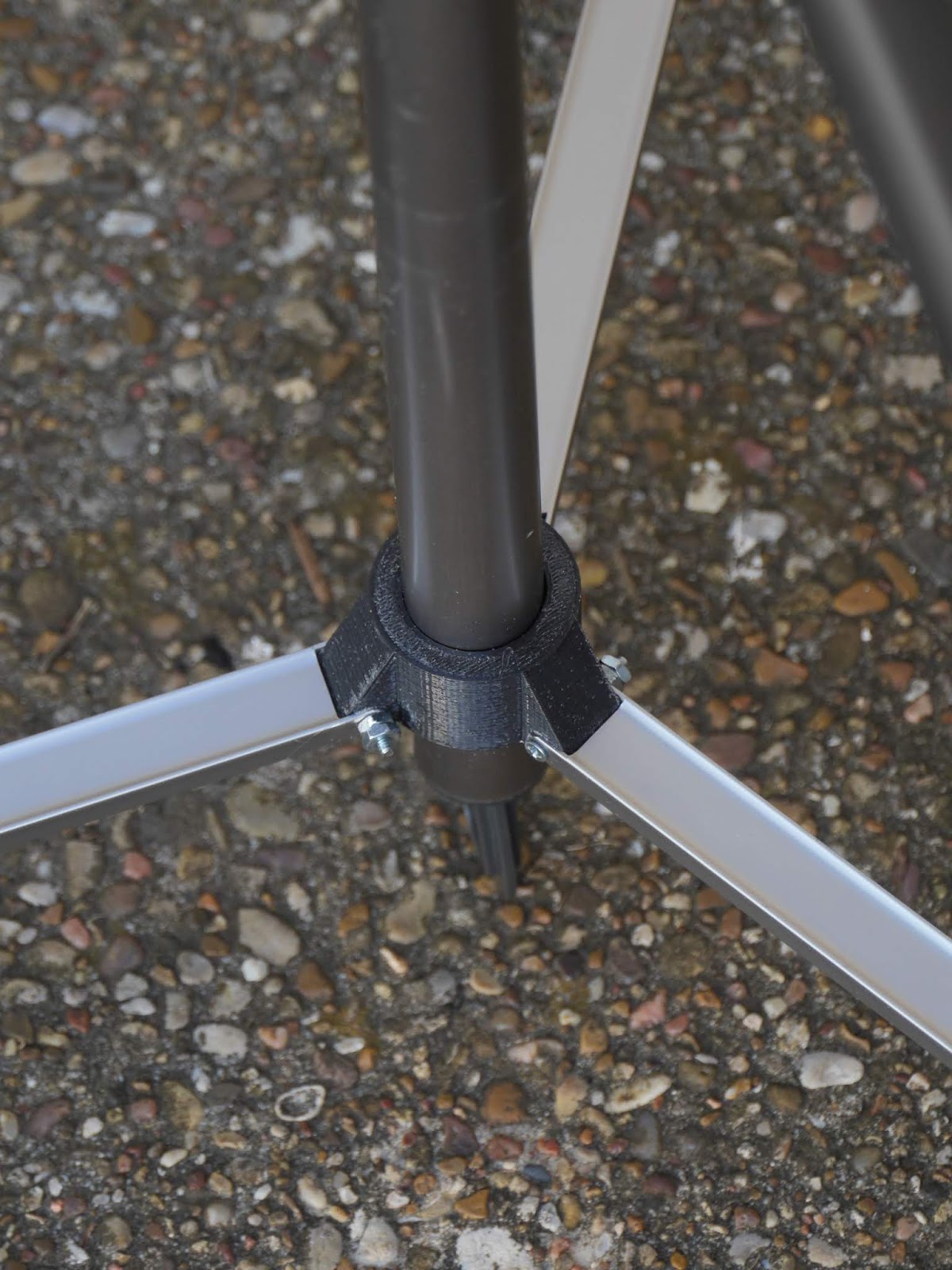
I'm teaching online. Mostly, I'm doing it by writing short notes, broken up into discussion-thread-sized bits, and posting them on a discussion forum. But I also recorded some short video segments today, which reminded me that our one camera tripod had a broken hub. So I designed and 3D printed a new one. (Design files are here.)

It's been bothering me for a while that one of our bathroom faucets had rounded knobs that had to be grasped firmly by the fist to turn. This means that you get the knobs dirty when you start the water with dirty hands, and then after you wash up you get your hands dirty from the knobs when you turn off the water. Levers are way better: you can either move them with elbows or you can ensure that you push on one side with dirty hands and on the other side with clean hands. I printed some lever attachments that slide over our rounded knobs. (Design files here.)


The grocery store was out of toilet paper. So we ordered some giant commercial-establishment bathroom rolls. Of course, they don't fit our toilet paper holders in the bathrooms, so I made this one out of some scrap wood and a handlebar from a broken-down scooter:


My usual form of exercise--the climbing wall--has been shut down. So, I've had to switch to tennis. I found out that it's hard to move around playing tennis in long pants, and I didn't own any shorts, so I found some old khakis in my scrap cloth box, and cut them down and hemmed them:

And, finally, I sewed a mask for myself and one for my wife for when we go to the grocery store. Mine used this design and the one for my wife used this one, except that I added some heavy gauge insulated copper wire to shape the nose ridge area. (I used cotton T-shirt material as per this article, layered with some microfiber for one of the masks.)