Showing posts with label defeating evil. Show all posts

Sunday, September 6, 2020

Heaven, the goods of others and the defeat of evil

There is a delight in competing athletically with one’s child: if they win, it feels good, and if one wins, it feels good, too. (The hedonic ideal is achieved when the child wins about 60% of the time; then one feels proud of their superiority, but not rarely one has the pleasure of beating a stronger opponent.)

Parental love makes it easy to love another as oneself (to paraphrase what C. S. Lewis says about Eros). It thus gives us an image of what it is like to be in heaven: we will greatly enjoy the goods had by others. This gives us an attractive picture of how the joy of heaven could fit with enduring differences in personal characteristics. Perhaps being an extrovert would not be true to my self and to God’s vocation for me, and so maybe even over an eternity in heaven I won’t be extroverted. But if so, I will still be fully happy for the joy of the heavenly extroverts, without any regret that I am not one of them, while they will be fully happy for me introverted joys, also without any regret that they are not like me.

Here are two controversial (for very different reasons) applications of this. First, there is a genuine and distinctive good in being a woman and there is a genuine and distinctive good in being a man, and it seems to make sense for a person to desire the goods of the other sex, regardless of whether it is possible to have them oneself. In heaven, however, Joseph can enjoy Mary’s good in being a woman and Mary can enjoy Joseph’s good in being a man, without Joseph regretting that he personally “only” has the good of manhood and Mary regretting that she personally “only” has the good of womanhood. That is what total love is like.

Second, given an eternalist or moving block theory of time, the past will always be fully real. This in turn gives us a solution to the problem that various important goods, such as marriage and self-sacrifice, will not be available in heaven. For we will be able to rejoice in others’ past possession of these goods, without regret for the fact that they aren’t ours and now.

The second point, however, raises the following problem: Won’t we also grieve for others’ past—and even present, if hell is a reality (as I think it is)—subjection to great evils? Maybe, but in God’s plan there is a crucial asymmetry between good and evil. Evils are defeated. How this defeat happens is deeply mysterious. But because of this defeat, I suspect the grief for a defeated evil will not hurt, precisely because of the evil’s being defeated, while goods remain undefeated and hence the joy for them will always delight.

In fact, the last point suggests something to me. A lot of philosophers of religion have said that it’s not enough for theodicy if evils are justly compensated for or their permission is in some way justified. We need these evils to be defeated. I think this is mistaken if all we are after is a response to the problem of evil. But we also need a response to the problem of why the past and present suffering of others doesn’t cause the saints pain in heaven. And it is here that we need the defeat of evil.

Thursday, December 22, 2011

Speculations on imitation, reflection, symmetry, truth, justice and value

Beartooth Butte / USDA/Forest Service
Imitation is a kind of reflection, and reflection seems to introduce a new symmetry into the world.  Symmetry has value, aesthetic value.  Therefore imitation seems to introduce value.

Wikipedia
Plato thought that the value of an imitation was derivative from the value of what was imitated.  That may be true if one considers the imitation in and of itself.  If the water is perfectly still, an ugly building will have an ugly reflection (if the water is not perfectly still, the natural beauty of the water may improve on the building).  But when one considers the imitation together with the imitated, the resultant symmetry can produce new, additional beauty.  The kaleidoscope is the most obvious example, where beauty arises by reflection from a jumble of shapes.


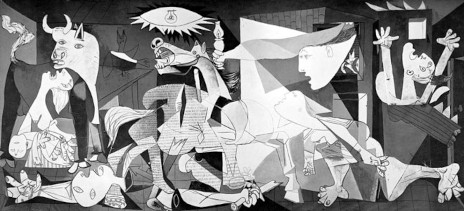
Thus the revelation of ugliness, as in Picasso's Guernica, when taken together with the horror that it reflects is a greater whole with a kind of grim beauty of symmetry.  This kind of symmetry is a case of truth.  It is aesthetically crucial for Guernica that the horrors it reflects are real.  Truth can have a beauty to it when it is a form of symmetry.  Thus at least sometimes we should take truth to correspond to reality.  

Symmetry, thus, is one way in which the bad and the ugly can become a constituent part of a good, a good that defeats the ugly and moves in the direction of defeating the bad.  Justice, in fitting reward and punishment, provides a further symmetry, a symmetry that also exhibits the aesthetic value of symmetry--we admire this aesthetic value when enjoy works of literature and film that exhibit poetic justice.  But justice has a value going beyond the aesthetic, as surely does truth.

The above show how one can derive an aesthetic value in imitation from the value of symmetry.  One could try to run the derivation in the opposite direction.  Could symmetry just be a form of imitation, and hence take its value from imitation?  First of all, only non-naturalists like theists and Platonists can say this, because a "chance" arrangement of pebbles can exhibit a genuinely beautiful symmetry without there being any imitation there.  The theist can say that Providence is behind the chance arrangement, and hence each symmetric segment of the arrangement can be imitating God in an infinitely imperfect way, while the Platonist can say that both symmetric segments reflect some Form.  But this would put the imitation in the wrong place.  For in the "chance" symmetric arrangement, what is beautiful is not just that each symmetric segment imitates God or the Forms, but that they are symmetric to one another.  This symmetry is not just a mirroring, because mirroring has an essential distinction between the mirror image and reality, with the reality being explanatorily prior, while the segments of an artistically planned symmetric arrangement do not need to have one of them be explanatorily prior to the others.

But, nonetheless, the theist needs to affirm that there is a value in imitation that does not come from the value of symmetry and, further, that there can be cases where imitation has no value of symmetry.  For all creation imitates God, but it does not thereby produce a greater God-and-creation whole (even an ontologically innocent) that exhibits the value of symmetry.  For nothing can add anything to God.  There is no holistic value of which God is component.  God perfectly exhibits the symmetry of three Persons with precisely one essence, and creation's imperfect imitation adds nothing to this perfection.  There is no new valuable symmetry of "God and creation".  Thus while symmetry is valuable in and of itself, imitation can have a value over and beyond the value of symmetry: the imitation of God only highlights the infinite gulf between God and creation rather than creating symmetry.

And so we come back to seeing that Plato may have been right.  The value (aesthetic and otherwise) of the imitation qua imitation, rather than of the imitation qua producer of symmetry, depends on the value of what is being imitated.  Creation as imitation of God exhibits that value, but does not as imitation of God exhibit the value of symmetry.  On the other hand, Guernica has no additional value of imitation qua imitation beyond symmetry, since the horrors of war that are being imitated are ugly and evil.  But at the same time, revelatory imitation of evil can have an additional value qua revelatory, namely the value of truth.

Thus, while there is a tie between imitation and symmetry, and within creation imitation produces a kind of symmetry, we should not derive the value of imitation from that of symmetry nor that of symmetry from that of imitation.  Likewise, truth and retributive justice have values independent of symmetry, though truth about creatures and retribution, whether positive or negative, to creatures seems to always exhibit the value of symmetry as well.

Saturday, April 19, 2008

Defeating evil

In recent years, some theists have proposed that it is not enough to say that God allows evil that greater good may come of it (with whatever qualifiers and precise formulation that needs). Rather, God defeats evil. I have suggested once that when x forgives an evil that was done to her, this is a good sufficiently to justify God's permitting the evil. In fact, I think a stronger claim holds: when we forgive an evil done to us, we thereby defeat that evil. Interestingly, even though the claim that an evil has been defeated strikes me as logically stronger than the claim that a greater good has come from the evil, it can sometimes be the case that we can directly see that the defeat claim is true and then infer from that that a greater good has come. Here is such a case. I think of Jews in one block of a concentration camp who get up an hour before everybody else at, so that they can all take turns praying using the one set of tefillin and one prayer shawl that they have hidden, risking their lives and sacrificing their meager sleep to praise the Lord. This, it seems clear to me, defeated at least some of the Nazi evils done to them: the Nazis strove to dehumanize them, but instead as a result they rose—by God's grace surely—to the greatest heights of humanity. (This kind of reminds me of what I say about poetic justice here.)

Let me end on a different, somewhat lighter note. Here is a proposed sufficient condition for defeat of an evil, that probably does not apply to the above cases. An evil E is defeated in respect of a victim x if x is able to properly and whole-heartedly laugh at E. (Here it's worth remembering Isaac's name. Literally: "He laughs (or will laugh)". Who is "He"? Probably God: "God laughs at his enemies" seems to be the image.)