Showing posts with label choice. Show all posts

Tuesday, January 23, 2024

Do I need to be aware of what I am intending if I am to be responsible?

I am going to argue that one doesn’t need to be conscious of intending to ϕ in order to be responsible for intending to ϕ.

The easiest version of the argument supposes time is discrete. Let t1 be the very first moment at which I have already intended to ϕ. My consciousness of that intending comes later, at some time t2: there is a time delay in our mental processing. So, at t1, I have already intended to ϕ. When I have intended to ϕ, I am responsible for ϕ. But now suppose that God annihilates me before t2. Then I never come to be aware that I intended to ϕ, but yet I was already responsible for it.

Here are three ways out:

  1. I am not yet responsible at t1, but only come to be responsible once I come to be aware of my intention, namely at t2.

  2. My awareness is simultaneous with the intention, and doesn’t come from the intention, but from the causal process preceeding the intention. During that causal process I become more and more likely to intend to ϕ, and so my awareness is informed by this high probability.

  3. My awareness is a direct simultaneous seeing of the intention, partially constituted by the intention itself, so there is no time delay.

Tuesday, February 1, 2022

Intentional acts that produce their own intentions

Start with these assumption:

  1. If you are at least partly responsible for x, then x is at least partly an outcome of an intentional act with an intention that you are at least partly responsible for.

  2. You are at least partly responsible for something.

  3. You do not have an infinite regress of intentions.

  4. You do not have a circle of distinct intentions.

For brevity, let’s drop the “at least partly”. Let’s say you’re responsible for x. Then x must be an outcome of an intentional act with an intention I1 you’re responsible for; the intention I1 then must be an outcome of an intentional act with an intention I2 you’re responsible for; and so on.

It seems we now have a contradiction: by (1) and (2), either you have infinitely many intentions in the list I1, I2, ..., and hence a regress contrary to (3), or else you come back to some intention that you already had, and hence you have a circle, contrary to (4).

But there is one more possibility, and (1)–(4) logically entail that this one more possibility must be true:

  1. For some n, In = In + 1.

This is like a circle, but not quite. It is a fixed point. What we have learned is that given (1)–(5):

  1. You have at least one intention that is at least partly an outcome of an intentional act with that very intention.

This seems even more absurd than a circle or regress. One wants to ask: How could an intention be its own outcome? But this question has a presupposition:

  1. Any at least partial outcome of an intentional act is an at least partial outcome of the intentional act’s intention.

What we learn from (6) is that the presupposition (7) is false. (For if (7) were true, then given (6) some intention would be its own at least partial outcome, which is indeed absurd.)

But how can (7) be false? How can an outcome (again, let’s drop the partiality for brevity) of an intentional act not be an outcome of the act’s intention? I think there are two possibilities. First, the act’s intention can itself be an outcome of the act. Second, the act’s intention can be something that is parallel to the act and neither is an outcome of the other. The second view fits with acausalist views in the philosophy of intention, but it does not seem plausible to me—there needs to be a causal connection of some sort between an intentional act and its intention. And in any case the second view won’t help solve our puzzle.

So, we are led to a view on which at least sometimes the intention of an intentional act is an outcome rather than a cause of the act. If we think of an intention as explaining the rational import of an act, then in such cases the rational import of the act is retrospective in a way.

It would be neatest if every time one performed an intentional act, the intention were an outcome of the act. But we have good reason to think that sometimes the intention precedes the intentional act. For instance, when I decide on a plan of action, and then simply carry out the plan, the plan as it is found in my mind informs my sequence of acts in the way an intention does, and so it makes sense to talk of the plan as an intention. But now think about the mental act of deliberation by which I decided on the plan, including on the plan’s end. Here it makes sense to think of the plan’s end as being a part of the intention behind the mental act—the mental act is made rational by aiming at the plan’s end.

But all this is predicated on (1). And it now occurs to me that (1) is perhaps not as secure as it initially seemed. For imagine this case. I am trying to decide on what to do, so I engage in deliberation. The deliberation is an intentional mental act, whose intention is to come to a decision. But perhaps I do not need to be responsible for this intention in order to be responsible for the decision I come to. I can be simply stuck with having to come to a decision, and still be responsible for the particular decision I come to. In other words, deliberative processes could be a unique case where I am responsible for an act’s outcome without being responsible for the act’s intention. That doesn’t sound quite right to me, though. It seems that if the outcome of the deliberative processes is not what I intend, and, as is often the case, is not even what I foresee, then I am not responsible for that outcome.

Wednesday, November 25, 2020

Reasons as construals

Scanlon argues that intentions do not affect the permissibility of non-expressive actions because our intentions come from our reasons, and our reasons are like beliefs in that they are not something we choose.

In this argument, our reasons are the reasons we take ourselves to have for action. Scanlon’s argument can be put as follows (my wording, not his):

  1. I do not have a choice of which reasons I take myself to have.

  2. If I rationally do A, I do it for all the reasons for A that I take myself to have for doing A.

And the analogy with beliefs supports (1). However, when formulated like this, there is something like an equivocation on “reasons I take myself to have” between (1) and (2).

On its face reasons I take myself to have are belief-like: indeed, one might even analyze “I take myself to have reason R for A” as “I believe that R supports A”. But if they are belief-like in this way, I think we can argue that (2) is false.

Beliefs come in occurrent and non-occurrent varieties. It is only the occurrent beliefs that are fit to ground or even be analogous to the reasons on the basis of which we act. Suppose I am a shady used car dealer. I have a nice-looking car. I actually tried it out and found that it really runs great. You ask me what the car is like. I am well-practiced at answering questions like that, and I don’t think about how it runs: I just say what I say about all my cars, namely that it runs great. In this case, my belief that the car runs great doesn’t inform my assertion to you. I do not even in part speak on the basis of the belief, because I haven’t bothered to even call to mind what I think about how this car runs.

So, (2) can only be true when the “take myself to have” is occurrent. For consistency, it has to be occurrent in (1). But (1) is only plausible in the non-occurrent sense of “take”. In the occurrent sense, it is not supported by the belief analogy. For we often do have a choice over which beliefs are occurrent. We have, for instance, the phenomenon of rummaging through our minds to find out what we think about something. In doing so, we are trying to make occurrent our beliefs about the matter. By rummaging through our minds, we do so. And so what beliefs are occurrent then is up to us.

This can be of moral significance. Suppose that I once figured out the moral value of some action, and now that action would be very convenient to engage in. I have a real choice: do I rummage through my mind to make occurrent my belief about the moral value of the action or not? I might choose to just do the convenient action without searching out what it is I believe about the action’s morality because I am afraid that I will realize that I believe the action to be wrong. In such a case, I am culpable for not making a belief occurrent.

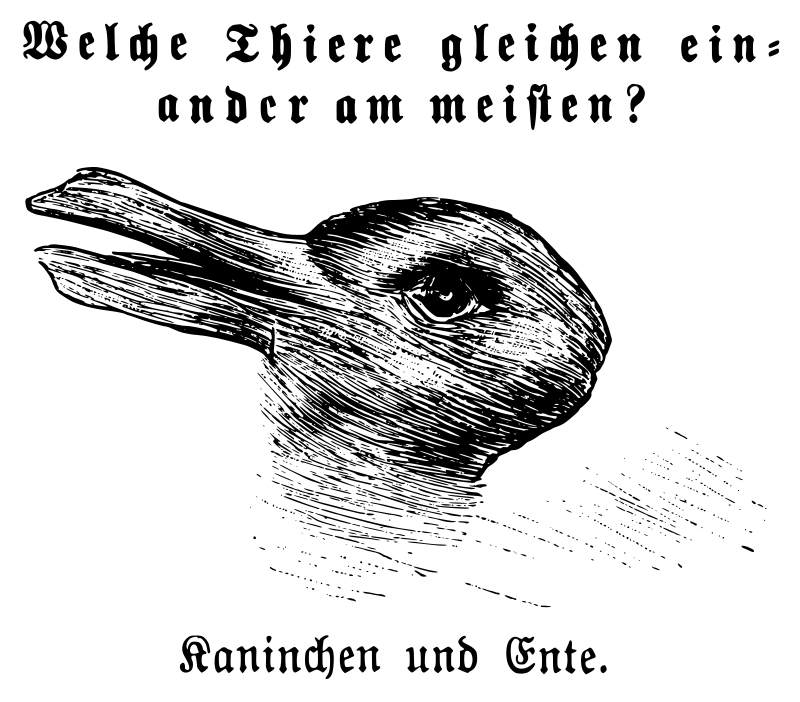
While the phenomenon of mental rummaging is enough to refute (1), I think the occurrent belief model of taking myself to have a reason is itself inadequate. A better model is a construal model, a seeing-as model. It’s up to me whether I see the duck-rabbit as a duck or as a rabbit. I can switch between them at will. Similarly, I can switch between seeing an action as supported by R1 and seeing it as supported by R2. Moreover, there is typically a fact of the matter whether I am seeing the duck-rabbit as a duck or as a rabbit at any given time. And similarly, there may be a fact of the matter as to how I construed the action when I finally settled on it, though I may not know what that fact is (for instance, because I don’t know when I settled on it).

In some cases I can also switch to seeing the action as supported by both R1 and R2, unlike in the case of the duck-rabbit. But in some cases, I can only see it as supported by one of the reasons at a time. Suppose Alice is a doctor treating a patient with a disease that when untreated will kill the patient in a month. There is an experimental drug available. In 90% of the cases, the drug results in instant death. In 10% of the cases, the drug extends the remaining lifetime to a year. Alice happens to know that this patient once did something really terrible to her best friend. Alice now has two reasons to recommend the drug to the patient:

  • the drug may avenge the evil done to her friend by killing the patient, and

  • the drug may save the life of the patient thereby helping Alice fulfill her medical duties of care.

Both reasons are available for Alice to act on. Unless Alice has far above average powers of compartmentalization (in a way in which some people perhaps can manage to see the duck-rabbit as both a duck and a rabbit at once), it is impossible for Alice to act on both reasons. She can construe the recommending of the pill as revenge on an enemy or she can construe it as a last-ditch effort to give her patient a year of life, but not both. And it is very plausible that she can flip between these. (It is also likely that after the fact, she may be unsure of which reason she chose the action for.)

In fact, we can imagine Alice as deliberating between four options:

  • to recommend the drug in the hope of killing her enemy instantly

  • to recommend the drug in the hope of giving her patient a year of life

  • to recommend against the drug in order that her enemy should die in a month

  • to recommend against the drug in order that her patient have at least a month of life.

The first two options involve the same physical activity—the same words, say—and the last two options do as well. But when she considers the first two options, she construes them differently, and similarly with the last two.

Thursday, February 27, 2020

A causal powers account of the favoring relation for reasons in a choice

Suppose we accept the following causal power account of what it means for reasons to enter deliberation:

  1. A complex of reasons R counts as entering into a choice C in favor of an act of will A precisely when R confers on the agent a causal power to A as the outcome of C.

And suppose we also add:

  1. In a choice C, there are two or more incompatible acts of will each of which is favored by its own complex of reasons entering C.

Finally, let’s add:

  1. If you have a causal power to ϕ as the outcome of C, then it is causally possible for you to ϕ when you are in C.

It follows from 1-3 that:

  1. In any choice, there are two or more causally possible incompatible acts of will.

And that’s a version of the Principle of Alternate Possibilities.

What about Frankfurt cases? Well, the above metaphysics of reasons gives a very nice response to non-theistic Frankfurt cases: No finite being can make you choose act of will A in C. For if someone did so, by (3), they would have to take away your causal power to will anything incompatible with A, and by (1), they would have to take out of the choice the complexes of reasons favoring acts of will incompatible with A, and in doing so they would thus be ensuring that by (2) there is no choice (but, rather, a shoo-in, where the reasons entering the deliberation end up favoring only one action).

What about theistic Frankfurt cases? Could God, without taking away the causal power for acts of will alternative to A, simply refuse to cooperate with such acts of will? Maybe. But I think in that case, he still wouldn't be making you choose A. At most, God could ensure you don't choose any alternative. But since you had a power for non-A, you wouldn't have to go for A. At the same time, you couldn't go for any alternative to A. Thus, I think, it would be possible for you to get into a position where you can't will contrary to A, but you can refrain from willing A. The only way God could take that away from you would be by taking a way the alternate powers, and in doing so he would be making you not make a choice.

Monday, January 15, 2018

If computers can be free, compatibilism is true

In this post I want to argue for this:

  1. If a computer can non-accidentally have free will, compatibilism is true.

Compatibilism here is the thesis that free will and determinism can both obtain. My interest in (1) is that I think the compatibilism is false, and hence I conclude from (1) that computers cannot non-accidentally have free will. But one could also use (1) as an argument for compatibilism.

Here’s the argument for (1). Assume that:

  1. Hal is a computer non-accidentally with free will.

  2. Compatibilism is false.

Then:

  1. Hal’s software must make use of an indeterministic (true) random number generator (TRNG).

For the only indeterminism that non-accidentally enters into a computer (i.e., not merely as a glitch in the hardware) is through TRNGs.

Now imagine that we modify Hal by outsourcing all of Hal’s use of its TRNG to some external source. Perhaps whenever Hal’s algorithms need a random number, Hal opens a web connection to random.org and requests a random number. As long as the TRNG is always truly random, it shouldn’t matter for anything relevant to agency whether the TRNG is internal or external to Hal. But if we make Hal function in this way, then Hal’s own algorithms will be deterministic. And Hal will still be free, because, as I said, the change won’t matter for anything relevant to agency. Hence a deterministic system can be free, contrary to (3). Hence (2) and (3) are not going to be both true, and so we have (1).

We perhaps don’t even need the thought experiment of modifying Hal to argue for a problem with (2) and (3). Hal’s actions are at the mercy of the TRNG. Now, the output of the TRNG is not under Hal’s rational control: if it were, then the TRNG wouldn’t be truly random.

Objection 1: While Hal’s own algorithms, after the change, would be deterministic, the world as a whole would be indeterministic. And so one can still maintain a weaker incompatibilism on which freedom requires indeterminism somewhere in the world, even if not in the agent.

Response: Such an incompatibilism is completely implausible. Being subject to random external vagaries is no better for freedom than being subject to determined external vagaries.

Objection 2: It really does make a big difference whether the source of the randomness is internal to Hal or not.

Response: Suppose I buy that. Now imagine that we modify Hal so that at the very first second of its existence, before it has any thoughts about anything, the software queries a TRNG to generate a supply of random numbers sufficient for all subsequent algorithmic use. Afterwards, instead of calling on a TRNG, Hal simply takes one of the generated random numbers. Now the source of randomness is internal to Hal, so he should be free. And, strictly speaking, Hal thus modified is not a deterministic system, so he is not a counterexample to compatibilism. However, an incompatibilism that allows for freedom in a system all of whose indeterminism happens prior to any thoughts that the system has is completely implausible.

Objection 3: The argument proves too much: it proves that nobody can be free if compatibilism is false. For whatever the source of indeterminism in an agent is, we can label that “a TRNG”. And then the rest of the argument goes through.

Response: This is the most powerful objection, I think. But I think there is a difference between a TRNG and a free indeterministic decision. In an indeterministic free computer, the reasons behind a choice would not be explanatorily relevant to the output of the TRNG (otherwise, it’s not truly random). We will presumably have some code like:

if (TRNG() < weightOfReasons(A)/(weightOfReasons(A)+weightOfReasons(B))) {
   do A
}
else {
   do B
}

where TRNG() is a function that returns a truly random number from 0 to 1. The source of the indeterminism is then independent of the reasons for the options A and B: the function TRNG() does not dependent on these reasons. (Of course, one could set up the algorithm so that there is some random permutation of the random number based on the options A and B. But that permutation is not going to be rationally relevant.) On the other hand, an agent truly choosing freely does not make use of a source of indeterminism that is rationally independent of the reasons for action—she chooses indeterministically on the basis of the reasons. How that’s done is a hard question—but the above arguments do not show it cannot be done.

Objection 4: Whatever mechanism we have for freedom could be transplanted into a computer, even if it’s not a TRNG.

Response: It is central to the notion of a computer, as I understand it, that it proceeds algorithmically, perhaps with a TRNG as a source of indeterminism. If one transplanted whatever source of freedom we have, the result would no longer be a computer.

Monday, October 30, 2017

Counseling the lesser evil

A controversial principle in Catholic moral theology is the principle of “counseling the lesser evil”, sometimes confusingly (or confusedly) presented as the “principle of the lesser evil”. The principle is one that the Church has not pronounced on. (For a survey of major historical points, see this piece by Fr. Flannery.)

First, a clarification. Nobody in the debate thinks it is ever permissible to do the lesser evil. The lesser evil is still an evil, and it is never permissible to do evil, no matter what might result from it. The debate is very specifically the following. Suppose someone is determined to do an evil, and cannot be dissuaded from doing some evil or other. Is it permissible to counsel a lesser evil in order to redirect the person from a greater evil? For instance, if someone is about to murder you, and cannot be dissuaded from an evil course of action, are you permitted to counsel theft instead, as on some interpretations the ten men in Jeremiah 41:8 do? (But see quotations in Flannery for other interpretations.)

There is no question that if the potential murderer is redirected to theft, the theft will still be wrong, indeed quite possibly a mortal sin (depending on the amount stolen). The moral question about “the lesser evil” is not about the primary evildoer but about the counselor. On the one hand, it appears that if the counselor’s counsel is sincere, the counselor is wrongfully endorsing an evil—albeit less evil—course of action. Indeed, it seems that the counselor is even intending the evil, albeit as an alternative to a greater evil.

On the other hand, a number of people will have very strong intuitions that it is not wrong to say to a potential murderer “Don’t kill me: here, take my laptop!” (Note: I assume the coerced circumstances do not render this a valid gift, so the potential murderer will indeed be a thief by taking the laptop.)

Let me add that the argument I will give leaves open the question of the advisability of counseling the lesser evil. Often it may be better to inspire the evildoer to do the good thing rather than the lesser of the evils. Moreover, one needs to be extremely wary of any public counseling of the lesser evil, because it is apt to encourage people who are not determined on evil to do the lesser evil. I think it is unlikely that such counseling is often advisable.

So, here’s the argument. Start with this thought. Agents deliberate about options. As they do so, they come to favor some options over others. Eventually, as they narrow in on the decision, they favor one option over all the others. Moreover:

  1. If a deliberating agent in the end favors B over C, typically the agent will not choose C as a result of this deliberation.

There are at least two reasons for the “typically”. First, maybe the agent is irrational. Second, maybe there can be cases of circular favoring structures, so that the agent favors B over C, favors A over B, and favors C over A, so that she ends up choosing C anyway.

Next observe this:

  1. If option B is better than option C, then it is good for a deliberating agent to favor B over C.

This is true regardless of whether B and C are both good options, or B is good and C is bad, or both B and C are bad. It is simply a good thing to favor the better over the worse.

With (1) and (2) in mind, consider a case where the agent has three options: a good A (e.g., going away), a lesser evil B (e.g., theft) and a greater evil C (e.g., murder). By (2) it is good if the agent to favors B over C. Suppose the counselor strives to lead the agent who is determined on evil to favor B over C (e.g., by emphasizing the resale value of the laptop, or the likelihood that the police will investigate a murder more thoroughly than a theft, or the greater sinfulness of murder, depending on what is more likely to impress the particular agent). Then the conditions for the Principle of Double Effect can be satisfied on the side of the counselor.

  1. The counselor is pursuing a good end, the agent’s not choosing C.

  2. The counselor’s chosen means to the good end is the agent’s favoring B over C. By (1), such favoring is likely to be effective in fulfilling the counselor’s good end (namely, the agent’s not choosing C) and by (2), such favoring is good.

  3. There is a foreseen but not intended evil of the agent opting for B. It is not intended, because the counselor’s plan of action will be successful whether or not the agent opts for B (as foreseen) or for A (an unexpected bonus).

  4. The good of the agent’s not choosing C is proportionate to the foreseen evil of the agent’s choosing B, and there is, we may suppose, no better way of achieving the good.

In particular, there is no intention that the agent choose B, or even choose B over C. The intention is that the agent favor B over C, which is all that is typically needed, given (1), for the agent not to choose C.

Note 1: This provides a defense of pretty strong cases of counseling the lesser evil. The argument works even in cases where the agent being counseled wouldn’t have thought of evil B prior to the counseling (that is the case in Jeremiah 41:8). It might even work where B is impossible prior to the counseling. For instance you might unlock your safe in order to make it easier for the agent to steal your money in place of killing you. In so doing, your end is still that C not be done, and the means is that B is favored over C.

Note 2: This solves the problem of bribes.

Note 3: I am not very confident of any of the above.

Tuesday, August 29, 2017

Right and wrong choices

Here's a thought I had that might have theodical applications. Agents tend to be more responsible when they choose rightly than when whey choose wrongly. For when one chooses wrongly, one acts against reason. And that cannot but contribute to making one less responsible for the action than had one acted following reason.

Monday, January 23, 2017

Prosthetic decision-making

Let’s idealize the decision process into two stages:

  1. Intellectual: Figure out the degrees to which various options promote things that one values (or desires, judges to be valuable, etc.).

  2. Volitive: On the basis of this data, will one option.

On an idealized version of the soft-determinist picture, the volitive stage can be very simple: one wills the option that one figured out in step 1 to best promote what one values. We may need a tie-breaking procedure, but typically that won’t be invoked.

On a libertarian picture, the volitive stage is where all the deep stuff happens. The intellect has delivered its judgment, but now the will must choose. On the best version of the libertarian picture, typically the intellect’s judgment includes a multiplicity of incommensurable options, rather than a single option that best promotes what one values.

On the (idealized) soft-determinist picture, it seems one could replace the mental structures (“the volitive faculty”) that implement the volitive stage by a prosthetic device (say, a brain implant) that follows the simple procedure without too much loss to the person. The actions of a person with a prosthetic volitive faculty would be determined by her values in much the same way as they are in a person with a normal volitive faculty. What is important is the generation of input to the volitive stage—the volitive stage is completely straightforward (except when there are ties).

On the libertarian picture, replacing the volitive faculty by a prosthesis, however, would utterly destroy one as a responsible agent. For it is here, in the volition, that all the action happened.

What about replacing the intellectual faculty by a prosthesis? Well, since the point of the intellectual stage is to figure out something, it seems that the point of the intellectual stage would be respected if one replaced it by an automated process that is at least as accurate as the actual process. Something else would be lost, but the main point would remain. (Compare: Something would be lost if one replaced a limb by a prosthetic that functioned as well as the limb, but the main point would remain.)

So, now, we can imagine replacing both faculties by prostheses. There is definite loss to the agent, but on the soft-determinist picture, there isn’t a loss of what is central to the agent. On the libertarian picture, there is a loss of what is central to the agent as soon as the volitive faculty is replaced by a prosthesis.

The upshot of this is this: On the soft-determinist picture, making decisions isn’t what is central to one as an agent. Rather, it is the formation of values and desires that is central, a formation that (in idealized cases) precedes the decision process. On the libertarian picture, making decisions—and especially the volitive stage of this process—is central to one as an agent.

Monday, October 24, 2016

Two senses of "decide"

Suppose:

  1. Alice sacrifices her life to protect her innocent comrades.

  2. Bob decides that if he ever has the opportunity to sacrifice his life to protect his innocent comrades, he’ll do it.

We praise Alice. But as for Bob, while we commend his moral judgment, we think that he is not yet in the crucible of character. Bob’s resolve has not yet been tested. And it’s not just that it hasn’t been tested. Alice’s decision not only reveals but also constitutes her as a courageous individual. Bob’s decision falls short both in the revealing but also in the constituting department (it’s not his fault, of course, that the opportunity hasn’t come up).

Now compare Alice and Bob to Carl:

  1. Carl knows that tomorrow he’ll have the opportunity to sacrifice his life to protect his innocent comrades, and he decides he will make the sacrifice.

Carl is more like Bob than like Alice. It’s true that Carl’s decision is unconditional while Bob’s is conditional. But even though Carl’s decision is unconditional, it’s not final. Carl knows (at least on the most obvious way of spelling out the story) that he will have another opportunity to decide come tomorrow, just as Bob will still have to make a final decision once the opportunity comes up.

I am not sure how much Bob and Carl actually count as deciding. They are figuring out what would or will (respectively) be the thing to do. They are making a prediction (hypothetical or future-oriented) about their action. They may even be trying by an act of will to form their character so as to determine that they would or will make the sacrifice. But if they know how human beings function, they know that their attempt is very unlikely to be successful: they would or will still have a real choice to make. And in the end it probably wouldn’t surprise us too much if, put to the test, Bob and Carl failed to make the sacrifice.

Alice did something decisive. Bob and Carl have yet to do so. There is an important sense in which only Alice decided to sacrifice her life.

The above were cases of laudable action. But what about the negative side? We could suppose that David steals from his employer; Erin decides that she will steal if she has the opportunity; and Frank knows he’ll have the opportunity to steal and decides he’ll take it.

I think we’ll blame Erin and Frank much more than we’ll praise Bob and Carl (this is an empirical prediction—feel free to test it). But I think that’s wrong. Erin and Frank haven’t yet gone into the relevant crucible of character, just as Bob and Carl haven’t. Bob and Carl may be praiseworthy for their present state; Erin and Frank may be blameworthy for theirs. But the praise and the blame shouldn’t go quite as far as in the case of Alice and David, respectively. (Of course, any one of the six people might for some other reason, say ignorance, fail to be blameworthy or praiseworthy.)

This is closely to connected to my previous post.

Monday, April 25, 2016

Two kinds of free will theodicies

I want to make a distinction that I've long thought is quite important, but which I think is not made enough. Suppose the theist responds to the problem of moral evil by saying that God's allowing moral evils is justified by the value of free will. There are two different ways that "the value of free will" could be invoked here.

First, the theodicy could depend on the intrinsic value of freedom itself. God allows me to freely choose the wrong thing, because my freely choosing something is intrinsically good qua free choice even when the thing I choose is bad.

Second, the theodicy could depend not on any value of the freedom in freely choosing the wrong thing, but only on the value that there would be in freely choosing the right thing were one to choose that. On this story, the only logically possible way God can have a chance of my freely choosing right over wrong in a given situation is by allowing me to have the possibility of choosing wrong over right in that situation. Notice that on this second story, if I end up freely choosing wrong over right, the evil of my choice might well be gratuitous in the sense that there is no compensating good for it. But even if the evil is gratuitous, God could be justified in permitting the evil to happen, since the only way he had to prevent it would have removed all possibility of my freely choosing right over wrong. This second story doesn't require there to be any intrinsic value in freedom as such. It only requires there to be value in freely choosing right over wrong.

I think the second story is superior to the first. But, interestingly, the second story is not available to a Molinist. For the second story only works when God cannot rely on knowing how you would choose in a situation when setting up the situation. (The story is available to a simple foreknowledge theorist if God cannot rely on knowledge of the future in ways that set up explanatory circularity.)

Friday, August 22, 2014

Freedom and consciousness

The following seems a logically possible story about how some contingent agent chooses. The agent consciously deliberates between reasons in favor of action A and reasons in favor of action B. The agent then forms a free decision for A—an act of will in favor of A. This free decision then causes two things: it causes the agent to do A and it causes the agent to be aware of having decided in favor of A.

Not only does the above story seem logically possible, but it seems likely to be true in at least some, and perhaps even all, cases of our free choices.
But if the above story is true, then it will also be possible for the causal link between the agent's decision and the agent's awareness of the decision to be severed, say because someone hit the agent on the head right after making the decision and right before the agent was aware of the decision, or because God miraculously suspended the causal linkage. In such a case, however, the agent will still have decided for A, and would have done so freely, but would not have been aware of so deciding.

Thus it is possible to freely decide for A without being aware that one has freely decided for A. This no doubt goes against common intuitions.

I think the main point to challenge in my story is the claim that it is possible that the decision causes the awareness of the decision. Maybe a decision for A has to be the kind of mental state that has awareness of its own nature built right in, so the awareness is simultaneous with and constituted by the decision. I think this is phenomenologically implausible. It seems to me that many times I am only aware of having decided to perform an action when I am already doing the physical movements partly constituting the action. But presumably the movements (at least typically) come after I've made up my mind, after my decision.

It would be a strange thing to have decided but not to have been aware of how one has decided. Perhaps we can imaginatively wrap our minds around this by thinking about cases where an agent remembers deliberating but doesn't remember what decision she came to. Surely that happens to all of us. Of course, in typical such cases, the agent was at some point aware of the outcome of the deliberation. So this isn't going to get our minds around the story completely. But it may help a little.

In the above, I want to distinguish awareness of choice from prediction of choice. It may be that even before one has made a decision, one has a very solid prediction of how one's choice will go. That prediction is not what I am talking about.

Monday, July 7, 2014

A quick Thomistic argument for alternate possibilities

  1. I freely choose between A and B only if I am deciding in the light of a non-dominated reason for A and a non-dominated reason for B.
  2. A non-dominated reason for C is a causal power for deciding in favor of C.
  3. If x has a causal power for φing, then x can φ.
  4. So, if I freely choose between A and B, then I can decide in favor of A and I can decide in favor of B.

Wednesday, April 23, 2014

Merely justifying reasons

A lot of philosophers think that there are "merely justifying reasons", reasons that do not require action but can justify it. The defining feature of a merely justifying reason is that if one has a merely justifying reason to A, one can rationally refrain from Aing without needing any reason to do so. On the other hand, if one has a requiring reason to even a pro tanto one, to rationally refrain from Aing one needs a contrary reason.

I will argue against this based mainly on five plausible theses:

  1. One only acts rationally when one acts for reasons.
  2. When one has to do what one does not have rationally compelling reason to do, one is in bondage.
  3. One does not come to act in bondage simply by not having reasons to act otherwise.
  4. Rationally compelling reasons are not merely justifying reasons.
  5. The status of a reason R as merely justifying does not depend on what other options are rationally available.

For my view of action, (1) is rock bottom. Claims (2) and (3) concern a concept of "bondage" that I don't have a very good characterization of. It is the opposite of the kind of freedom that Augustine and Leibniz talk about (Leibniz defines freedom as doing the best thing for the best reasons). Brainwashing produces bondage. There is bondage whenever a reason's action-causing force significantly exceeds its rational force. On the other hand, being compelled by one's virtue to do the right thing is not a case of bondage, even though a libertarian might worry that it's not a case of freedom (or only derivatively a case of freedom). Bondage is not necessarily opposed to responsibility. For our own freely chosen vicious activities can cause us to be in bondage. A compatibilist may think lack of bondage is necessary and sufficient for freedom. The libertarian is apt to think that it's necessary but not sufficient. Claim (4) seems very plausible. Now, maybe (5) can be disputed. One might think that whether a reason to A is merely justifying will depend on what reasons one has for other options. But that seems mistaken: the reason to A may become more or less opposed by the presence or absence of other options, but that shouldn't affect the status of the reason.

Now, imagine that I am the sort of being that can only act rationally (probably the notion I have in mind is something like minimal rationality). This surely does not make me be in bondage. Suppose that I rationally and freely choose to A for a reason R over some option B for which I have some other reason S. And consider a similar world W where I do not in fact have any reason to choose otherwise than to A. In that world, S doesn't support my choosing B. For instance, maybe in this world I choose to watch a movie for fun (and "for fun" seems to be a paradigm case of a merely justifying reason, if there are merely justifying reasons) over going to bed early to rest up more. But in W, going to bed early is known by me not to be restful. By (3), I don't come to be in bondage just by losing reasons, so in W my choice to A is still a choice not made in bondage. But in W, I have only one choice available supported by reasons, namely to A, and hence only one rational choice by (1). So if I can only act rationally, I have only one possibility available: to A. Since I am not in bondage, by (2) it follows that my reason R to A is rationally compelling. But a rationally compelling reason is not merely justifying, by (4). So, my reason R to A is not merely justifying in W. Hence, it is not merely justifying in the actual world. Thus, one does not rationally choose to A on the basis of a merely justifying reason.

Friday, November 29, 2013

Dominating reasons

Some things just aren't reasons for a choice. For instance, the fact that a portion of ice cream has an odd number of carbon atoms is by itself not a reason at all for eating the ice cream, and the fact that I find hot chocolate unpleasant is by itself not a reason to choose the hot chocolate. (The "by itself" qualifier is needed. I might have some instrumental reason for consuming an odd number of carbon atoms, and I might be ascetically training myself to consume what is unpleasant.)

Sometimes, however, something can be a reason for A without being a reason for A rather than B. For instance, that I enjoy hot chocolate to degree 100 is a reason to have hot chocolate. But if I enjoy ice cream to degree 150 on the very same scale, then my enjoying hot chocolate to degree 100 is not by itself a reason to have hot chocolate rather than ice cream. In the absence of other reasons, it would then make no rational sense to choose hot chocolate over ice cream, since my reason for hot chocolate is strictly dominated by my reason for ice cream.

At least roughly speaking:

  • Reason R (not necessarily strictly) dominates reason S if and only if S is not at all a reason for choosing an action supported by S over an action supported by R.
  • Reason R strictly dominates reason S if and only if R dominates S and S does not dominate R.
And of course reasons can be replaced by sets of reasons here. Then, Buridan's Ass cases are ones where the reasons for each action non-strictly dominate the reasons for the other.

Rational choice between A and B occurs only when one has reason to choose A over B and reason to choose B over A. Thus, rational choice between A and B occurs only when the reasons for neither option dominate the reasons for the other.

Definition: Reasons R and S are incommensurable if and only if neither dominates the other.

Thus, rational choice is possible only given sets of reasons that are incommensurable.

Friday, October 4, 2013

A simple account of agential moral responsibility

Distinguish between properly agential responsibility and effect responsibility. If I force you to do B, I am agentially responsible for forcing you, but only effect responsible for your doing B. If I deliberately take a drug that forces me to do B, I am agentially repsonsible for taking the drug, but only effect responsible for my doing B. One can put the distinction by distinguishing between responsibility for an action an responsibility for a state of affairs. If I take a drug that forces me to do B, then I am agentially responsible for taking the drug, but only effect responsible for the state of affairs of my doing B.

Simplify slightly by considering actions where there is only one alternative.

  1. x is agentially morally responsible for an action A if and only if there is an alternative B and subjective reason sets R for A and S for B such that x is agentially morally responsible for doing A for R rather than B for S.
  2. x is agentially morally responsible for doing A for R rather than B for S if and only if x did A out of a choice of A for R over B for S that x is agentially morally responsible for.
  3. x is agentially morally responsible for choosing A for R over B for S if and only if (a) x chose A for R over B for S and (b) the moral considerations in R and S are not exactly balanced.

Tuesday, September 24, 2013

Conditional analysis of ability

It's sometimes fun to beat a dead horse. Consider the classic compatibilist conditional analysis of ability:

  • x can do A if and only if were x to choose to do A, x would do A.
A student in class today pointed out that then the indecisive Kirk in The Enemy Within can save the crew, since if he were to choose to do so, he would. But of course the point is that he can't (or at least wouldn't be able to if the condition progressed).

It gets worse:

  • My pen can make a choice. For if it were to choose to make a choice, it would make a choice.
  • A shark can entertain thoughts about moral duties. For if it were to choose to entertain thoughts about moral duties, it would entertain thoughts about moral duties.

Friday, April 5, 2013

A regress of reasons

Suppose I vote to admit Artur to our program because Artur is Polish. A colleague then criticizes me, not for my voting to admit Artur, who is indisputably an excellent candidate, but for my voting to admit Artur for the reason I did. The colleague says that I should have voted to admit Artur because of his qualifications, not his ethnicity. And of course the colleague would be right in the criticism.

It is a familiar phenomenon that when we make a decision, we can be morally criticized (by others or by ourselves) for acting on the reasons we did. Sometimes it is not up to us which reasons we act on—we might, after all, not be free at all, but be compelled to act on the reasons we act on. Such cases could lead to a paralysis: I know what I ought to do, and I know the reason I ought to do it for, but I am unable to do the action for the right reason.

I suspect that when we conscientiously realize that we are in a position where we are moved to do what we know is the correct action, but we know we are moved by reasons we should not be moved by, typically we are not helpless. We can in fact get ourselves to act for the right reasons. It would be too paradoxical if it were typical in such cases that the only way we had to avoid acting for the wrong reasons was to avoid the correct action.

But this means that we should be able to exercise some power of choice over the reasons for which we choose. To choose an action A for reason R is itself an action, and it is possible to have reasons for and against this action, since choice requires reasons. This threatens a regress of reasons.

One way to arrest the regress is to say that, in practice, our freedom eventually runs out. Eventually, we have no freedom to choose our reasons, but only freedom to choose the action. That may be the case sometimes. But I think a more interesting case would be where we can choose to act on a reason for that very reason, thereby arresting the regress. My love for my children, perhaps, not only provides me with reason to spend time with my children, but reason to do things out of love for my children.

Wednesday, December 12, 2012

Supererogation

Supererogation is a difficult concept for me. But there has to be such a thing. If Jones has suffered two hundred weeks of torture to save the lives of two hundred strangers, and then declines the 201st week of torture to save the life of the 201st stranger, Jones does not do wrong. And if he were to accept the torture, he would be acting superegatorily (barring special circumstances).

I doubt the following account is in the end right, but I think it is surprisingly defensible (modulo perhaps some minor tweaks):

  • An action is supererogatory if and only if it is permissible and less convenient than some available alternative permissible action.
I don't have a good account of what "convenient" means, but "convenience" is meant to convey what one sacrifices when one makes "self-sacrifices". Thus, it is more convenient to endure less pain rather than more; it is more convenient to do the easier rather than the harder thing; it is more convenient to save than to lose one's life (this is an understatement in ordinary English, but I am using "convenience" in a sort of technical sense). But convenience probably won't count some higher goods to self, such as the exercise of virtue, which are gained rather than lost in self-sacrifice. Thus, a self-sacrifice can count as inconvenient even if overall one benefits from it because of the value of the exercise of virtue.

The account above seems to be subject to simple counterexamples. Let's say it's permissible for me to go to the kitchen, and suppose there are two paths—an easier and a harder one. Then surely both paths are permissible, and the harder one is less convenient, but that doesn't make the less convenient one supererogatory!

To respond I note that it is wrong to pointlessly impose burdens on any person—including oneself. (Argument 1: We are to love all of the people that God loves, and love prohibits pointless imposition of burdens. But I am one of the people God loves. So I am not permitted to impose pointless burdens on myself. Argument 2: What is vicious is impermissible. But pointless imposition of burdens on myself is contrary to the virtues of prudence and hence vicious.) Thus if there is no benefit to anybody from taking the harder path, the harder path is not permissible, and hence is not supererogatory. But suppose that there is a benefit to someone from the harder path: maybe I become physically or morally stronger, or maybe someone else benefits in some way. Then as long as the harder path is permissible (if the benefit is too trivial as compared to the burden, it might not be), it does seem to be supererogatory.

I do suspect that this account of supererogation only stands a chance if we have duties to self, but that's not a weakness of it.

Some people doubt that there are any supererogatory actions. On the above account, it is quite plausible that there are. First, we need to note that surely there are cases where we choose between multiple permissible actions. And second we note that it is very likely that among such choices there are going to be cases where the permissible options are not all equally convenient. And then the less convenient ones will be supererogatory.

Note that if convenience is what is given up in self-sacrifice, then every supererogatory action involves self-sacrifice. Now, self-sacrifice is relative to some alternative that does not involve such a sacrifice. We might then rephrase our definition of supererogation as:

  • An action is supererogatory if and only if it is permissible and it is a self-sacrifice relative to some permissible alternative.

Go back to my initial case of Jones. If Jones did undergo the 201st week of torture, he would be doing something permissible, but it would also be permissible for him not to undergo that torture. However, undergoing the torture is less convenient. Again, this sounds like an absurd understatement, but in our technical sense of "convenient", it's not. It sounds a lot better in the language of self-sacrifice: Jones' undergoing the torture is permissible and is a self-sacrifice relative to the alternative of not undergoing it.

I think the weakness of the account is it does not make clear why supererogation is particularly praiseworthy. Moreover, even if the account happens to be extensionally correct, I don't think it captures what it is that grounds supererogation.

Thursday, April 19, 2012

Choices and intentions

Start with this situation:

  • Six innocents are drowning: A, B, C, D, E, F.
  • One innocent is in no antecedent danger: G.
  • Sam, who is truthful but evil, tells me that if I do anything that kills G, he will rescue D, E and F, and only then.
I cannot reach the innocents except by activing remote drones with rescue equipment. There are two buttons in front of me that activate the drones.
  • If I press the green button, A, B and C are rescued.
  • If I press the red button, A, B and C are rescued and G is killed along the way (maybe G is standing so close to the relevant drone that he will be killed by the drone when it launches; his death is not a means to the rescue of A, B and C, however).
So, if I press the green button, then four (A, B, C, G) live and three die (D, E, F). If I press red button, then six (A, B, C, D, E and F) live and one dies (G).

Suppose first that my choice is between the green button and nothing. (Maybe the red button is covered beneath an unbreakable dome.) Then I should press the green button.

Suppose instead that my choice is between the red button and nothing. Then I should press the red button. My intention would be to rescue A, B and C. The death of G is an unintended side-effect of rescuing A, B and C. The rescue of D, E and F by Sam is welcome but not intended (since if it were intended, then the death of G would have to be intended as a means thereto, and it is wrong to intend G's death).

But now suppose that my choice is between the green button, the red button and nothing. The red button has the best consequences, because two more innocents live. But if I choose the red button over the green button because of this fact, then I am intending the rescue of D, E and F, and therefore I am intending the means to that rescue, namely G's death. To make the point clearer, suppose that the way things work, when I press the green button, a signal gets sent to the drone to go rescue A, B and C, and when I press the red button, that happens and an additional signal is sent to the drone to activate a powerful booster that kills G. To choose the red over the green button seems to involve a choice to activate the booster, since otherwise there is no reason for that choice. Imagine, after all, that one could directly control the two signals without pressing the buttons. It would be wrong to send both the launch signal and the booster signal if one was capable of only sending the launch signal.

So it seems that although the red button is one that it is permissible to press in a binary choice between pressing it and doing nothing, it is not permissible to press the red button in preference to pressing the green button, even though pressing the red button has better consequences than pressing the green button.

If this line of reasoning is correct then to figure out what someone intends one needs to look not just at what they chose, but also at what alternative they chose it against. This fits neatly with my view of our choice and responsibility as essentially contrastive.

But I am not so confident of this line of reasoning.

Monday, January 2, 2012

Choice, rationality and contrastivity

Suppose I choose A over B. For me to have chosen over B, B must have been a relevant alternative. For instance, I am choosing to write this post over doing dishes, but I am not choosing to write this post over plugging in a soldering iron and grabbing its hot tip. Why? Well, I was impressed by some reasons in favor of doing dishes but not impressed by any reasons in favor of holding the tip of a hot soldering iron.

To choose A over B, I not only needed to have a reason to choose A, but also a reason to choose B. Moreover, plausibly, choices are contrastive and so are the reasons for them. If so, then the reason to choose B would have to have been a contrastive reason, a reason for choosing B over A. If this is right, then to choose A over B, I need a reason for A over B and a reason for B over A. Now when A rationally dominates B for me in the sense that any of my reasons for B is at least as much a reason for A, then I have no reason for B over A. But lacking a reason for B over A, I cannot choose A over B, paradoxical as that sounds. I may have reason to do A rather than B, but this isn't a matter of choice, because B is not a relevant alternative to A, since in the context of a choice between A and B, there are no reasons for B, i.e., no reasons for B over A.

We now have several principles:

  • Rationality of Choice: one can only choose between options for which there are reasons in the context of choice
  • Contrastivity of Reasons: reasons in the context of choice are always reasons for an option over the alternatives
  • Domination Principle: choice between A and B is impossible when every reason for B is at least as much a reason for A
  • Incommensurability Principle: choice between A and B is only possible when there is a reason for each of these that isn't, or isn't as much, a reason for the other.
The Domination and Incommensurability Principles are equivalent, and are basically endorsed by Aquinas. The argument at the beginning of the post shows that Rationality of Choice plus Contrastivity of Reasons implies the Domination and Incommensurability Principles.

An interesting consequence of the Incommensurability Principle is that one's moral psychology had better not endorse both of the following theses:

  • Total Ordering of Strengths: for any two desires d1 and d2, either they are equal in strength, or one is stronger than the other
  • Desires are Reasons: the reasons on the basis of which one chooses are desires and their strengths are the strengths of reasons.
For Total Ordering of Strengths, Desires are Reasons and Incommensurability together implies that there are no choices.

Humean compatibilists are committed to Desires are Reasons. Humean determinists are committed to Total Ordering of Strengths given how on Humean grounds we can test the strength of desire by seeing what the agent is determined by her psychological state to choose. If this is right then if Rationality and Contrastivity are true, Humeanism needs to be rejected.